Short answer: Superblocks wins when a high-compliance enterprise wants many semi-technical builders under one policy layer, with Clark and AI inference running inside its own AWS, GCP or Azure account. ToolJet wins when developers already use coding agents and want an open-source, self-hosted platform, priced per builder.
A regional bank's loan operations team wants an exception review console: flagged applications, missing documents, override approvals. The risk office has one rule. No customer data leaves our cloud, and that includes prompts to an AI model.
Superblocks and ToolJet both claim to meet that rule, in different ways. This page tests each claim against vendor pages checked in November 2026, and notes where a source is the vendor's own marketing.
In this comparison:
- Superblocks and ToolJet at a glance
- Feature comparison
- Cost model by team size
- Where Superblocks wins
- Where ToolJet wins
The sections follow the order a risk review would.
Superblocks and ToolJet at a glance
Superblocks 3.0 launched on August 3, 2026, with an AWS strategic partnership. It added in-VPC deployment with Bedrock inference, specialized security agents that review each code change, a private package registry, SBOM and CVE scanning per app, and a Smart Router that sends sub-tasks to different models (Superblocks 3.0). Superblocks 2.0, in April, gave its Clark agent memory of code policies, design systems and audit rules (Superblocks 2.0). It is "built for both builders and the teams that govern them at scale." One oddity: the Clark docs page still says Clark is "currently in private beta" (Clark docs).
The "new ToolJet" was announced on September 2, 2026. Teams can "Build apps from your own coding agents (Claude Code, Codex, Grok Build, Cursor, etc)" through ToolJet MCP, and a Governance MCP manages permissions from agents (ToolJet blog). ToolJet positions itself as "Designed for self-hosted, security-sensitive environments" (ToolJet 2026 post).
A note on sources: ToolJet publishes its own "ToolJet vs Superblocks" page. We use it only for facts about ToolJet, not for claims about Superblocks.
Feature comparison
| Aspect | Superblocks | ToolJet | Source |
|---|---|---|---|
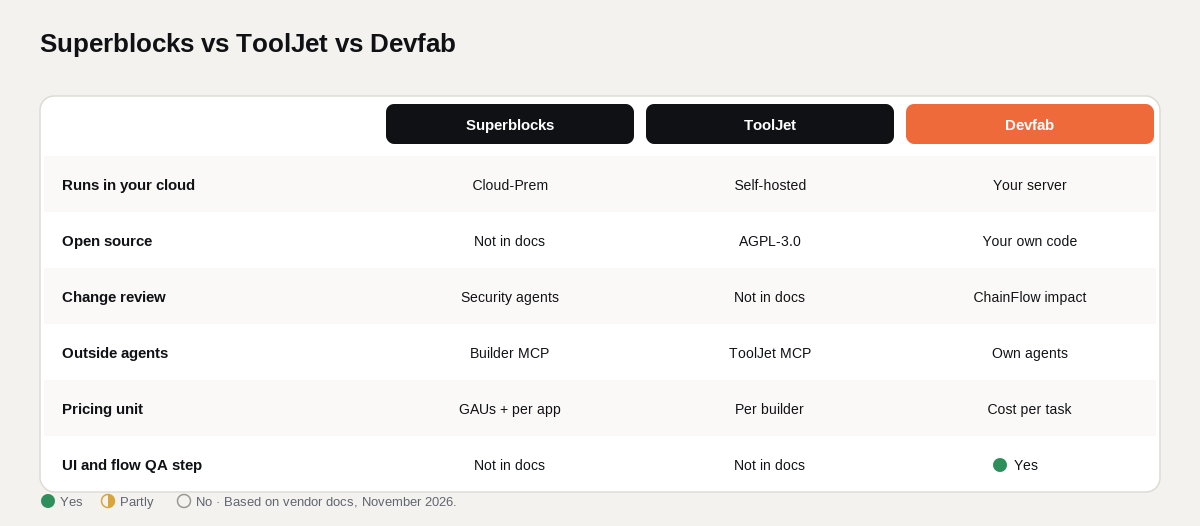
| Where it runs | Superblocks Cloud, Hybrid, or Cloud-Prem in your AWS, GCP or Azure account | ToolJet Cloud, VPC, or self-hosted on Docker, Kubernetes, major clouds or on-prem | Superblocks stack post; ToolJet vs Superblocks (ToolJet) |
| Building | Clark generates an app from chat; refine visually or in the React code | AI Builder creates complete apps, editable in the visual builder | Clark docs; ToolJet blog |
| Outside coding agents | Builder MCP from Claude, Slack, Cursor or ChatGPT; imports prototypes from Lovable, Replit and raw code | ToolJet MCP for Claude Code, Codex, Cursor; no ToolJet AI credits used | Superblocks 3.0; ToolJet vs Superblocks (ToolJet) |
| Review and testing | Security agents and deterministic scanners review each change | Assistant auto-fixes component errors; testing not covered | Superblocks 3.0; ToolJet 2026 post |
| Code and Git | GitHub, GitLab, Bitbucket and Azure DevOps | Git-based workflows, dev and prod environments | Superblocks stack post; ToolJet blog |
| Admin and compliance | RBAC, SSO, always-on audit logs; SOC 2, GDPR, HIPAA-eligible | SSO with SCIM, fine-grained RBAC, OpenTelemetry; SOC 2 Type II, ISO 27001, GDPR | Superblocks stack post; ToolJet 2026 post |
| Model choice | Approved models via Bedrock, Vertex AI, Azure AI, Snowflake Cortex, Databricks | Several model families on paid plans; bring your own key on Enterprise | Superblocks 2.0; ToolJet vs Superblocks (ToolJet) |
| Open source | Not covered in the pages we checked | Community Edition AGPL-3.0; MCP server MIT | ToolJet vs Superblocks (ToolJet) |
| Pricing model | Governed Agent Units plus a charge per published app; no per-seat fees on enterprise license | Per builder, with end-user caps and AI credits | Superblocks billing docs; ToolJet pricing |
Cost model by team size
| Team size | Superblocks | ToolJet |
|---|---|---|
| 1 person | No free tier, per a competitor review; Teams self-serve plan with a GAU pool | Free USD 0: 1 builder, 10 end users, 3 apps, 100 AI credits per month |
| 5 people | Teams plan: org-wide GAU pool with packs, auto-refills and per-user spend limits | Pro USD 79 per month (annual): 5 builders, 50 end users, unlimited apps |
| 25 people | Enterprise dollar-commit contract; GAUs plus a charge per published app, no per-seat fees | Team USD 199 per builder per month billed annually (USD 249 monthly), 100 end users; or Enterprise custom |
ToolJet prices as of November 2026 from ToolJet pricing; extra AI credits cost USD 1 per 100 (minimum 2,000). Superblocks shows no plan prices on its pricing page; the model comes from its billing and self-serve plan docs. A competitor review (Jet Admin, Sep 30, 2026) says VPC deployment, SSO, audit logs and source control are Enterprise-only and GAU refills mean the base subscription may not cap the invoice (Jet Admin).
Where Superblocks wins
- AI inference must stay in your cloud. In-VPC deployment with Bedrock inference is the core of 3.0.
- Every change gets a security review. Security agents, Custom Policy Agents and per-app SBOM and CVE scans.
- Many builders, no seat math. The enterprise license has no per-seat builder or end-user fees.
- Consolidating shadow prototypes. Import prototypes from Claude, ChatGPT, Lovable, Replit and raw code into one approved path.
Where ToolJet wins
- Open source you can read and fork. AGPL-3.0 Community Edition.
- Developers already live in coding agents. ToolJet MCP turns their sessions into governed apps without using ToolJet credits.
- You can start free and self-host. The whole platform self-hosts; workflows and AI agents are listed as self-hosted only.
- Published prices. A few builders serving many staff can work out the bill from the pricing page.
ToolJet has trade-offs too: self-hosting adds DevOps cost, and a competitor review warns AI-built apps may lack input validation and need developer review (Jet Admin).
Switching from one to the other
Neither vendor documents a direct import from the other in the pages we checked. Both connect to the same kinds of databases and APIs, so point the new platform at the existing data first. Moving to Superblocks, use its prototype import for raw code or let Clark rebuild screens from a description. Moving to ToolJet, a coding agent can rebuild screens through ToolJet MCP, then you set RBAC on queries and pages.
Where Devfab fits
Both platforms run internal tools inside their own runtime. The bank's console fits that well. A customer-facing loan portal the bank wants as its own codebase does not.
Coding agents automate the developer. Devfab automates the development lifecycle. A person approves the plan before any tickets exist. ChainFlow maps which functions and APIs call each other and what is deployed, so a change to override rules shows its impact on document checks, notifications and reports before it ships. Code lives in your GitHub account, and Deploy ships to your own server. Devfab is in Beta, with a smaller community and fewer enterprise integrations. See Devfab vs Superblocks and Devfab vs ToolJet.
FAQ
Is ToolJet open source and is Superblocks?
ToolJet's Community Edition is AGPL-3.0 and its MCP server is MIT-licensed, per ToolJet's own comparison page. The Superblocks pages we checked describe a commercial platform with Cloud, Hybrid and Cloud-Prem deployment, not an open-source edition.
Which one keeps AI inference inside our cloud?
Superblocks 3.0, announced August 3, 2026 with AWS, supports in-VPC deployment with Bedrock inference, and approved models from Bedrock, Vertex AI, Azure AI, Snowflake Cortex and Databricks. ToolJet offers bring-your-own-key on Enterprise and air-gapped operation through a self-hosted Enterprise add-on.
How do Superblocks and ToolJet charge?
Superblocks is usage-based: Governed Agent Units for AI work plus a charge per published app, with no per-seat fees on the enterprise license; prices are not listed. ToolJet charges per builder, from Free to USD 199 per builder per month billed annually for Team, as of November 2026.
Can we use Claude Code or Cursor with either one?
Yes. ToolJet MCP lets Claude Code, Codex, Cursor and others create and modify ToolJet apps without using ToolJet AI credits. Superblocks' Builder MCP lets builders iterate from Claude, Slack, Cursor or ChatGPT, and 3.0 imports prototypes from several AI tools.
Read next
Building a customer-facing app you must own as code? Try Beta
Sources (checked November 2026): Superblocks pricing; Superblocks 3.0 (Aug 3, 2026); Announcing Superblocks 2.0 (Apr 15, 2026); The AI-native enterprise tooling stack (Superblocks, Mar 17, 2026); Clark AI docs; Superblocks billing overview; Superblocks self-serve plan; Jet Admin: Superblocks review (competitor, Sep 30, 2026); Meet the new ToolJet (Sep 2, 2026); ToolJet at the start of 2026 (Jan 8, 2026); ToolJet vs Superblocks (ToolJet's own page); ToolJet pricing; Jet Admin: ToolJet vs Retool 2026 (competitor, Jul 27, 2026).
Frequently asked questions
Is ToolJet open source and is Superblocks?
ToolJet's Community Edition is AGPL-3.0 and its MCP server is MIT-licensed, per ToolJet's own comparison page. The Superblocks pages we checked describe a commercial platform with Cloud, Hybrid and Cloud-Prem deployment, not an open-source edition.
Which one keeps AI inference inside our cloud?
Superblocks 3.0, announced August 3, 2026 with AWS, supports in-VPC deployment with Bedrock inference, and approved models from Bedrock, Vertex AI, Azure AI, Snowflake Cortex and Databricks. ToolJet offers bring-your-own-key on Enterprise and air-gapped operation through a self-hosted Enterprise add-on.
How do Superblocks and ToolJet charge?
Superblocks is usage-based: Governed Agent Units for AI work plus a charge per published app, with no per-seat fees on the enterprise license; prices are not listed. ToolJet charges per builder, from Free to USD 199 per builder per month billed annually for Team, as of November 2026.
Can we use Claude Code or Cursor with either one?
Yes. ToolJet MCP lets Claude Code, Codex, Cursor and others create and modify ToolJet apps without using ToolJet AI credits. Superblocks' Builder MCP lets builders iterate from Claude, Slack, Cursor or ChatGPT, and 3.0 imports prototypes from several AI tools.