Short answer: For a mature commercial platform with a free tier, pick Retool. For open source you can self-host without an Enterprise contract, pick ToolJet (closest in AI direction) or Appsmith. For approvals and agents in regulated teams, Budibase. For a custom app you own as code on your own server, Devfab.
You liked the pitch: governed AI app building for the whole company. Then you read the plan details. There's no free tier, and VPC deployment, SSO, audit logs and source control sit on Enterprise. Billing runs on agent units with refills, so the base subscription may not cap the invoice. For a small team, that can be more platform than the job needs.
In this guide, you'll learn:
- Why teams leave Superblocks
- How five alternatives compare
- Verdict, best for and trade-off per tool
- Where Superblocks is still the better choice
Each claim links to a source at the bottom.
Why teams leave Superblocks
Status first. Superblocks is active and growing its enterprise focus. Superblocks 2.0 (April 15, 2026) added agent memory and VPC deployment on AWS. Superblocks 3.0 (August 3, 2026) added an AWS partnership, in-VPC deployment with Bedrock inference, security agents and a Smart Router that sends sub-tasks to different models.
The switching triggers we found:
- No free tier. Jet Admin's review (a competitor, Sep 2026) notes there is no free plan to try before committing.
- Key controls on Enterprise. VPC deployment, SSO, audit logs and source control are Enterprise-only, per the same review.
- Usage billing that can grow. Clark's AI work uses Governed Agent Units, and each published app has a monthly charge. Teams plans have auto-refills and per-user spend limits; Jet Admin warns the base subscription may not cap the invoice.
- Mixed signals in the docs. As of our check, the Clark docs page still says "Clark is currently in private beta," which conflicts with Superblocks' later announcements.
- Built for big organizations. Superblocks says it is "built for both builders and the teams that govern them at scale." Small teams may not need that layer.
Quick comparison
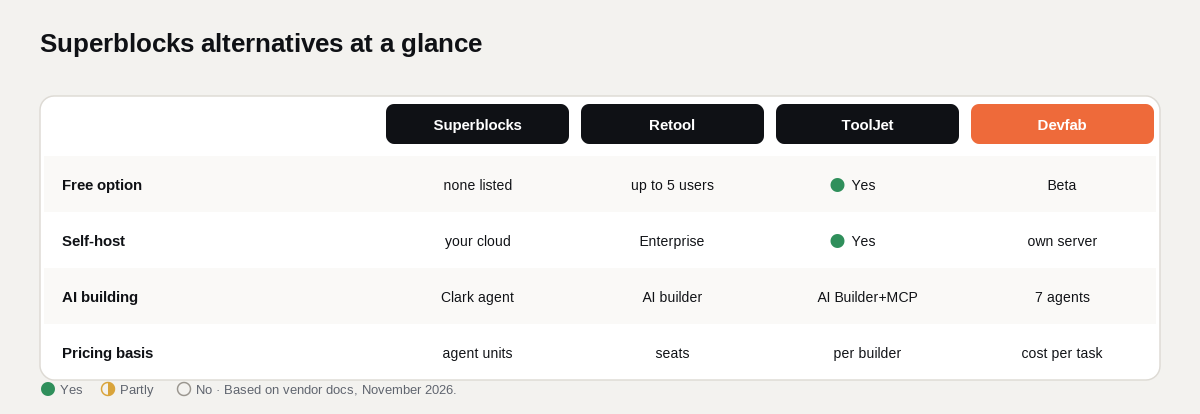
| Tool | Type | Free option | Self-host | AI building | Pricing model |
|---|---|---|---|---|---|
| Superblocks (baseline) | Governed enterprise AI builder | None listed | Hybrid or Cloud-Prem in your cloud | Clark agent, Builder MCP | Agent units plus per published app |
| Retool | Internal-tool and AI app builder | Free tier up to 5 users | Enterprise only | Prompt-first React builder | Per builder and per user, plus AI credits |
| ToolJet | Open-source internal-tool builder | Free tier; free Community Edition | Yes, whole platform | AI Builder; MCP for coding agents | Per builder, with AI credits |
| Appsmith | Open-source internal-tool builder | Free Community edition | Yes, any edition | Ask AI for JS and queries | Free self-hosted; cloud per user |
| Budibase | Open-source apps, automations, agents | Free self-hosted Community plan | Yes, incl. air-gapped | Agents with approval policies | Free self-hosted; Cloud subscription |
| Devfab | AI software factory | Beta | Deploys to your own server | Research, plan, build, QA, deploy | Cost logged per task and per project (Beta) |
The alternatives
1. Retool
Verdict: the most direct swap, with a free tier and a large community. Best for: engineering-led teams building many internal tools on company data. Trade-off: per-seat pricing; Git source control and self-hosting are Enterprise-only. Pricing: free tier up to 5 users; per-seat paid plans with separate builder and internal-user rates; pooled AI credits; agents billed separately by runtime.
- Retool's AI app builder (GA June 17, 2026) writes React and TypeScript you can edit.
- Like Superblocks, it imports prototypes from Lovable, Replit, Cursor and Claude Code and applies central governance.
- Its agent asks for approval before running functions that change data, per Jet Admin's review (Sep 2026).
Head to head: Retool vs Superblocks.
2. ToolJet
Verdict: the closest match in direction, with an open-source core. Best for: security-sensitive teams that self-host and want coding agents to build governed apps. Trade-off: AGPL-3.0 license; workflows and agents are self-hosted only. Pricing: per builder, not per end user; free tier; paid tiers include AI credits per builder; Enterprise custom.
- The "new ToolJet" (September 2026) lets Claude Code, Codex or Cursor build apps through ToolJet MCP, and that path uses no ToolJet AI credits.
- You can self-host the whole platform on Docker, Kubernetes, AWS, Azure, GCP or on-prem.
- It lists SSO with SCIM, fine-grained RBAC, SOC 2 Type II and ISO 27001.
3. Appsmith
Verdict: the budget pick for hand-built internal tools. Best for: teams that want an Apache-2.0 tool they can self-host and modify. Trade-off: thin AI building; Appsmith Agents is Legacy. Pricing: free self-managed Community edition; cloud Free plan capped at 5 users; Business per user; no charge for developers.
- Apps sync to Git for branches, commits and pull requests.
- The Appsmith AI datasource was removed on September 30, 2026.
- Air-gapped editions and managed hosting are Enterprise add-ons.
4. Budibase
Verdict: the open-source answer for governed agents and approvals. Best for: regulated teams that want a human sign-off step built into agent workflows. Trade-off: Cloud action limits are hard monthly limits. Pricing: free self-hosted Community plan with unlimited users, apps and agents (bring your own AI key); Cloud subscription; custom Enterprise.
- Budibase 4.0 (November 10, 2026) added Approval Policies, tool-level permissions and agent audit logs.
- It self-hosts on private cloud, on-premise or air-gapped infrastructure.
- It supports any OpenAI-format model through LiteLLM.
5. Devfab
Verdict: a fit when you need one or a few real applications built well, not a platform for hundreds of builders. Best for: agencies and product teams that want an approved plan, tested code and their own server. Trade-off: no central governance layer and far fewer data connectors. Pricing: predictable cost: cost is logged after each run, per task and per project. Devfab is in Beta.
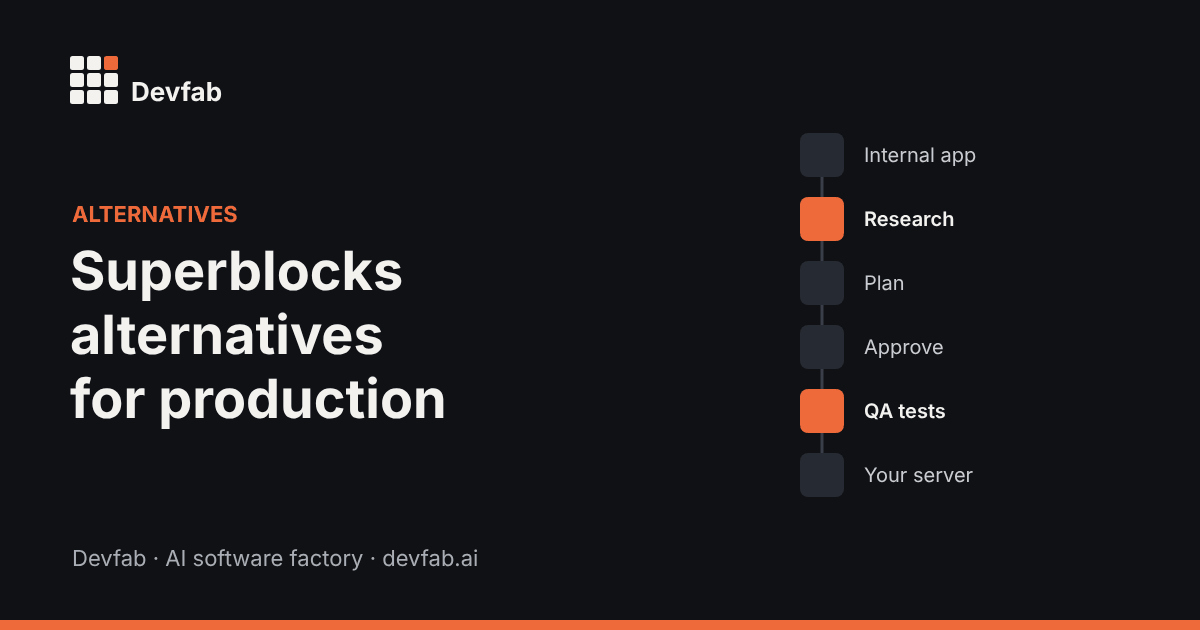
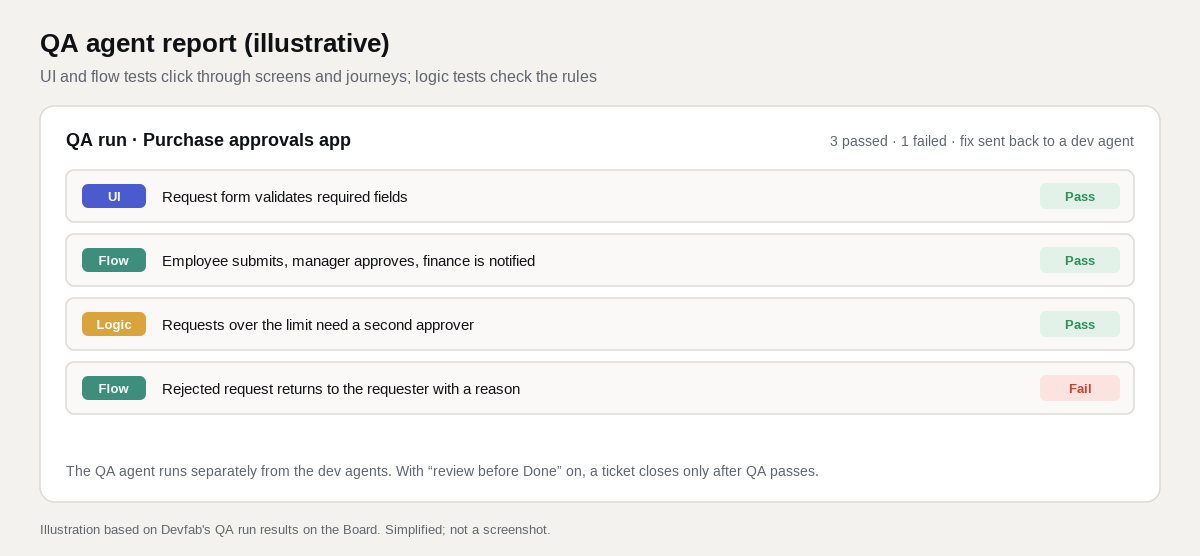
Devfab is an AI software factory. It doesn't host your app or meter builders; it runs the software lifecycle with seven agents. A research step maps the domain before any plan: key terms, best practices and competitors, then suggests a prototype. A Planner writes the plan and a person approves it before tickets are created. Developer agents use ChainFlow, which maps which functions and APIs call each other and what is deployed, so they see the impact of a change. The QA agent runs UI and flow tests (screens, buttons and user journeys clicked end to end) plus logic tests. Code lives in your own GitHub account (or your organization's), and Deploy ships to your own server.
Like Superblocks, you can choose the model for each agent or keep Devfab's default.
Coding agents automate the developer. Devfab automates the development lifecycle.
Devfab's honest limits:
- It's new and in Beta, with a smaller community than any tool here.
- It has no central policy layer, SBOM scanning or security agents like Superblocks 3.0.
- It isn't a visual builder or an editor for hands-on coding.
- It needs a GitHub account, and you run the server.
More: Devfab vs Superblocks.
Where Superblocks is still the better choice
- Security wants everything in your own cloud, including AI inference. Cloud-Prem runs inside your AWS, GCP or Azure account, and 3.0 adds in-VPC Bedrock inference.
- Many semi-technical builders under one policy layer. Clark remembers code policies, design systems and audit rules, and only uses data each builder may see.
- No per-seat fees at scale. The enterprise license has no per-seat builder or end-user fees.
- Consolidating vibe-coded prototypes. 3.0 imports prototypes from Claude, ChatGPT, Lovable, Replit and raw code into one IT-approved path.
- Security review on every change. Security agents and deterministic scanners review each code change, with SBOM and CVE scanning per app.
How to choose
- Want a free tier and a mature platform? Retool.
- Must self-host without an Enterprise contract, and want coding agents to build? ToolJet.
- Hand-built tools, permissive license, smallest budget? Appsmith.
- Agents with human approval in regulated settings? Budibase.
- A few important apps you want to own as tested code? Devfab. Start with What is an AI software factory?
FAQ
Does Superblocks have a free plan?
No free tier is listed. Superblocks has self-serve Teams plans with a pooled agent-unit balance and an Enterprise contract. Retool, ToolJet, Appsmith and Budibase all offer free tiers or free self-hosted editions.
How does Superblocks pricing work?
It's usage-based. AI work by the Clark agent is measured in Governed Agent Units, and each published app has a monthly charge. There are no per-seat builder or end-user fees on the enterprise license. Teams plans can auto-refill agent units.
What is the best self-hosted alternative to Superblocks?
ToolJet, Appsmith and Budibase can all be self-hosted on their free editions. ToolJet is closest in direction, since it now lets coding agents build governed apps through its MCP server.
Is Devfab an enterprise internal-tool platform like Superblocks?
No. Devfab is an AI software factory. It researches, plans, builds, tests and deploys a normal codebase in your own GitHub and on your own server. It has no central policy layer for hundreds of builders.
Read next
Need one app done right, not another platform? Try the Devfab Beta
Sources (checked November 13, 2026): Announcing Superblocks 2.0 (Apr 2026); Superblocks 3.0 (Aug 2026); The AI-native enterprise tooling stack (Superblocks, Mar 2026); Clark AI docs; Superblocks billing overview; Superblocks self-serve plan; Superblocks Review 2026 (Jet Admin, a competitor, Sep 2026); Retool pricing; Retool launches a React AI app builder (Jun 2026); Retool extends governance to vibe-coded apps; Retool Review 2026 (Jet Admin, a competitor, Sep 2026); Meet the new ToolJet (Sep 2026); ToolJet at the start of 2026; ToolJet vs Superblocks (ToolJet); appsmithorg/appsmith on GitHub; Appsmith pricing; Appsmith 2.3; AI datasource EOL (Aug 2026); Budibase pricing; Introducing Budibase 4.0 (Nov 2026); Budibase 2026 roadmap (Dec 2025).
Frequently asked questions
Does Superblocks have a free plan?
No free tier is listed. Superblocks has self-serve Teams plans with a pooled agent-unit balance and an Enterprise contract. Retool, ToolJet, Appsmith and Budibase all offer free tiers or free self-hosted editions.
How does Superblocks pricing work?
It's usage-based. AI work by the Clark agent is measured in Governed Agent Units, and each published app has a monthly charge. There are no per-seat builder or end-user fees on the enterprise license. Teams plans can auto-refill agent units.
What is the best self-hosted alternative to Superblocks?
ToolJet, Appsmith and Budibase can all be self-hosted on their free editions. ToolJet is closest in direction, since it now lets coding agents build governed apps through its MCP server.
Is Devfab an enterprise internal-tool platform like Superblocks?
No. Devfab is an AI software factory. It researches, plans, builds, tests and deploys a normal codebase in your own GitHub and on your own server. It has no central policy layer for hundreds of builders.