Short answer: Cline wins for almost every team in November 2026, because Continue was acquired by Cursor in June 2026 and discontinued, with billing switched off and a July 15 export deadline already past. Continue wins only if you want to fork its Apache-2.0 code and maintain an in-editor assistant yourself.
You run a team on open-source AI in the editor. Two names kept coming up: Cline and Continue. Most comparison pages still treat them as equals. They are not anymore. One of them stopped shipping in June 2026, and its users had to export their data or lose it.
That makes this less of a feature contest and more of a "what now" question. We act as the referee, with vendor pages and dated news checked in November 2026.
In this comparison:
- Cline and Continue at a glance
- Feature comparison
- Where Cline wins
- Where Continue wins
- Switching from one to the other
Read the status section first. It decides most of the rest.
Cline and Continue at a glance
Continue is discontinued. The continue.dev homepage now reads "Continue has joined Cursor" (continue.dev). Cursor bought it around June 16, 2026, with terms undisclosed, and co-founder Nate Sesti is joining Cursor (The New Stack, Jun 22, 2026). Recurring billing was disabled, and users had until July 15, 2026 to export data before deletion (same source). A final 2.0.0 release removed telemetry, and the Apache-2.0 code stays public for anyone to fork (same source).
Before the shutdown, Continue was a VS Code extension, a JetBrains plugin (community-maintained from February 2026) and a CLI called cn for the terminal and CI (Continue blog, Feb 17, 2026). Its cloud product, Mission Control, ran agents in parallel and ran "AI Checks" on every pull request: markdown-defined agents that posted GitHub status checks with suggested diffs (same source). It had about 34,300 GitHub stars when it was sold (The New Stack).
Cline is active. Cline Bot Inc. posted blog updates through November 19, 2026 (Cline blog archive). It is an open-source coding agent that reads and writes files, runs commands and uses a browser, and every action needs your approval (Cline docs). It runs as a VS Code extension, a JetBrains plugin, a CLI (interactive or headless for CI/CD), a desktop app, an SDK and Kanban, a web board that runs many agents at once (same source). In January 2026, OpenAI hired at least seven Cline employees; OpenAI said it was not an acquisition (TEXXR, Jan 29, 2026).
Feature comparison
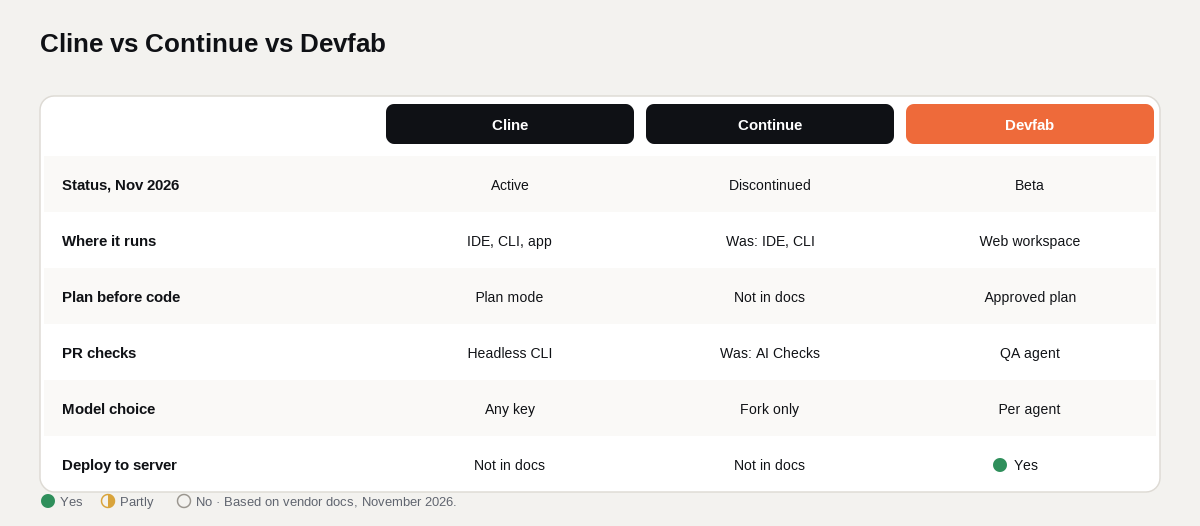
| Aspect | Cline | Continue | Source |
|---|---|---|---|
| Status, November 2026 | Active; releases through 2026 | Discontinued after Cursor bought it (June 2026) | Cline blog; The New Stack |
| Where it runs | VS Code, JetBrains, CLI, desktop app, SDK, Kanban; other editors via ACP | Was: VS Code, JetBrains (community-maintained), cn CLI | Cline docs; Continue blog |
| Planning | Plan mode (read and discuss only), Act mode, /deep-planning, Checkpoints for rollback | Not covered in the pages we checked | Cline Plan & Act |
| Agent autonomy | You approve every action; Kanban runs agents in parallel | Was: Mission Control cloud agents in parallel | Cline docs; Continue blog |
| Checks on pull requests | Headless CLI for CI/CD | Was: AI Checks posting GitHub status checks | Cline docs; Continue blog |
| Deploy and hosting | Not covered in the docs we checked | Not covered in the pages we checked | — |
| Code and license | Extension, CLI and desktop app described as fully open source | Apache-2.0 code public for forking | Cline Desktop post; continue.dev |
| Team and admin | Enterprise: SSO, SLA, RBAC, central billing, team dashboard, auth logs | Was: team permissions in Mission Control | Cline pricing; Continue blog |
| Model choice | Cline billing, ClinePass for open-weight models, or your own key, incl. local runtimes | Fork only; no hosted service | Cline docs |
| Pricing model | Free extension, you pay inference; Enterprise custom | Not applicable; billing disabled | Cline pricing; The New Stack |
Cost model by team size
| Team size | Cline | Continue |
|---|---|---|
| 1 person | Free open-source extension; you pay for inference through Cline billing or your own key | Not sold; a fork costs only your own upkeep and model bills |
| 5 people | Same per developer; no seat fee in the docs we checked | Not sold |
| 25 people | Enterprise on custom pricing for SSO, RBAC, SLA and central billing | Not sold |
Cline's pricing page shows no plan prices as of November 2026: Free for individuals (inference billed separately) and Enterprise on custom terms (Cline pricing). Continue has no pricing page; continue.dev shows only the "joined Cursor" notice.
Where Cline wins
- You need a tool that will get fixes next quarter. Cline shipped CLI 2.0, Kanban, an SDK rebuild, ClinePass, a new harness and a desktop beta during 2026 (Cline blog archive).
- You want to approve each step. Every file edit and command waits for you (Cline docs).
- You want a plan before edits. Plan mode discusses without changing files, and Checkpoints let you roll back (Plan & Act).
- You need the agent in many places: VS Code, JetBrains, the terminal, CI and other editors through ACP.
- Your company wants vendor support. Cline's Enterprise tier lists an SLA, SSO and RBAC (Cline pricing).
Where Continue wins
- You want to own the assistant outright. The Apache-2.0 code is public, and the final release removed telemetry (The New Stack).
- You already customized Continue heavily and have engineers who can keep a fork alive.
- You need an air-gapped assistant with no vendor at all. A fork you host has no outside service to call except the models you pick.
- You want to study its PR-check design. The AI Checks idea (agents defined in markdown that post status checks) is documented in Continue's blog (Continue blog).
For new work, the honest answer is that Continue only wins if you are ready to become its maintainer.
Switching from one to the other
From Continue to Cline. There is no code to move: both work in your own repository. Install Cline in VS Code or JetBrains, or use its CLI. Then pick how you pay for models: Cline billing, ClinePass, or your own key for a cloud provider or a local runtime (Cline docs). If you relied on Continue's AI Checks, plan how to replace them. Cline's headless CLI can run in CI/CD, but a drop-in match for Continue's status checks is not covered in the docs we checked. Any data you kept in Continue's hosted service had to be exported by July 15, 2026.
From Cline to Continue. Only as a fork. Clone the public repo, build the final release, and plan who will patch it when VS Code or model APIs change.
Where Devfab fits
Both tools sit next to a developer in the editor. Neither, in the pages we checked, researches the domain before a plan, sends a project plan to a person for approval, runs a separate QA step, or deploys the app.
Coding agents automate the developer. Devfab automates the development lifecycle. Devfab's Researcher maps key terms, best practices and competitors before the Planner writes a plan. A person approves the plan. The QA agent then runs UI and flow tests, clicking screens and user journeys end to end, plus logic tests. Picture a clinic booking app: the plan, the test report and the deploy to your own server sit in one workspace.
Devfab is in Beta, with a smaller community and fewer integrations, and it is not an editor. Many teams keep Cline for hands-on fixes on the same GitHub repo. See Devfab vs Cline and Devfab vs Continue.
FAQ
Is Continue still available?
No. Cursor acquired Continue around June 16, 2026, and the product was discontinued. Recurring billing was turned off, and users had until July 15, 2026 to export their data before deletion. The continue.dev homepage now reads "Continue has joined Cursor."
Can I still use the Continue extension?
The Apache-2.0 code stays public, and a final 2.0.0 release removed telemetry. You can fork it and maintain it yourself. Nobody at Continue is shipping fixes, and its cloud features such as Mission Control are gone with the hosted service.
Is Cline a good replacement for Continue?
For most Continue users, yes. Cline runs in VS Code, JetBrains, a CLI that also works headless in CI, and a desktop app. It is open source and lets you bring your own model key or run local models, which were the main reasons people picked Continue.
Did Cursor replace Continue with its own product?
The sources we checked say Continue's co-founder joined Cursor and the product was discontinued. They do not describe a Continue feature moving into Cursor. If you want Cursor, treat it as a separate editor with its own plans and pricing.
Read next
- What is an AI software factory?
- Continue alternatives for teams that ship to production (2026)
- Cline alternatives for teams that ship to production (2026)
Moving off Continue? Try a tool that runs the project, not just the editor. Try Beta
Sources (checked November 2026): continue.dev homepage; Cursor acquires Continue (The New Stack, Jun 22, 2026); From Extension to Mission Control (Continue blog, Feb 17, 2026); Cline docs overview; Cline Plan & Act; Cline pricing; Cline blog archive; Cline Desktop announcement (Sep 14, 2026); OpenAI hires seven employees from Cline (TEXXR, Jan 29, 2026).
Frequently asked questions
Is Continue still available?
No. Cursor acquired Continue around June 16, 2026, and the product was discontinued. Recurring billing was turned off, and users had until July 15, 2026 to export their data before deletion. The continue.dev homepage now reads "Continue has joined Cursor."
Can I still use the Continue extension?
The Apache-2.0 code stays public, and a final 2.0.0 release removed telemetry. You can fork it and maintain it yourself. Nobody at Continue is shipping fixes, and its cloud features such as Mission Control are gone with the hosted service.
Is Cline a good replacement for Continue?
For most Continue users, yes. Cline runs in VS Code, JetBrains, a CLI that also works headless in CI, and a desktop app. It is open source and lets you bring your own model key or run local models, which were the main reasons people picked Continue.
Did Cursor replace Continue with its own product?
The sources we checked say Continue's co-founder joined Cursor and the product was discontinued. They do not describe a Continue feature moving into Cursor. If you want Cursor, treat it as a separate editor with its own plans and pricing.