Short answer: Cursor wins for almost every team in 2026, because Cursor acquired Continue in June and discontinued it. A fork of Continue's Apache-2.0 code wins only when you must run an open-source assistant you control, with any model and no vendor, and you have engineers willing to maintain it yourselves.
You searched "Cursor vs Continue," so you may still have Continue installed in VS Code. Here is the news most comparisons missed: Cursor bought Continue, and the product is gone. One camp says just move to Cursor. The other says the open-source code is still there, so fork it. Both are real options with real costs. This page lays them out using sources checked on November 20, 2026.
In this comparison:
- Cursor and Continue at a glance
- Feature comparison
- Cost model by team size
- Where Cursor wins
- Where Continue wins
Start with what happened in June.
Cursor and Continue at a glance
Continue: acquired by Cursor and discontinued. Around June 16, 2026, Continue's homepage announced the acquisition; terms were not disclosed (The New Stack, Jun 22, 2026). The product was discontinued, recurring billing was disabled, and users had until July 15, 2026 to export data before deletion (same source). Today continue.dev shows only the notice "Continue has joined Cursor" and says "our open-source codebase remains freely available as a foundation for others" (continue.dev).
Before the shutdown, Continue was an open-source assistant for VS Code and JetBrains, plus a CLI called cn and a cloud dashboard called Mission Control (Continue blog, Feb 2026). Mission Control ran cloud agents in parallel and "AI Checks," markdown-defined agents that posted GitHub status checks on pull requests (same source). It let developers connect any model, and had about 34,300 GitHub stars at the time of the deal (The New Stack).
Cursor: active, now owned by SpaceX. SpaceX's deal for Anysphere, Cursor's maker, was confirmed on June 16, 2026 (The Next Web), and Cursor's August 14 post says it has "officially been acquired by SpaceX" (Cursor blog). Cursor is an AI code editor plus a coding agent that also runs in a CLI, cloud agents, mobile and SDKs (Cursor docs).
So this is not a fair fight between two products. It is a supported product versus a codebase you would have to adopt.
Feature comparison
| Aspect | Cursor | Continue (fork of final release) | Source |
|---|---|---|---|
| Status | Active; SpaceX-owned | Discontinued; Apache-2.0 code public; final 2.0.0 removed telemetry | Cursor blog; The New Stack |
| Where it runs | Desktop editor, CLI, cloud agents, mobile, SDKs | VS Code extension, JetBrains plugin (community-maintained since Feb 2026), cn CLI | Cursor docs; Continue blog |
| Planning | Plan Mode drafts an editable plan before code | Not covered in the docs we checked | Cursor Plan Mode |
| Agents | Cloud agents in isolated VMs, many in parallel, each on its own branch | Mission Control cloud agents (hosted service, now shut down) | Cursor cloud agents; Continue blog |
| PR review | Bugbot finds bugs and security issues; Autofix pushes fixes | AI Checks posted GitHub status checks (hosted, now shut down) | Cursor Bugbot; Continue blog |
| Deploy and hosting | Not covered in the docs we checked | Not covered in the docs we checked | — |
| Team and admin | SSO on Teams; SCIM, audit logs, model restrictions on Enterprise | None; you build your own | Cursor Enterprise |
| Model choice | Claude, Gemini, GPT, Grok, Cursor Composer and others | Any model you connect | Cursor docs; The New Stack |
| Pricing model | Subscription tiers with a weekly usage pool; third-party models at API list price | No vendor billing; you pay your model provider and your own upkeep | Cursor pricing; continue.dev |
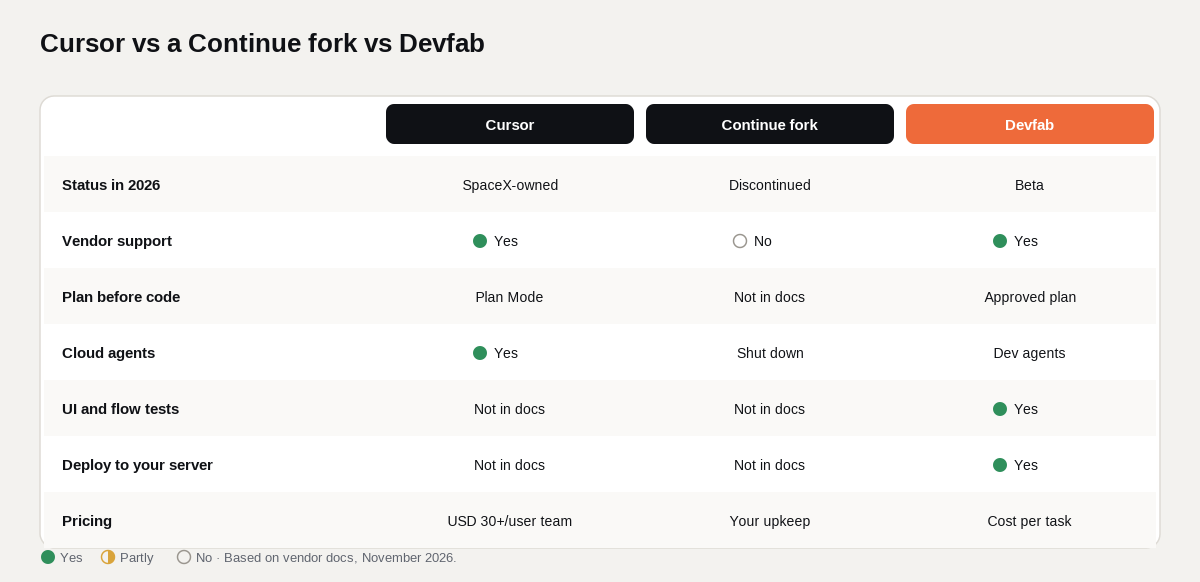
A note on the fork column: the hosted parts of Continue, Mission Control and AI Checks, ran on Continue's service. A fork gives you the extension and CLI code, not a running cloud.
Cost model by team size
| Team size | Cursor | Continue fork | Devfab |
|---|---|---|---|
| 1 person | Free; Plus USD 8 per month (Grok models only); Premium USD 30 per month with cloud agents | No license fee; you pay your model provider | Cost logged per task and per project (Beta) |
| 5 people | Teams USD 30+ per user per month, with SSO | No license fee; someone owns builds, updates and security fixes | Cost logged per task and per project (Beta) |
| 25 people | Teams, or Enterprise (custom) with SCIM, audit logs and spend limits | No license fee; maintenance becomes an internal product | Cost logged per task and per project (Beta) |
Cursor prices as of November 2026 from Cursor pricing; the page says subscriptions are sold through X Subscription Corp. Continue has no pricing page (continue.dev). Devfab offers predictable cost: cost is logged after each run, per task and per project; Devfab is in Beta.
Where Cursor wins
- You want a supported product. Cursor ships updates, security fixes and new models; Continue does not.
- You want agents that run without your laptop. Cloud agents run in isolated VMs and push to their own branches.
- You want a plan before code. Plan Mode asks clarifying questions, researches the codebase and drafts an editable plan.
- You want PR review built in. Bugbot reviews pull requests, and Autofix can push fixes.
- You need SSO and admin controls for a team, which a fork would not give you.
Where Continue wins
- Open source is a hard requirement. The Apache-2.0 code is public and free to fork and modify.
- You want no vendor at all. A fork has no account, no billing and, after the final 2.0.0 release, no telemetry.
- You need any model, including in-house ones, wired into an assistant you control.
- Your developers refuse to switch editors. Continue runs as an extension inside VS Code or JetBrains rather than as a new editor.
Each of these comes with a cost: your team becomes the maintainer.
Switching from one to the other
From Continue to Cursor. Continue ran inside VS Code, and Cursor has a one-click VS Code import that brings over extensions, themes, settings and keybindings (Cursor VS Code migration). Move your Continue rules into Cursor rules or an AGENTS.md file (Cursor docs). Add model keys or pick a plan.
From a Continue install to a fork. Clone the public repository, pin the final release, and decide who reviews dependency updates. Budget for the JetBrains plugin too: it was already community-maintained before the shutdown (Continue blog).
Where Devfab fits
Cursor makes developers faster in the editor, and Continue did the same in open source. Neither, in the pages we checked, researches the domain before planning, routes a project plan to a person for approval, tests user journeys as a separate step or deploys the app.
Coding agents automate the developer. Devfab automates the development lifecycle. Say a dental lab needs an order tracker: clinics submit cases, technicians move them through stages, and clinics get status updates. Devfab's Researcher maps lab terms and how similar trackers work, then suggests a prototype. A person approves the plan. ChainFlow maps which functions and APIs call each other, so a change to case stages shows its effect on clinic notices and invoices. The QA agent clicks through the clinic and technician journeys and runs logic tests. Deploy ships to your own server.
Devfab is in Beta, with a smaller community and fewer integrations. It is not an editor, and it needs a GitHub account; developers can keep Cursor on the same repo. See Devfab vs Cursor and Devfab vs Continue.
FAQ
Is Continue still available?
Not as a product. Continue's homepage now reads 'Continue has joined Cursor'. The product was discontinued, recurring billing was disabled, and users had until July 15, 2026 to export data. The Apache-2.0 code stays public, and a final 2.0.0 release removed telemetry, so anyone can fork it.
Did Cursor add Continue's features?
Nothing public says so. The New Stack's report on the deal includes no statement from Cursor on why it bought Continue or whether Continue features will come to Cursor. It describes the deal as an apparent acqui-hire with the product shut down.
What should Continue users move to?
If you want a supported product, Cursor is the obvious path, since it bought Continue and imports VS Code settings and extensions in one click. If you need open source and any model, fork Continue's code or look at other open-source assistants. If you need the whole delivery process, look at a software factory.
Who owns Cursor now?
SpaceX. Cursor's maker, Anysphere, agreed to an all-stock deal confirmed on June 16, 2026, and Cursor's August 14 post says the acquisition has officially closed. That makes SpaceX the indirect owner of Continue's assets as well.
Read next
Moving off Continue? Try a factory for the whole project. Try Beta
Sources (checked November 2026): continue.dev ("Continue has joined Cursor"); The New Stack: Cursor acquires Continue (Jun 22, 2026); Continue blog: From Extension to Mission Control (Feb 17, 2026); Cursor docs; Cursor pricing; Cursor Plan Mode; Cursor cloud agents; Cursor Bugbot; Cursor Enterprise; Cursor VS Code migration; Cursor blog: Joining SpaceX; The Next Web: SpaceX makes its Cursor takeover official.
Frequently asked questions
Is Continue still available?
Not as a product. Continue's homepage now reads 'Continue has joined Cursor'. The product was discontinued, recurring billing was disabled, and users had until July 15, 2026 to export data. The Apache-2.0 code stays public, and a final 2.0.0 release removed telemetry, so anyone can fork it.
Did Cursor add Continue's features?
Nothing public says so. The New Stack's report on the deal includes no statement from Cursor on why it bought Continue or whether Continue features will come to Cursor. It describes the deal as an apparent acqui-hire with the product shut down.
What should Continue users move to?
If you want a supported product, Cursor is the obvious path, since it bought Continue and imports VS Code settings and extensions in one click. If you need open source and any model, fork Continue's code or look at other open-source assistants. If you need the whole delivery process, look at a software factory.
Who owns Cursor now?
SpaceX. Cursor's maker, Anysphere, agreed to an all-stock deal confirmed on June 16, 2026, and Cursor's August 14 post says the acquisition has officially closed. That makes SpaceX the indirect owner of Continue's assets as well.