Short answer: Trae wins for individual developers who want a free or low-cost AI IDE with an autonomous SOLO mode and are happy to drive the work. Kiro wins for teams that want written requirements, design and tasks before code, published per-seat prices, and identity and policy managed through AWS.
You want an AI IDE that does more than autocomplete. Two names keep coming up, and they come from very different companies. One is ByteDance's. The other is built and run by AWS.
Trae fans like the price and the autonomous mode. Kiro fans like that every feature starts as a spec. This page puts both on the same checklist, using vendor pages and dated reviews checked in November 2026.
In this comparison:
Start with Trae's status; it affects what you'd be buying.
Trae and Kiro at a glance
Trae's product name is moving. The international site presents two products, TraeCode for coding and TraeWork, a work assistant (Trae). On October 9, 2026, ByteDance merged them into one TRAE app and shut the standalone TraeWork service on October 23; TechNode's report cites Chinese docs, so the scope may be China-only (TechNode, Oct 10, 2026). A Bloomberg-sourced report said ByteDance plans to fold Trae into Doubao (AI Weekly, Aug 24, 2026).
Trae is ByteDance's AI coding environment, with an IDE mode for hands-on work and SOLO mode for autonomous tasks (diyai.io review, Aug 2026). Enterprises buy TRAE Enterprise through BytePlus (BytePlus).
Kiro is active and shipping often. Built and run by AWS, Kiro comes as an IDE, CLI, Web, Mobile and Crew, persistent background agents (Kiro). November 2026 releases include Kiro Crew LTS, an Enterprise Management preview and Kiro Mobile for Android (Kiro changelog). It is for developers and teams "from quick fixes to larger projects."
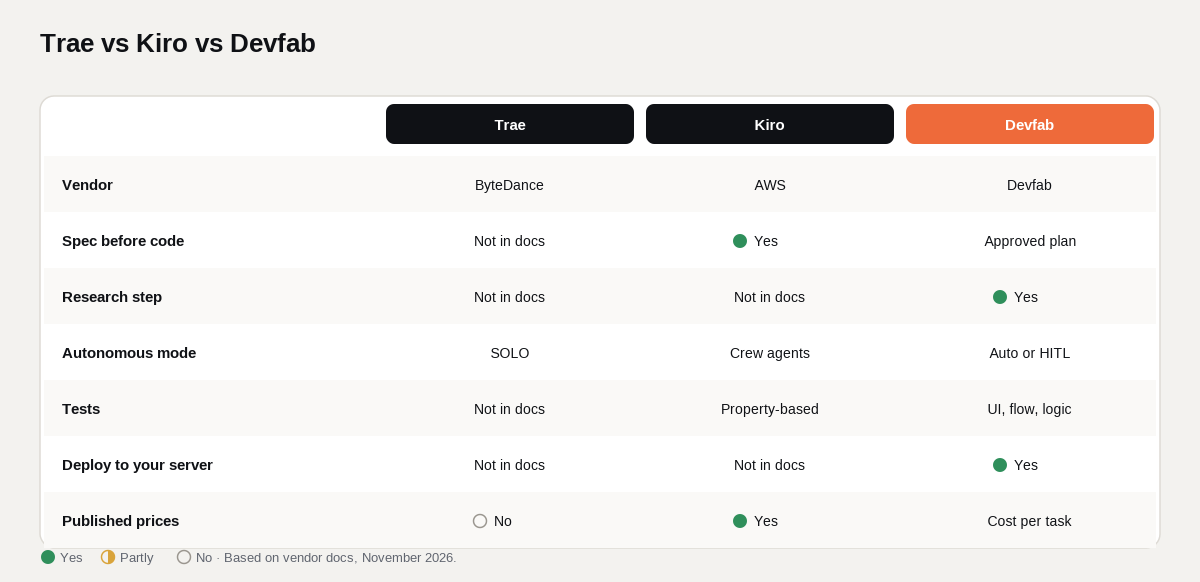
Feature comparison
| Aspect | Trae | Kiro | Source |
|---|---|---|---|
| Where it runs | TraeCode and TraeWork apps, TraeWork Web; merged TRAE app on desktop, web and mobile | IDE, CLI, Web, Mobile, Crew background agents | Trae; TechNode; Kiro |
| Planning and specs | Not covered as a spec step in the pages we checked | requirements.md, design.md and tasks.md per spec; each phase before the next | Kiro spec docs |
| Agent autonomy | SOLO mode; up to 200 tool calls per session, per a review citing Trae docs | Crew agents; cloud sessions with parallel agents | diyai.io; Kiro |
| Testing | Not covered in the pages we checked | Specs verified with property-based tests | Kiro |
| Automation | Not covered in the pages we checked | Agent hooks on file save, tool use and stop | Kiro hooks |
| Deploy and hosting | Not covered in the pages we checked | Not covered in the pages we checked | — |
| Team and admin | Enterprise: rules, knowledge bases, spend caps, roles, SSO, audit logs; VPC "coming soon" | SSO, credit pooling, per-user limits; Enterprise via AWS IAM Identity Center or external IdP | BytePlus; Kiro pricing |
| Model choice | Enterprise: frontier third-party models or your own custom models | Claude, GPT, open-weight models such as DeepSeek and Qwen, or Auto routing | BytePlus; Kiro |
| Pricing model | Free start; token-based usage from a monthly allowance (per review); enterprise via BytePlus sales | Credits: free tier, paid individual tiers, Teams per seat with pooled credits | Trae pricing; Kiro pricing |
Cost model by team size
| Team size | Trae | Kiro |
|---|---|---|
| 1 person | Free to start; upgrade to raise limits (no prices shown on the official page) | Free USD 0 (50 credits); Pro USD 20 per user per month (1,000 credits); Pro+ USD 40; Pro Max USD 100; Power USD 200 |
| 5 people | Individual plans per developer, or TRAE Enterprise through BytePlus | Teams USD 20 per seat per month, 500 credits per seat, pooled |
| 25 people | TRAE Enterprise, quoted by BytePlus sales | Teams, or Enterprise with AWS IAM Identity Center (no free tier for Enterprise) |
Kiro prices as of November 2026 from Kiro pricing. Trae's pricing page shows no plan prices; it points to docs and to BytePlus for enterprise.
Where Trae wins
- You want a low-cost start. Trae begins free and scales by usage.
- You want an autonomous mode inside the IDE. SOLO handles tasks while you watch, and IDE mode is there for hands-on edits.
- You want to follow work from a phone. The merged TRAE app lets you start on a computer and check from mobile, per TechNode.
- Your company is in the BytePlus ecosystem and wants org-wide spend caps and a productivity dashboard.
Where Kiro wins
- You want the plan written down first. Specs produce requirements, design and tasks before code.
- You want tests tied to requirements. Kiro verifies specs with property-based tests.
- Your identity and policy live in AWS. Enterprise uses IAM Identity Center, and Enterprise Management applies one policy across IDE, CLI, Web and Crew.
- You need published, per-seat prices to plan a budget.
- Privacy defaults matter. A Trae review notes files may be uploaded for embeddings and chats "may be used for analytics" when Privacy Mode is off (diyai.io).
Switching from one to the other
From Trae to Kiro. Open the same repo in Kiro and write a spec for your next feature instead of a prompt. Kiro supports MCP, AGENTS.md, Skills and Open VSX extensions (Kiro), so keep shared instructions in AGENTS.md.
From Kiro to Trae. Keep the spec files in the repo as plain Markdown; they stay readable as context. Watch the SOLO limits: a review says tasks can stop on context limits, permissions or usage exhaustion. More options: Trae alternatives and Kiro alternatives.
Where Devfab fits
Kiro writes a spec for a feature. Trae runs a task in SOLO mode. Both still assume a developer drives each piece in their own IDE.
Coding agents automate the developer. Devfab automates the development lifecycle. Before any plan, Devfab's Researcher maps the domain: key terms, best practices and competitors for, say, a clinic booking app, then suggests a prototype. The Planner writes the project plan, a person approves it, and the QA agent clicks through screens and user journeys and runs logic tests. Devfab is in Beta, needs a GitHub account and is not an editor. See Devfab vs Kiro and Devfab vs Trae.
FAQ
Is Trae being renamed or merged?
Its branding is in flux. On October 9, 2026, ByteDance merged TraeWork and TraeCode into one TRAE app, per TechNode, which cites Chinese docs, so the change may be China-only. A Bloomberg-sourced report from August 2026 said ByteDance plans to fold Trae into Doubao. The international site still offers TraeCode and TraeWork downloads.
What are Kiro specs?
A Kiro spec generates three files: requirements.md with user stories and EARS-format acceptance criteria, design.md with architecture and sequence diagrams, and tasks.md with trackable tasks. Each phase is completed before the next one starts.
Which is cheaper, Trae or Kiro?
Kiro publishes prices: as of November 2026, a free tier with 50 credits, Pro at USD 20 per user per month and Teams at USD 20 per seat per month with pooled credits. Trae's pricing page shows no plan prices; it says to start free and upgrade to increase limits.
Which is safer for regulated teams?
Kiro, on the evidence we found. Enterprise requires AWS IAM Identity Center or an external identity provider and adds AWS-console policy. A Trae review notes files may be uploaded to build embeddings and some telemetry remains with privacy controls on. TRAE Enterprise lists SOC 2 Type 2, SSO and audit logs.
Read next
- What is an AI software factory?
- Trae alternatives
- Kiro alternatives
- AI software factory vs AI coding tools
Want research and an approved plan before any code? Try Beta
Sources (checked November 2026): Trae homepage; Trae pricing; TRAE Enterprise (BytePlus); diyai.io: TRAE AI Review 2026 (updated Aug 24, 2026); TechNode (Oct 10, 2026); AI Weekly (Aug 24, 2026); Kiro home; Kiro pricing; Kiro spec concepts; Kiro hooks; Kiro changelog.
Frequently asked questions
Is Trae being renamed or merged?
Its branding is in flux. On October 9, 2026, ByteDance merged TraeWork and TraeCode into one TRAE app, per TechNode, which cites Chinese docs, so the change may be China-only. A Bloomberg-sourced report from August 2026 said ByteDance plans to fold Trae into Doubao. The international site still offers TraeCode and TraeWork downloads.
What are Kiro specs?
A Kiro spec generates three files: requirements.md with user stories and EARS-format acceptance criteria, design.md with architecture and sequence diagrams, and tasks.md with trackable tasks. Each phase is completed before the next one starts.
Which is cheaper, Trae or Kiro?
Kiro publishes prices: as of November 2026, a free tier with 50 credits, Pro at USD 20 per user per month and Teams at USD 20 per seat per month with pooled credits. Trae's pricing page shows no plan prices; it says to start free and upgrade to increase limits.
Which is safer for regulated teams?
Kiro, on the evidence we found. Enterprise requires AWS IAM Identity Center or an external identity provider and adds AWS-console policy. A Trae review notes files may be uploaded to build embeddings and some telemetry remains with privacy controls on. TRAE Enterprise lists SOC 2 Type 2, SSO and audit logs.