Short answer: If ToolJet's AGPL license is the issue, pick Appsmith (Apache-2.0). If you're tired of running the servers, pick Retool on its cloud. For approval-heavy agents, Budibase. For governed AI building inside your own cloud, Superblocks. If you want a custom app as code you own, Devfab.
You chose ToolJet for open source and self-hosting. Then legal asked about AGPL-3.0. Then you found that workflows and AI agents are self-hosted only, so your team now runs the platform. A competitor's review says ToolJet is production-ready only "with proper DevOps practices." That's fair for many teams. It's a real cost for others.
In this guide, you'll learn:
- Why teams leave ToolJet
- How five alternatives compare
- What each alternative is best for
- Where ToolJet is still the better choice
- How to choose
Here's how each one compares.
Why teams leave ToolJet
Status first. ToolJet is active and shifting fast. In January 2026 its CEO described a move "from low-code to an AI-native enterprise platform." On September 2, 2026 it launched the "new ToolJet," which lets coding agents build governed internal tools through ToolJet MCP.
The switching triggers we found:
- AGPL-3.0 license. The Community Edition is AGPL-3.0, per ToolJet's own comparison page. Some legal teams prefer permissive licenses such as Apache-2.0.
- Key features need self-hosting. ToolJet lists workflows and AI agents as self-hosted only, and air-gapped operation needs a Self-hosted Enterprise add-on.
- DevOps effort. Jet Admin (a competitor, Jul 2026) says self-hosting adds infrastructure cost and is production-ready only "with proper DevOps practices."
- AI-built apps still need review. The same review says AI-built apps may lack input validation and need developer review.
- Paid gates. Builder bring-your-own-key for AI is Enterprise-only, and ToolJet's docs label GitSync a Team plan feature.
Quick comparison
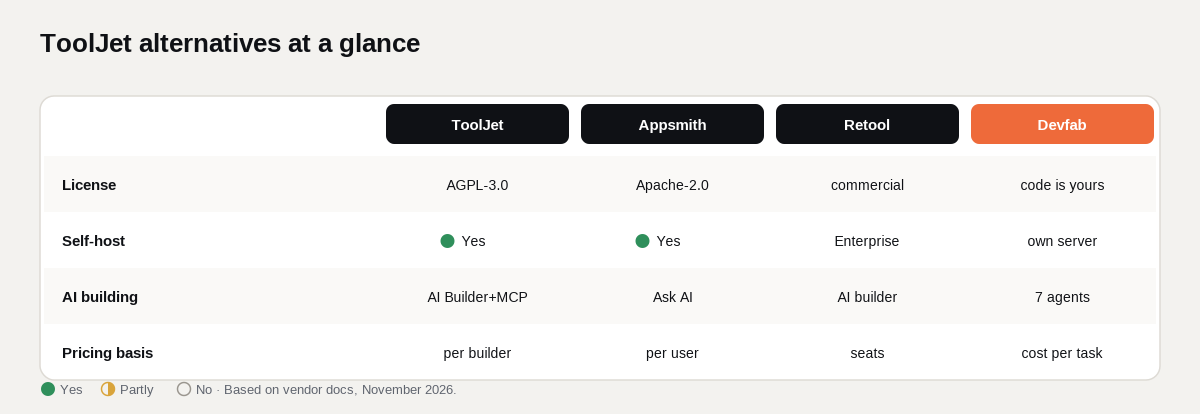
| Tool | Type | License | Self-host | AI building | Pricing model |
|---|---|---|---|---|---|
| ToolJet (baseline) | Open-source internal-tool builder | AGPL-3.0 core | Yes, whole platform | AI Builder; MCP for coding agents | Per builder, with AI credits |
| Appsmith | Open-source internal-tool builder | Apache-2.0 | Yes, any edition | Ask AI for JS and queries | Free self-hosted; cloud per user |
| Retool | Internal-tool and AI app builder | Commercial | Enterprise only | Prompt-first React builder | Per builder and per user, plus AI credits |
| Budibase | Open-source apps, automations, agents | GPL v3 core; paid features BSL | Yes, incl. air-gapped | Agents with approval policies | Free self-hosted; Cloud subscription |
| Superblocks | Governed enterprise AI builder | Commercial | Hybrid or Cloud-Prem | Clark agent | Agent units plus per published app |
| Devfab | AI software factory | Your app's code is yours | Deploys to your own server | Research, plan, build, QA, deploy | Cost logged per task and per project (Beta) |
The alternatives
1. Appsmith
Verdict: the best swap if the license is the problem. Best for: teams that want a permissively licensed internal-tool builder they can self-host and modify. Trade-off: less AI building than ToolJet; Appsmith Agents is Legacy. Pricing: free self-managed Community edition; cloud Free plan capped at 5 users; Business per user; Enterprise flat base fee. No charge for developers.
- Apache-2.0, about 41k GitHub stars; self-host via Docker, Kubernetes or an AWS AMI.
- Git sync for branches, commits, pull requests and merges.
- Appsmith 2.3 (August 2026) added Ask AI to Community Edition; the Appsmith AI datasource was removed on September 30, 2026.
- G2 reviewers quoted by Superblocks (a competitor, Sep 2026) say it "can be slow or buggy at times" on data-heavy apps.
2. Retool
Verdict: the pick if you want someone else to run the platform. Best for: engineering teams that want a mature cloud platform and strong governance. Trade-off: per-seat pricing; self-hosting moves you to Enterprise. Pricing: free tier up to 5 users; per-seat plans with separate builder and internal-user rates; pooled AI credits; Enterprise custom.
- AI app builder (GA June 17, 2026) writes React and TypeScript that you can edit.
- Permissions attach to data sources and are enforced wherever an app was built.
- In October 2026 Retool made bring-your-own AI key Enterprise-only, which drew forum complaints.
Head to head: Retool vs ToolJet.
3. Budibase
Verdict: the open-source pick for approvals, requests and agents. Best for: regulated IT teams that want human sign-off rules in agent workflows. Trade-off: Cloud action allowances are hard monthly limits. Pricing: free self-hosted Community plan with unlimited users and apps (bring your own AI key); Cloud subscription; custom Enterprise.
- Budibase 4.0 (November 10, 2026) added Approval Policies, agent audit logs and approvals in Slack and Teams.
- Self-hosts on Docker, Kubernetes, DigitalOcean or Portainer, including air-gapped.
- LiteLLM support for any OpenAI-format model.
4. Superblocks
Verdict: the enterprise pick when everything, including AI inference, must stay in your cloud. Best for: large organizations with many semi-technical builders. Trade-off: no free tier; VPC, SSO, audit logs and source control are Enterprise-only. Pricing: usage-based Governed Agent Units plus a charge per published app; no per-seat fees on the enterprise license.
- Builder MCP lets builders iterate from Claude, Slack, Cursor or ChatGPT, similar to ToolJet's MCP direction.
- Superblocks 3.0 added security agents and SBOM and CVE scanning per app.
- It deploys as Cloud, Hybrid or Cloud-Prem in your AWS, GCP or Azure account.
5. Devfab
Verdict: a fit when the tool has become an application, and you want code and servers you control without running a platform. Best for: agencies and product teams that want an approved plan, tested code and their own server. Trade-off: no visual builder and far fewer data connectors. Pricing: predictable cost: cost is logged after each run, per task and per project. Devfab is in Beta.
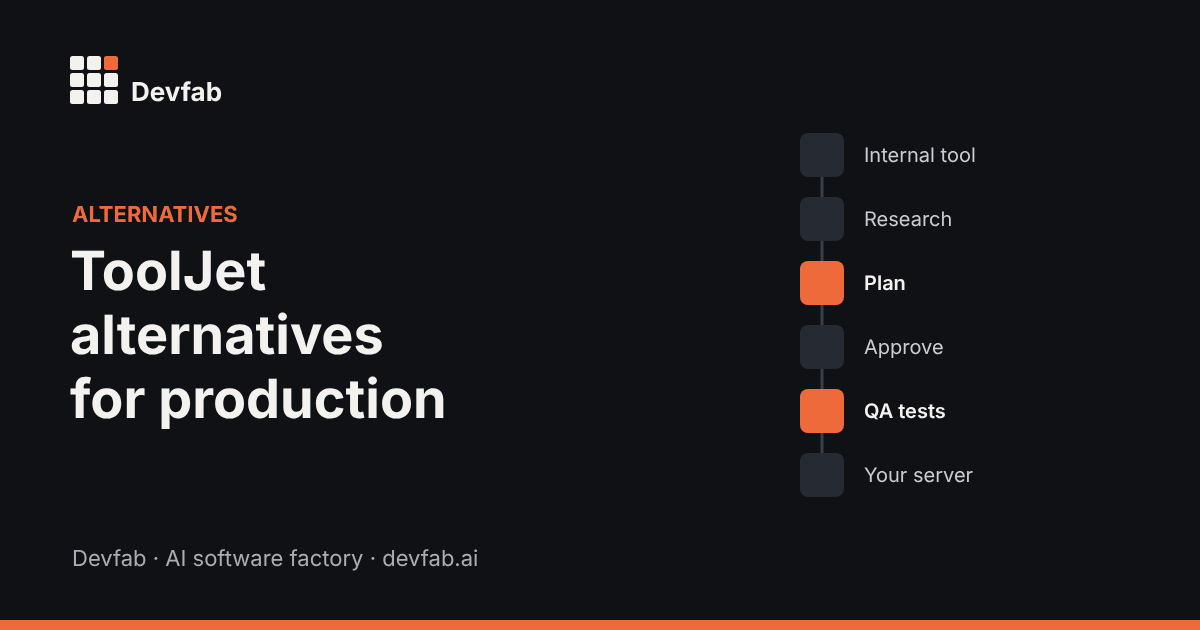
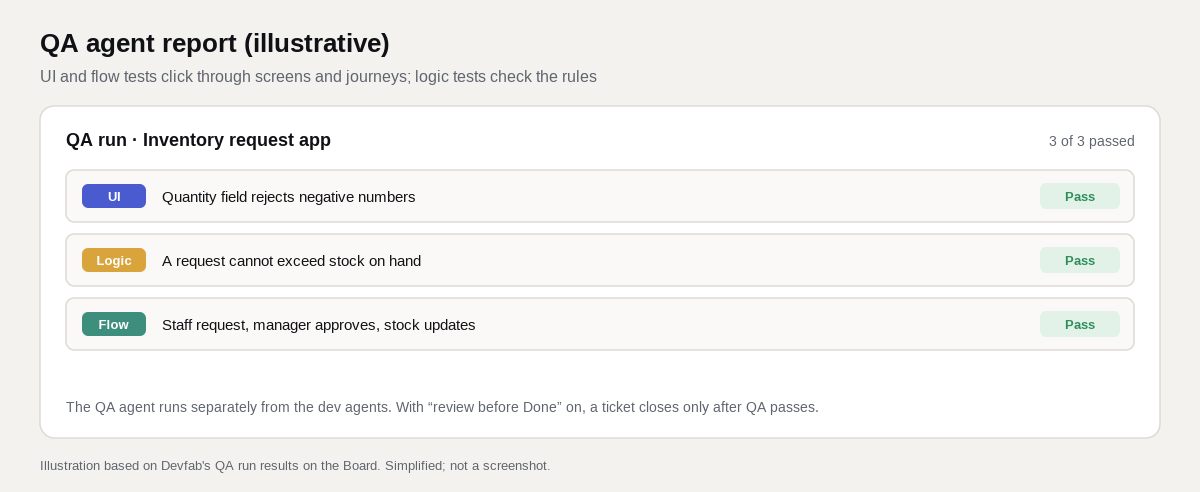
ToolJet's MCP lets your coding agent build inside ToolJet. Devfab takes a different route: it runs the whole lifecycle and hands you a normal codebase. A research step maps the domain before the plan: key terms, best practices and competitors, then suggests a prototype. A person approves the plan. Developer agents build with ChainFlow, which maps which functions and APIs call each other and what is deployed, so a change doesn't break connected features. The QA agent runs UI and flow tests (screens, buttons and user journeys clicked end to end) plus logic tests; logic tests are where missing input validation should show up. Code lives in your own GitHub account (or your organization's), and Deploy ships to your own server. There's no platform runtime to self-host.
Coding agents automate the developer. Devfab automates the development lifecycle.
Devfab's honest limits:
- It's new and in Beta, with a smaller community than ToolJet's open-source project.
- It has far fewer ready-made integrations than ToolJet's 100+.
- No drag-and-drop canvas, and it isn't an editor for hands-on coding.
- It needs a GitHub account, and you still run the server the app deploys to.
More detail: Devfab vs ToolJet.
Where ToolJet is still the better choice
- You want your own coding agent, but a governed runtime. ToolJet MCP lets Claude Code, Codex or Cursor build apps, and a Governance MCP manages permissions from agents.
- Self-hosting the whole platform. Docker, Kubernetes, AWS, Azure, GCP or on-prem, positioned for security-sensitive environments.
- Many end users, few builders. Pricing is per builder, not per end user.
- Building over MCP costs no ToolJet AI credits. You pay your own agent's provider instead.
- Enterprise controls. SSO with SCIM, fine-grained RBAC on queries, components and pages, OpenTelemetry, SOC 2 Type II and ISO 27001.
How to choose
- License is the blocker? Appsmith.
- Don't want to run servers? Retool Cloud.
- Approvals and agents with human sign-off? Budibase.
- Large enterprise, everything inside your cloud account? Superblocks.
- A real application, tested, in your GitHub, on your server? Devfab. See What is an AI software factory? and Internal tool builder vs custom app.
FAQ
What license is ToolJet under?
ToolJet's Community Edition is AGPL-3.0, according to ToolJet's own comparison page, and its MCP server is MIT-licensed. Appsmith uses the more permissive Apache-2.0 license.
Which ToolJet features need self-hosting?
ToolJet's own comparison page lists workflows and AI agents as self-hosted only, and air-gapped operation needs a Self-hosted Enterprise add-on. Builder bring-your-own-key for AI models is an Enterprise feature.
Can coding agents like Claude Code build ToolJet apps?
Yes. Since September 2026, ToolJet MCP lets coding agents such as Claude Code, Codex or Cursor create, inspect and modify ToolJet apps, and building that way uses no ToolJet AI credits.
When should I use Devfab instead of ToolJet?
When the app is no longer a set of internal screens but a product with its own rules and users, and you want it as tested code in your own GitHub, deployed to your own server, with no platform runtime.
Read next
- What is an AI software factory?
- Devfab vs ToolJet
- Retool vs ToolJet
- Internal tool builder vs custom app
Want the app without running the platform? Try the Devfab Beta
Sources (checked November 13, 2026): Meet the new ToolJet (Sep 2026); ToolJet at the start of 2026 (Jan 2026); ToolJet vs Superblocks (ToolJet's comparison and pricing page); ToolJet GitSync docs; ToolJet vs Retool 2026 (Jet Admin, a competitor, Jul 2026); appsmithorg/appsmith on GitHub; Appsmith pricing; Appsmith Agents (Legacy); Appsmith 2.3; AI datasource EOL (Aug 2026); Appsmith Review 2026 (Superblocks, a competitor, Sep 2026); Retool pricing; Retool launches a React AI app builder (Jun 2026); Retool extends governance to vibe-coded apps; Retool Forum: BYOK gating (Oct 2026); Budibase pricing; Introducing Budibase 4.0 (Nov 2026); Budibase on GitHub; Budibase 2026 roadmap (Dec 2025); Superblocks 3.0 (Aug 2026); Superblocks billing overview; Superblocks Review 2026 (Jet Admin, a competitor, Sep 2026).
Frequently asked questions
What license is ToolJet under?
ToolJet's Community Edition is AGPL-3.0, according to ToolJet's own comparison page, and its MCP server is MIT-licensed. Appsmith uses the more permissive Apache-2.0 license.
Which ToolJet features need self-hosting?
ToolJet's own comparison page lists workflows and AI agents as self-hosted only, and air-gapped operation needs a Self-hosted Enterprise add-on. Builder bring-your-own-key for AI models is an Enterprise feature.
Can coding agents like Claude Code build ToolJet apps?
Yes. Since September 2026, ToolJet MCP lets coding agents such as Claude Code, Codex or Cursor create, inspect and modify ToolJet apps, and building that way uses no ToolJet AI credits.
When should I use Devfab instead of ToolJet?
When the app is no longer a set of internal screens but a product with its own rules and users, and you want it as tested code in your own GitHub, deployed to your own server, with no platform runtime.