Short answer: Retool wins when you want a prompt-first builder that writes React and TypeScript, managed workflows, and governance for apps imported from other AI tools. ToolJet wins when you want an AGPL open-source core you can self-host, pricing per builder rather than per end user, and your own coding agents building apps through its MCP server.
Your developers already use a coding agent every day. Your company still needs internal tools with permissions, audit logs and SSO. In 2026 both Retool and ToolJet decided to meet that team where it is. Retool built a React AI builder and a governance layer for apps made elsewhere. ToolJet rebuilt itself so Claude Code, Codex or Cursor can build governed apps over MCP. Both sell the same promise; the details differ a lot. Here is a fair look.
In this comparison:
- Retool and ToolJet at a glance
- Feature comparison
- Cost model by team size
- Where Retool wins and where ToolJet wins
- Switching from one to the other
Use the table first, then the win lists.
Retool and ToolJet at a glance
Retool builds internal apps, workflows and agents on top of company data. Status: its React-based AI app builder became generally available on June 17, 2026. It is "optimized for prompt-first workflows"; apps are written in React on the frontend and TypeScript on the backend. You can also build through Retool's MCP server or CLI and import apps from Lovable, Replit, Cursor, Codex, Kiro or Claude Code, which then inherit central auth, role-based access and data policies. Retool runs on Retool Cloud, in your VPC or on-prem.
ToolJet is an open-source internal-tool platform. Status: on September 2, 2026, it announced the "new ToolJet," built so you can "Build apps from your own coding agents (Claude Code, Codex, Grok Build, Cursor, etc)." ToolJet MCP lets agents create, inspect and modify apps, and a Governance MCP manages permissions. Its AI Builder "can create complete business applications" across "100+ integrations," and every generated app stays editable in the visual builder. ToolJet positions itself as "Designed for self-hosted, security-sensitive environments."
Feature comparison
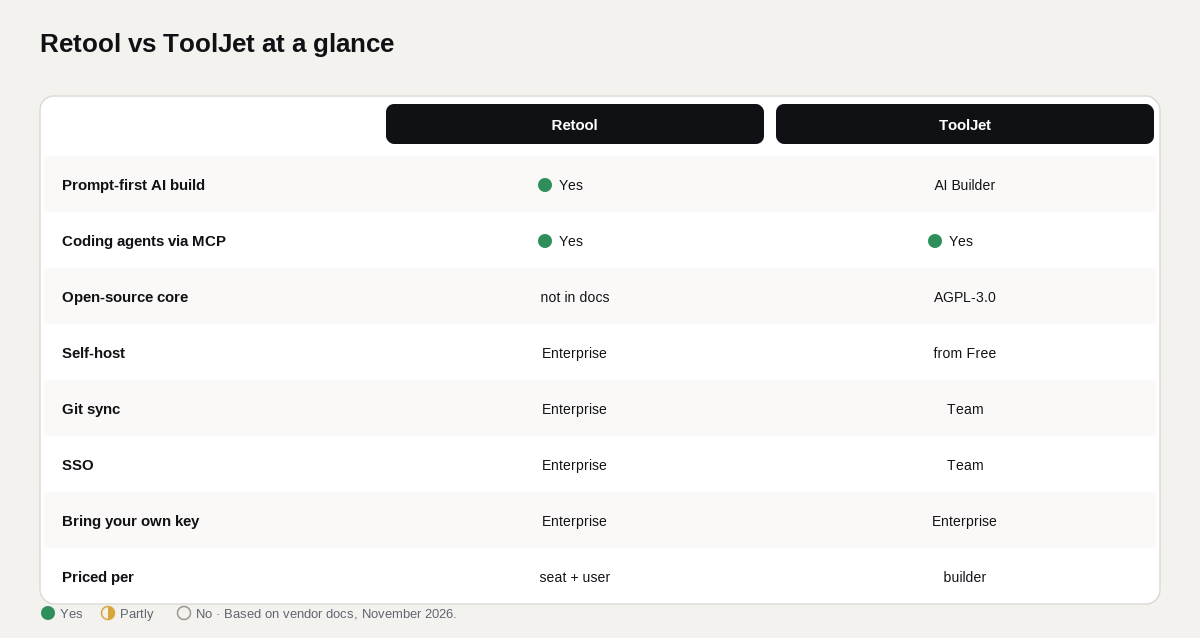
| Aspect | Retool | ToolJet | Source |
|---|---|---|---|
| Where it runs | Retool Cloud, your VPC or on-prem | ToolJet Cloud, VPC or self-hosted on Docker, Kubernetes, AWS, Azure, GCP or on-prem | Retool launch · ToolJet vs Superblocks (ToolJet) |
| How you build | Prompt-first AI builder; Code tab with the React | AI Builder plus visual builder; AI assistant reads API specs and fixes component errors | Retool launch · ToolJet 2026 |
| Your own coding agent | Build through Retool's MCP server or CLI; import from Claude Code and others | ToolJet MCP for Claude Code, Codex, Grok Build, Cursor; Governance MCP | Retool governance · New ToolJet |
| Workflows | Schedules, webhooks, versioned releases, run history | Scheduled and event-driven, NPM libraries; self-hosted only | Jet Admin: Retool review · ToolJet vs Superblocks |
| Environments / Git | Team adds staging; Git source control on Enterprise | Dev and prod environments; Git sync on Team | Retool pricing · ToolJet vs Retool (ToolJet) |
| SSO / admin | SSO, SCIM, granular roles on Enterprise; audit logs from Business | SAML, OIDC and LDAP from Team; SCIM, fine-grained RBAC on queries and pages on Enterprise | Retool pricing · ToolJet vs Retool · ToolJet 2026 |
| Open source | Not covered in the docs we checked | Community Edition AGPL-3.0; MCP server MIT | ToolJet vs Superblocks |
| Model choice | Retool-managed Anthropic and OpenAI; bring your own key on Enterprise | Several model families on paid plans; bring your own key on Enterprise | Retool models · ToolJet vs Superblocks |
| Pricing model | Per seat (builder and internal-user rates), AI credits, metered workflows and agents | Per builder, not per end user; AI credits per builder | Retool pricing · ToolJet 2026 |
Cost model by team size
| Team size | Retool | ToolJet | Devfab |
|---|---|---|---|
| 1 person | Free tier for up to 5 users, production only | Free tier; self-hosting available from Free | Cost logged per task and per project (Beta) |
| 5 people | Team plan per seat, with builder and internal-user rates | Team plan per builder; end users included up to a plan limit; Git sync, SSO and audit logs | Cost logged per task and per project (Beta) |
| 25 people | Business for audit logs, or Enterprise for SSO, SCIM, Git and self-hosting | Enterprise (custom): SCIM, fine-grained RBAC, bring your own key, air-gapped add-on | Cost logged per task and per project (Beta) |
The biggest difference shows up when many people use the tools and few build them. ToolJet charges per builder; Retool charges for internal users too. ToolJet also says building through Claude Code or Codex over its MCP uses no ToolJet AI credits, and claims Retool's MCP path consumes Retool AI credits; that's ToolJet's claim, and its own page is not consistent on Retool's figures. Check Retool's pricing page and ToolJet's comparison page.
Where Retool wins
- Prompt-first building with readable code. React and TypeScript, with Code and Data tabs to inspect what was built.
- Importing apps from many AI tools. Lovable, Replit, Cursor, Codex, Kiro and Claude Code apps can land under one governance model.
- Workflows on the managed cloud. ToolJet lists its workflows and AI agents as self-hosted only.
- Data-source permissions. Retool attaches permissions to data sources and enforces them wherever an app was built.
Where ToolJet wins
- Your coding agent stays your builder. Claude Code, Codex, Grok Build or Cursor create and modify apps through ToolJet MCP.
- Open source and self-hosting from the free tier. AGPL-3.0 core, with the whole platform deployable on your own infrastructure.
- Large audiences, few builders. Per-builder pricing keeps end users off the bill up to the plan limit.
- Admin features earlier. Git sync, SAML/OIDC/LDAP SSO and audit logs on the Team plan, per ToolJet's page.
ToolJet's trade-offs: self-hosting adds DevOps cost, and a Jet Admin review (a competitor, July 2026) warns AI-built apps may lack input validation and need developer review. Air-gapped operation needs a Self-hosted Enterprise add-on.
Switching from one to the other
Retool to ToolJet. ToolJet's own page says there is "no automatic Retool export importer." Its suggested path is to have a coding agent rebuild each app through ToolJet MCP, and it offers migration consultations for larger estates. Retool's JSON or Toolscript exports help as reference; they exclude resources.
ToolJet to Retool. Retool's importer accepts React, HTML or JavaScript apps with Node.js or Supabase backends, as a ZIP of up to 50 MB or through its MCP server, and maps data sources to Retool resources. ToolJet apps aren't in that list in the docs we checked, so expect a rebuild with the AI builder.
Where Devfab fits
Retool and ToolJet both help coding agents produce internal tools inside a governed runtime. Neither runs the delivery process around those agents: research before the plan, a plan a person approves, tickets split across agents, user-journey tests and a deploy to your own server.
Coding agents automate the developer. Devfab automates the development lifecycle.
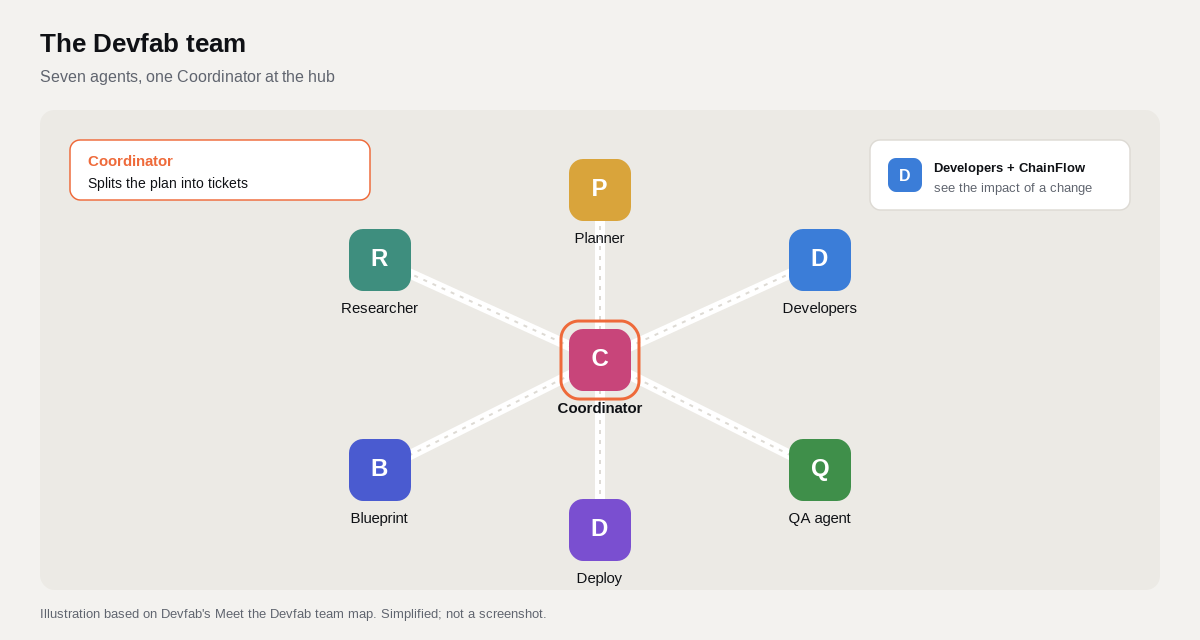
Devfab is an AI software factory with seven agents. The Researcher maps the domain first: key terms, best practices and competitors. The Planner writes the plan, a person approves it, and the Coordinator turns it into tickets and assigns dev agents. Developers work with ChainFlow, which maps which functions and APIs call each other so a change doesn't break connected features. The QA agent runs UI and flow tests plus logic tests, and Deploy ships to your own server.
Devfab's honest limits: it is new and in Beta, with a smaller community and fewer integrations and data connectors than either platform. It is not a low-code editor or an editor for hands-on coding, and it needs a GitHub account. For CRUD screens over an existing database, Retool or ToolJet is the quicker tool. See Devfab vs ToolJet.
FAQ
Is ToolJet open source?
Yes. ToolJet's Community Edition is licensed under AGPL-3.0, and its MCP server is MIT-licensed. ToolJet says the whole platform can be self-hosted on Docker, Kubernetes, AWS, Azure, GCP or on-prem.
Can Claude Code or Codex build apps in Retool or ToolJet?
Both. ToolJet's MCP lets agents such as Claude Code, Codex, Grok Build and Cursor create, inspect and modify apps, and ToolJet says this uses no ToolJet AI credits. Retool lets you build through its MCP server or CLI and import apps from Claude Code and other tools.
Can I import my Retool apps into ToolJet?
Not automatically. ToolJet's own comparison page says there is no automatic Retool export importer. It suggests having a coding agent rebuild the app through its MCP server and offers migration consultations for larger estates.
How is pricing different?
ToolJet prices per builder, not per end user, with AI credits per builder. Retool prices per seat with separate builder and internal-user rates, plus pooled AI credits, metered workflow runs and agents billed by model run time.
Read next
- What is an AI software factory?
- Devfab vs ToolJet
- ToolJet alternatives
- Retool vs Superblocks
- AI software factory vs AI coding tools
Want your agents run as a delivery team? Try Devfab Beta
Sources (checked November 13, 2026): Retool launches a full-stack React AI app builder; Retool extends enterprise governance to vibe-coded apps; Retool pricing; Retool AI providers and models; Retool: import and export apps; Retool: import external React apps; Jet Admin: Retool review (competitor, Sep 26, 2026); Meet the new ToolJet (Sep 2, 2026); ToolJet at the start of 2026 (Jan 8, 2026); ToolJet vs Superblocks (ToolJet); ToolJet vs Retool (ToolJet); Jet Admin: ToolJet vs Retool (competitor, Jul 27, 2026).
Frequently asked questions
Is ToolJet open source?
Yes. ToolJet's Community Edition is licensed under AGPL-3.0, and its MCP server is MIT-licensed. ToolJet says the whole platform can be self-hosted on Docker, Kubernetes, AWS, Azure, GCP or on-prem.
Can Claude Code or Codex build apps in Retool or ToolJet?
Both. ToolJet's MCP lets agents such as Claude Code, Codex, Grok Build and Cursor create, inspect and modify apps, and ToolJet says this uses no ToolJet AI credits. Retool lets you build through its MCP server or CLI and import apps from Claude Code and other tools.
Can I import my Retool apps into ToolJet?
Not automatically. ToolJet's own comparison page says there is no automatic Retool export importer. It suggests having a coding agent rebuild the app through its MCP server and offers migration consultations for larger estates.
How is pricing different?
ToolJet prices per builder, not per end user, with AI credits per builder. Retool prices per seat with separate builder and internal-user rates, plus pooled AI credits, metered workflow runs and agents billed by model run time.