Short answer: For low seat prices inside GitHub, pick GitHub Copilot. For an agent-first editor, Cursor; for a terminal agent with strong planning, Claude Code. Need on-prem? Look at Factory or Tabnine. Choose Devfab when the gap is the whole delivery line: research, an approved plan, QA on user journeys and deployment.
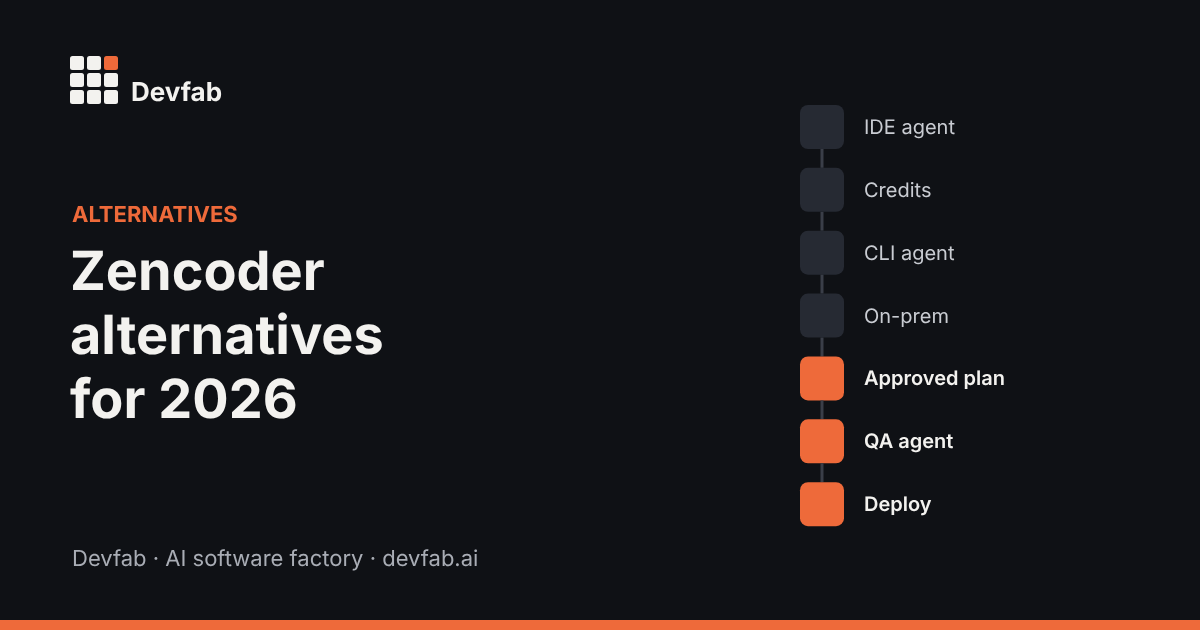
You bought Zencoder seats for the whole engineering group. Some people use them every day. Others open the IDE agent once a week and still cost a full seat. Then the monthly credits reset, and nobody can say where the last batch went.
That is the usual story behind a search for Zencoder alternatives: price per seat, credits you can't forecast, and product names that keep changing. This page compares seven options using vendor pages re-checked in November 2026.
In this guide, you'll learn:
- Why teams leave Zencoder
- Quick comparison
- The alternatives
- Where Zencoder is still the better choice
- How to choose
One note first: this is Zencoder the AI coding platform, not the old video encoder with the same name.
Why teams leave Zencoder
Zencoder is active. Its product line now centers on Zenflow (Zenflow Code and Zenflow Work), IDE agents, a CLI and a new product called Hops (Zencoder pricing). Zenflow Code runs spec-driven workflows for features, bugs and refactors, with agents in parallel in isolated environments (Zencoder). People still leave, for these documented reasons:
- Entry price. Pro is USD 40 per user per month billed annually (USD 45 monthly), Pro Plus USD 85 and Pro Max USD 175, as of November 2026 (Zencoder pricing). A review updated August 2026 calls the entry price the highest in its category (AISO Tools).
- Credits you can't forecast. Plans include 30K, 80K or 180K monthly credits that expire each month; top-ups start at USD 20 and are non-refundable (Zencoder pricing FAQ). The same review says credit use is hard to predict.
- Renaming. The review notes frequent product renaming, and Hops is the newest name on the site.
- Testing in flux. Zentester, a UI end-to-end test agent announced in public beta in June 2025, is not mentioned on today's pricing or home page (Zentester announcement).
- Admin features gated. SSO, audit logs, a shared credit pool and multi-repo indexing start at Pro Plus.
Quick comparison
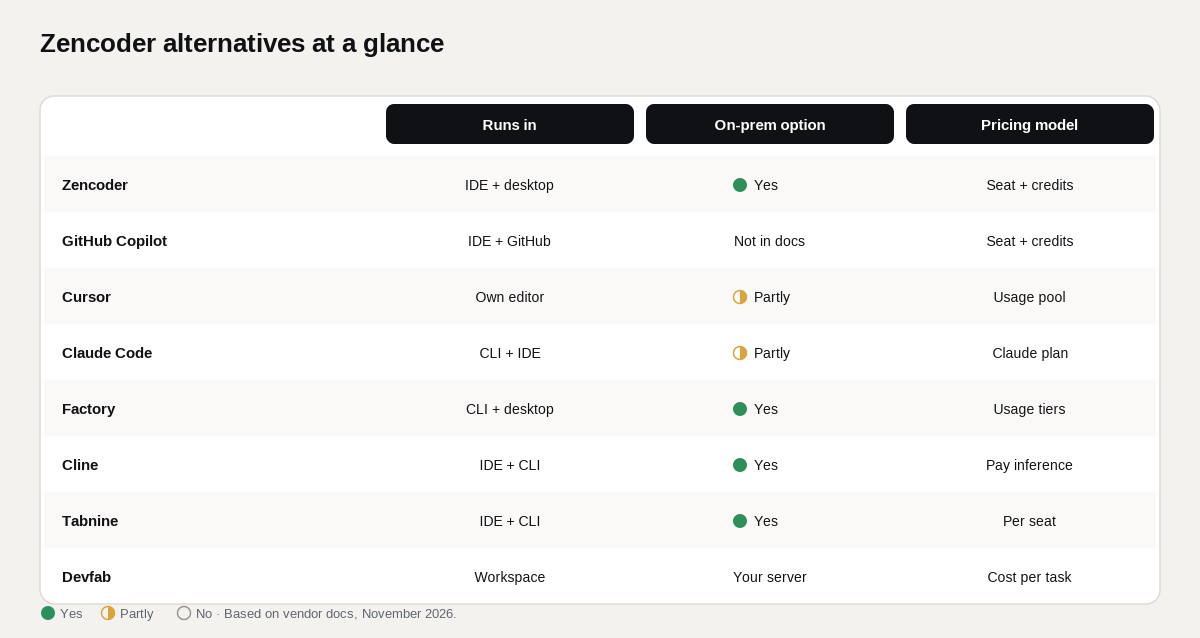
| Tool | Type | Where it runs | Deploy options for the tool | Pricing model | Starting paid price (Nov 2026) |
|---|---|---|---|---|---|
| Zencoder (baseline) | Spec-driven coding agents | VS Code, JetBrains, Zenflow Desktop, CLI | Cloud, on-premise or hybrid | Seat plus monthly credits | Pro USD 40 per user per month, annual |
| GitHub Copilot | Assistant plus cloud agent | IDEs, GitHub.com, CLI, desktop app | GitHub cloud | Seat plus AI credits | Pro USD 10 per user per month |
| Cursor | Agent-first editor | Desktop editor, CLI, cloud agents | Self-Hosted Machines for agent tool execution | Tiers with usage pool | Plus USD 8 per month (Grok models only) |
| Claude Code | Terminal and IDE agent | CLI, VS Code, JetBrains, desktop, web | Inference via Bedrock, Google Cloud or Microsoft Foundry | Included in paid Claude plans | Pro USD 20 per month |
| Factory | Software factory agents (Droids) | CLI, desktop app, IDEs | On-prem and air-gapped on Enterprise | Usage tiers; team base plus seats | Pro USD 20 per user per month |
| Cline | Open-source agent | VS Code, JetBrains, CLI, desktop | VPC and self-hosting on Enterprise | Free; pay inference or BYOK | Free; Enterprise custom |
| Tabnine | Private coding assistant | VS Code, JetBrains, Eclipse, Visual Studio, CLI | SaaS, VPC, on-prem, air-gapped | Per seat | No prices shown |
| Devfab | AI software factory | Web workspace with your GitHub repo | App deploys to your own server | Cost logged per task and per project | Beta |
The alternatives
GitHub Copilot
Verdict: the low-cost default when code, issues and reviews already live on GitHub. Best for: organizations that want seat prices they can forecast plus agent governance in one place. Trade-off: the cloud agent only works with repositories hosted on GitHub. Pricing: Free; Pro USD 10 per user per month; Business USD 19 and Enterprise USD 39 per granted seat per month, as of November 2026 (Copilot plans).
The cloud agent can research a repository and create an implementation plan before it changes code (GitHub Docs: features). Models come from OpenAI, Anthropic, Google, Microsoft, Moonshot AI and xAI. Enterprise AI Controls and an agent control plane went GA on February 26, 2026, with agent activity in audit logs (GitHub changelog). Plans are now described in AI credits, and usage beyond the pool is metered (GitHub Docs: plans).
Cursor
Verdict: the pick for developers who want the agent built into the editor itself. Best for: teams running many parallel cloud agents on separate branches. Trade-off: new owner; a reviewer calls the credit pricing "opaque." Pricing: Free; Plus USD 8 per month; Premium USD 30 per month; Teams USD 30+ per user per month, as of November 2026 (Cursor pricing).
SpaceX acquired Cursor, and Cursor's August 14, 2026 post says the deal has closed (Cursor blog). Plan Mode asks clarifying questions and drafts an editable plan before writing code (Cursor Docs: Plan Mode). Cloud agents run in isolated VMs, and Self-Hosted Machines let their tool execution run on hardware you manage (Cursor Docs: Cloud Agents). Cloud agents need Premium or higher; Plus is limited to Grok models.
Claude Code
Verdict: a strong pick for planning work inside an existing codebase. Best for: developers in the terminal or IDE who want plan mode, subagents and managed PR review. Trade-off: Claude models only; usage limits are shared with the Claude apps. Pricing: included in paid Claude plans; Pro USD 20 per month, Team Standard USD 25 per user per month, as of November 2026 (Claude pricing).
Plan mode has Claude explore the codebase and propose an approach for approval before editing (Claude Code Docs: costs). It stages changes, writes commit messages and opens pull requests (Claude Code overview). Enterprises can route inference through Amazon Bedrock, Google Cloud or Microsoft Foundry and run cloud sessions on self-hosted environments (Claude Code enterprise deployment). Managed Code Review never approves or blocks a PR.
Factory
Verdict: the closest match if you liked Zenflow's multi-agent workflows and need on-prem. Best for: enterprises that need air-gapped deployment, data residency and self-hosted Git. Trade-off: the pricing page gives usage only as multiples of Pro, with no token or credit amounts. Pricing: Free (bring your own inference); Pro USD 20 per user per month; Teams USD 60 per team per month plus USD 40 per user, as of November 2026 (Factory pricing).
Factory 2.0, announced June 15, 2026, repositioned the company around "software factories" with Missions that split work into parallel tracks (Factory news). Modes are Normal, Spec and Mission, with autonomy levels and rules to allow, approve or block shell commands (Factory docs). The Factory Router picks a model per task, and BYOK supports local models. Enterprise adds on-prem deployment and SLAs.
Cline
Verdict: the budget pick for developers who want to approve every step. Best for: teams that want open source and full model freedom, with inference at cost. Trade-off: you steer it task by task; it is not a delivery pipeline. Pricing: free extension with inference billed separately or BYOK; Enterprise custom, as of November 2026 (Cline pricing).
Every Cline action requires your approval (Cline docs). Plan mode reads and discusses without editing, Act mode executes, and Checkpoints allow rollback (Cline Plan & Act). It runs in VS Code, JetBrains, a CLI, a desktop app and a Kanban board for parallel agents. Enterprise adds SSO, RBAC and audit logs, and the FAQ mentions VPC deployments and self-hosting.
Tabnine
Verdict: for organizations whose IT blocks SaaS AI tools. Best for: defense, finance, healthcare and government teams that need air-gapped deployment. Trade-off: acquired by Tricentis in July 2026 with no stated roadmap for the standalone assistant. Pricing: per-seat subscription; the official page showed no prices in November 2026 (Tabnine pricing).
Tricentis announced the acquisition on July 30, 2026, and will fold Tabnine's Enterprise Context Engine into its quality-engineering platform (Tricentis). Tabnine runs as SaaS, in a VPC, on-premises or fully air-gapped (DEV review, Jun 2026). The Context Engine, launched March 4, 2026, builds a knowledge graph of code, docs, tickets and APIs for impact analysis (SD Times). Analysts flag roadmap risk after the deal (BERI).
Devfab
Verdict: for teams whose problem is not the code edits but the path to production. Best for: agencies and IT teams shipping client or internal apps that need a plan, QA and a deploy. Trade-off: in Beta; not an editor for hands-on coding. Pricing: predictable cost; cost is logged after each run, per task and per project.
Every tool above automates a developer's work. Devfab automates the project around it. Details in Where Devfab fits, and the head-to-head is Devfab vs Zencoder.
Where Zencoder is still the better choice
- Mixing models per step. Zencoder routes across models ("Plan with Opus. Build with Gemini. Review with Codex."), and BYOK for OpenAI, Anthropic or Gemini does not consume credits (Zencoder).
- Certifications on the agent vendor. SOC 2 Type II, ISO 27001 and ISO 42001.
- On-premise or hybrid without an acquisition question. Zencoder lists cloud, on-premise and hybrid deployment, while Tabnine's future is unclear.
- Work beyond code. Zenflow Work runs goal-driven automations across Jira, Slack, Notion and Gmail.
- Agents inside VS Code and JetBrains you already use. No new editor to roll out.
Where Devfab fits
Coding agents automate the developer. Devfab automates the development lifecycle.
Say a property manager wants a tenant maintenance portal. Tenants report issues with photos, staff assign vendors, and owners see costs. With Devfab, you describe it in "What should we build?" The Researcher maps the domain first: work order categories, emergency vs routine repairs, vendor dispatch rules and competing products. Then it suggests a prototype. The Planner writes a plan, and a person approves it before the Coordinator creates tickets.
On an existing repo, ChainFlow maps which functions and APIs call each other. A change to repair requests shows its impact on vendor dispatch, tenant notifications and owner statements before developer agents touch it. The QA agent runs UI and flow tests, clicking a tenant's report through to a closed work order, plus logic tests. Deploy ships to your own server, with code in your own GitHub account. You can choose the model for each agent or keep Devfab's default.
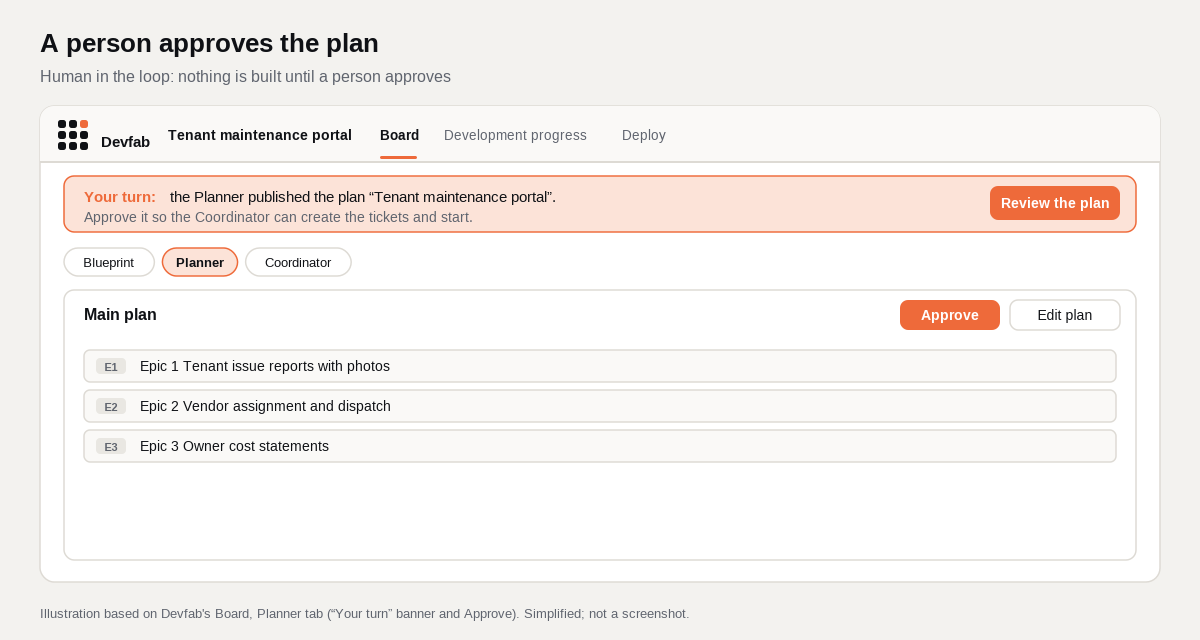
Honest limits: Devfab is in Beta, with a smaller community and fewer integrations than these tools. It is not an editor, so developers will still want an IDE agent for hands-on work. It needs a GitHub account, and it has no on-prem deployment of Devfab itself stated.
How to choose
- Code and reviews live on GitHub, and seat cost matters most: GitHub Copilot.
- Developers want the agent inside their editor: Cursor.
- Deep planning in the terminal: Claude Code.
- Multi-agent workflows plus on-prem: Factory.
- Open source, approve every step, pay only for inference: Cline.
- No SaaS AI allowed at all: Tabnine, after you ask Tricentis about the roadmap.
- You need the whole path from idea to a deployed, tested app: Devfab.
- You rely on per-step model routing and ISO 42001: stay on Zencoder.
FAQ
Is this Zencoder the video encoder or the AI coding tool?
This page covers Zencoder at zencoder.ai, the AI coding agent platform with IDE agents, Zenflow and a CLI. Many search results for Zencoder alternatives list video encoding services instead, because an older cloud video encoder shares the name. The two products are unrelated.
Why do teams leave Zencoder?
The most cited reasons are price and predictability. As of November 2026, Pro starts at USD 40 per user per month billed annually, credits expire monthly and top-ups are non-refundable. A review updated in August 2026 calls the entry price the highest in its category, says credit use is hard to predict and notes frequent product renaming.
What is the cheapest Zencoder alternative?
Cline's extension is free and open source, and you pay only for inference or bring your own key. GitHub Copilot Pro is USD 10 per user per month and Factory Pro is USD 20 per user per month, as of November 2026. Zencoder's own Free plan is bring-your-own-key only.
Which Zencoder alternative can run on-premises?
Tabnine can be deployed as SaaS, in a VPC, on-premises or fully air-gapped, though Tricentis acquired it in July 2026. Factory's Enterprise plan adds on-prem deployment, and its docs cover air-gapped setups. Cline's Enterprise FAQ mentions VPC deployments and self-hosting.
Does any alternative cover planning, testing and deployment together?
Devfab does. It runs research before the plan, a plan a person approves, tickets for developer agents, a QA agent that runs UI, flow and logic tests, and deployment to your own server. It is in Beta and is not an editor for hands-on coding.
Read next
- What is an AI software factory?
- Devfab vs Zencoder
- Zencoder vs GitHub Copilot
- Zencoder vs Cursor
- Per-seat vs usage-based AI pricing
Paying for seats but still missing QA and deploy? Try Beta
Sources (checked November 2026): Zencoder; Zencoder pricing; Zencoder Docs: pricing FAQ; Introducing Zentester (Jun 2025); AISO Tools: Zencoder review (Aug 2026); GitHub Copilot plans; GitHub Docs: Copilot plans; GitHub Docs: Copilot features; GitHub changelog: agent control plane GA (Feb 26, 2026); Cursor pricing; Cursor blog: Joining SpaceX; Cursor Docs: Plan Mode; Cursor Docs: Cloud Agents; Claude Code overview; Claude Code: manage costs; Claude Code: enterprise deployment; Claude pricing; Factory pricing; Factory 2.0 announcement (Jun 15, 2026); Factory docs index; Cline docs; Cline Plan & Act; Cline pricing; Tricentis acquires Tabnine (Jul 30, 2026); Tabnine pricing; DEV: Tabnine review (Jun 2026); SD Times: Tabnine Context Engine (Mar 2026); BERI: Tricentis and Tabnine roadmap risk (Aug 2026).
Frequently asked questions
Is this Zencoder the video encoder or the AI coding tool?
This page covers Zencoder at zencoder.ai, the AI coding agent platform with IDE agents, Zenflow and a CLI. Many search results for Zencoder alternatives list video encoding services instead, because an older cloud video encoder shares the name. The two products are unrelated.
Why do teams leave Zencoder?
The most cited reasons are price and predictability. As of November 2026, Pro starts at USD 40 per user per month billed annually, credits expire monthly and top-ups are non-refundable. A review updated in August 2026 calls the entry price the highest in its category, says credit use is hard to predict and notes frequent product renaming.
What is the cheapest Zencoder alternative?
Cline's extension is free and open source, and you pay only for inference or bring your own key. GitHub Copilot Pro is USD 10 per user per month and Factory Pro is USD 20 per user per month, as of November 2026. Zencoder's own Free plan is bring-your-own-key only.
Which Zencoder alternative can run on-premises?
Tabnine can be deployed as SaaS, in a VPC, on-premises or fully air-gapped, though Tricentis acquired it in July 2026. Factory's Enterprise plan adds on-prem deployment, and its docs cover air-gapped setups. Cline's Enterprise FAQ mentions VPC deployments and self-hosting.
Does any alternative cover planning, testing and deployment together?
Devfab does. It runs research before the plan, a plan a person approves, tickets for developer agents, a QA agent that runs UI, flow and logic tests, and deployment to your own server. It is in Beta and is not an editor for hands-on coding.