Short answer: For a like-for-like reviewer with on-prem options and pooled credits, pick Qodo. If you already pay for GitHub Copilot, its code review costs nothing extra. If the real worry is bugs that only show when the app runs, add QA Wolf. Devfab fits when you want the whole build run with QA as one step.
CodeRabbit is probably on every pull request your team opens. It's good at it. Then the seat count grows, someone asks about self-hosting, and a bug in a clinic booking app slips through a clean review because nobody ran the double-booking flow. Three different problems, three different fixes.
People leave CodeRabbit for price, for control over where code goes, or because review alone stopped being enough. This page sorts the alternatives by which of those you're solving.
In this guide, you'll learn:
- Why teams leave CodeRabbit
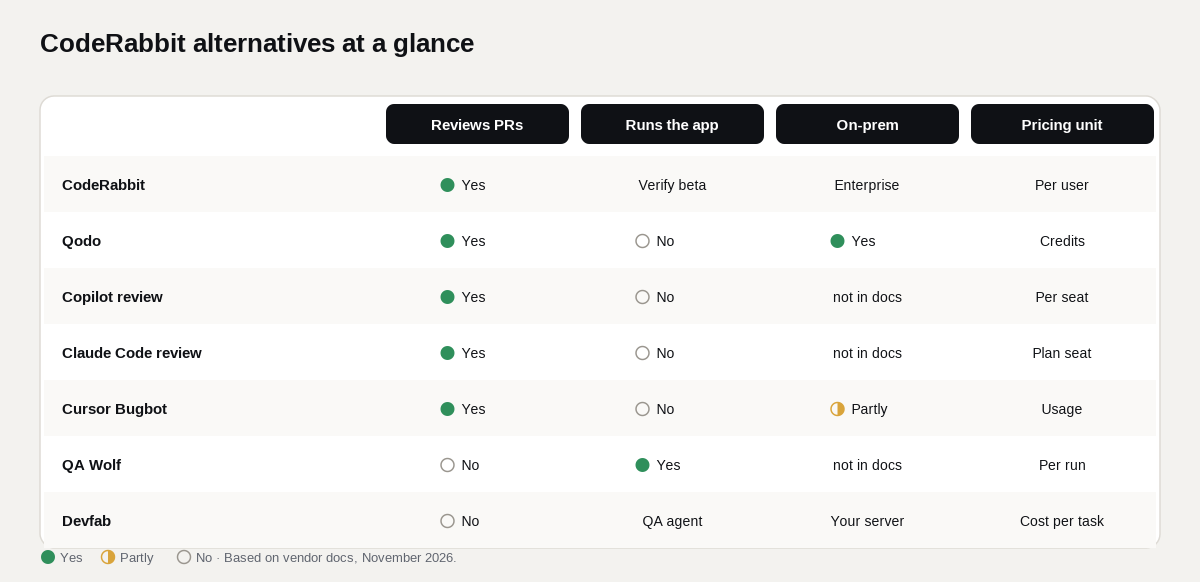
- The six alternatives in one table
- Where CodeRabbit is still the better choice
- How to choose
Every fact below comes from vendor pages checked in November 2026.
Why teams leave CodeRabbit
Status, November 2026: active and well funded. CodeRabbit raised a USD 143M Series C at a USD 1.5B valuation on August 12, 2026, and introduced an "Agentic Change Management" category (CodeRabbit newsroom). It reports 20K customers and 8.5M repositories (CodeRabbit). Nobody is leaving because it's going away. The documented triggers are these:
- Per-user pricing. Essentials is USD 24, Team USD 48 and Advanced USD 72 per user per month, as of November 2026 (CodeRabbit pricing). Costs scale with headcount.
- Review caps. PR reviews per developer are capped under a fair-usage policy, and extra reviews are billed on consumption (CodeRabbit pricing).
- Control features sit on Enterprise. SSO, custom roles, audit logs, self-hosting and chosen SaaS regions are Enterprise only (CodeRabbit pricing).
- Runtime testing is still beta. Verify tests how the app behaves, but it is in beta, web-only, and on CodeRabbit Cloud (CodeRabbit Verify).
Quick comparison
| Tool | What it does | Git hosts | Self-host or on-prem | Pricing model (Nov 2026) | Source |
|---|---|---|---|---|---|
| Qodo | Multi-agent PR review and governance | GitHub, GitLab, Bitbucket, Azure DevOps (+ Gerrit on Enterprise) | On-prem or air-gapped | Pooled credits, USD 0.015 each; Enterprise custom | Qodo pricing |
| GitHub Copilot code review | PR review inside GitHub | GitHub | Not covered in the pages we checked | Included on paid Copilot plans; Business USD 19 per seat | Copilot plans |
| Claude Code Code Review | Multi-agent review with verified findings | GitHub only | Not with Zero Data Retention | Team or Enterprise Claude plans | Claude Code review |
| Cursor Bugbot | PR review with Autofix | Not covered in the pages we checked | Cloud agents can run tools on self-hosted machines | Usage-based; Autofix billed as cloud agent usage | Cursor Bugbot |
| QA Wolf | End-to-end tests on the running app | GitHub connector | Not covered in the pages we checked | USD 1 per web run, no seats | QA Wolf pricing |
| Devfab | Full lifecycle with a QA agent step | GitHub | Deploy to your own server | Cost logged per task and per project (Beta) | Devfab |
The alternatives
Qodo
Verdict: the closest swap, with stronger hosting options. Best for: regulated or multi-repo organizations. Trade-off: no permanent free tier, and credits expire each month. Pricing: Pro Team uses pooled credits at USD 0.015 each, in packs of 2,000, 4,000 or 16,000 a month, with a spending cap; Enterprise custom for 30+ users, as of November 2026 (Qodo pricing).
- Multi-agent review checks each PR against your organization's rules (Qodo).
- Cross Repo Review flags changes that could break downstream repos (Qodo).
- On-prem or air-gapped deployment, zero data retention, SOC 2 Type II (Qodo pricing).
- Bring your own model keys with OpenAI, Anthropic, Azure OpenAI or self-hosted models on Enterprise (Qodo pricing).
- Formerly CodiumAI; raised a USD 70M Series B on March 30, 2026 (Globes).
GitHub Copilot code review
Verdict: the low-friction pick if your team already pays for Copilot. Best for: GitHub-only teams that want review without another vendor. Trade-off: GitHub only; fewer review-specific controls in the pages we checked. Pricing: PR code review is on paid plans, not Free; Business is USD 19 and Enterprise USD 39 per granted seat per month, as of November 2026 (Copilot plans).
- Offers PR code review in GitHub and file diff review in editors (Copilot plans).
- Model choice across OpenAI, Anthropic, Google and others, by plan (GitHub Docs: models).
- Enterprise AI Controls log agent activity with
actor_is_agentin audit logs (GitHub Changelog). - GitHub warns Copilot "can produce incorrect or suboptimal code, including code that contains security vulnerabilities" (GitHub Docs).
Claude Code Code Review
Verdict: a careful reviewer for teams already on Claude Team or Enterprise. Best for: GitHub teams that want fewer false positives. Trade-off: GitHub only; it comments but never approves or blocks. Pricing: part of Team and Enterprise Claude plans; Team Standard is USD 25 per user per month (USD 20 billed annually), as of November 2026 (Claude pricing).
- Runs several agents on each PR and verifies findings to filter false positives (Claude Code review).
- Posts severity-ranked inline comments (Claude Code review).
- Not available with Zero Data Retention, the HIPAA configuration or CMEK (Claude Code review).
- Reads the diff and surrounding code without building or running it (Claude Code review).
Cursor Bugbot
Verdict: best when you want the reviewer to also push the fix. Best for: teams already using Cursor and its cloud agents. Trade-off: usage billing on two meters; Cursor's ownership changed in 2026. Pricing: Bugbot is usage-based; Autofix is billed separately as cloud agent usage (Cursor Bugbot).
- "Reviews pull requests and identifies bugs, security issues, and code quality problems" (Cursor Bugbot).
- Autofix spawns a cloud agent to push fixes to a branch (Cursor Bugbot).
- Cloud agents support GitHub, GitLab, Bitbucket Cloud and Azure DevOps (Cursor cloud agents).
- Cursor's maker is now owned by SpaceX; Cursor says the deal closed in its August 14, 2026 post (Cursor blog).
QA Wolf
Verdict: not a reviewer; the fix when bugs only show at runtime. Best for: teams whose agents ship code faster than anyone can test it. Trade-off: per-run billing grows with suite size and frequency. Pricing: USD 1 per web run, USD 2 per mobile or desktop run, no seat fees, as of November 2026 (QA Wolf pricing).
- Agents pick the tests each PR needs, investigate failures and file bugs to Linear or Jira (QA Wolf pricing).
- Covers web, iOS, Android and Windows (QA Wolf).
- Tests export as Playwright and Appium code (QA Wolf pricing).
- An MCP server works with Claude Code, Codex and Cursor (QA Wolf).
Devfab
Verdict: not a PR reviewer. Consider it when you want review, testing and delivery run as one process. Best for: agencies and IT teams delivering whole apps, often for clients. Trade-off: in Beta, smaller community, fewer integrations; not an editor; needs a GitHub account. Pricing: predictable cost; cost is logged after each run, per task and per project.
Coding agents automate the developer. Devfab automates the development lifecycle. The Researcher maps the domain before the Planner writes a plan, and a person approves it. Dev agents work with ChainFlow, which maps which functions and APIs call each other and what is deployed. In the clinic booking app, a change to appointment slots shows its impact on reminders, billing and the calendar view. The QA agent runs UI and flow tests (screens, buttons and user journeys clicked end to end) plus logic tests, such as "no double booking of a slot". Deploy ships to your own server.
Where CodeRabbit is still the better choice
- You need one reviewer across four Git hosts. GitHub, GitLab, Azure DevOps and Bitbucket are all supported (CodeRabbit docs).
- Developers want review before they push. IDE extensions for VS Code, Cursor, Windsurf and JetBrains, plus a pre-commit CLI (CodeRabbit docs).
- You want review and runtime tests from one vendor. Verify is free during its beta (CodeRabbit Verify).
- Security scanning matters. CodeRabbit Security checks for vulnerabilities, leaked secrets and vulnerable dependencies (CodeRabbit docs).
- You want predictable per-seat budgeting rather than credits or usage meters.
How to choose
- If price per seat is the trigger, compare Qodo's pooled credits and the review already in your Copilot or Claude plan.
- If data control is the trigger, Qodo's on-prem and zero-retention options lead; check Claude Code's ZDR exclusion.
- If bugs pass review, add runtime tests (QA Wolf, or CodeRabbit Verify) rather than a second reviewer.
- If the whole delivery process is the trigger, read AI code review vs a QA agent and consider a lifecycle tool.
- Run two reviewers on the same PRs for a sprint and compare what each catches before you switch.
FAQ
What is the closest alternative to CodeRabbit?
Qodo. Both review every pull request across GitHub, GitLab, Bitbucket and Azure DevOps, with IDE plugins and a CLI. Qodo adds cross-repo review, on-prem or air-gapped deployment and credit-based team pricing instead of per-user seats.
Is there a free CodeRabbit alternative?
Qodo's open-source PR-Agent project underlies Qodo Merge, and Qodo runs a free program for qualifying open-source projects. CodeRabbit itself offers free reviews in the IDE and refers to a free open-source plan. Most team features on every tool are paid.
Can I self-host an AI code reviewer?
CodeRabbit offers self-hosting on Enterprise. Qodo offers single-tenant SaaS or on-prem and air-gapped deployment with zero data retention. Claude Code's managed Code Review is not available with Zero Data Retention, according to its docs.
Is code review enough for AI-written code?
Usually not. Anthropic notes a Claude Code review with no findings doesn't mean code is error-free or secure, because it reads the diff without running it. Pair a reviewer with tests that run the app, such as QA Wolf or CodeRabbit's Verify beta.
Does Devfab replace CodeRabbit?
Not as a like-for-like reviewer. CodeRabbit reviews code you already write. Devfab runs the whole lifecycle, from research and an approved plan to QA tests and deploy, with its QA agent as one step. Teams writing code by hand still benefit from a PR reviewer.
Read next
Want review, tests and deploy in one approved plan? Try Beta
Sources (checked November 2026): CodeRabbit pricing; CodeRabbit docs; CodeRabbit Verify; CodeRabbit FAQ; CodeRabbit llms.txt; CodeRabbit homepage (JA); CodeRabbit Series C (Aug 12, 2026); Qodo homepage; Qodo pricing; Qodo year-end recap; Qodo raises USD 70M (Globes, Mar 30, 2026); GitHub Copilot plans; GitHub Docs: supported models; GitHub Docs: Copilot cloud agent; GitHub Changelog: Enterprise AI Controls GA; Claude Code review; Claude pricing; Cursor Bugbot; Cursor cloud agents; Cursor blog: joining SpaceX; QA Wolf homepage; QA Wolf pricing.
Frequently asked questions
What is the closest alternative to CodeRabbit?
Qodo. Both review every pull request across GitHub, GitLab, Bitbucket and Azure DevOps, with IDE plugins and a CLI. Qodo adds cross-repo review, on-prem or air-gapped deployment and credit-based team pricing instead of per-user seats.
Is there a free CodeRabbit alternative?
Qodo's open-source PR-Agent project underlies Qodo Merge, and Qodo runs a free program for qualifying open-source projects. CodeRabbit itself offers free reviews in the IDE and refers to a free open-source plan. Most team features on every tool are paid.
Can I self-host an AI code reviewer?
CodeRabbit offers self-hosting on Enterprise. Qodo offers single-tenant SaaS or on-prem and air-gapped deployment with zero data retention. Claude Code's managed Code Review is not available with Zero Data Retention, according to its docs.
Is code review enough for AI-written code?
Usually not. Anthropic notes a Claude Code review with no findings doesn't mean code is error-free or secure, because it reads the diff without running it. Pair a reviewer with tests that run the app, such as QA Wolf or CodeRabbit's Verify beta.
Does Devfab replace CodeRabbit?
Not as a like-for-like reviewer. CodeRabbit reviews code you already write. Devfab runs the whole lifecycle, from research and an approved plan to QA tests and deploy, with its QA agent as one step. Teams writing code by hand still benefit from a PR reviewer.