Short answer: Pick an AI app builder when the business app is new, mostly web screens over a simple database, and you want code you can export. Pick a low-code platform when the app holds regulated data, serves many signed-in users on a flat plan, and staff will change it for years without developers.
A school district needs an equipment loan tracker: laptops and hotspots go out, come back, and sometimes vanish. The IT lead typed the idea into an AI app builder and had screens on the first try. Then procurement asked four questions. Who can sign in? Where does student data live? Who fixes it next spring? And what does it cost once every student and teacher has a login?
Those questions, not the demo, decide which tool fits. This page walks through them with each vendor's own pages, checked in November 2026.
In this guide, you'll learn:
- Definitions
- Side by side for a business app
- When to choose an AI app builder
- When to choose a low-code platform
- Where an AI software factory fits
Use the four procurement questions as your filter.
Definitions
AI app builder. A tool that turns a prompt into a working web app, usually with hosting and a database included, and gives you the generated code. Lovable is a typical example. It has Build, Plan and Chat modes, publishes to its own URL with HTTPS, and offers a built-in backend with managed PostgreSQL, login and file storage (Lovable FAQ). Base44, owned by Wix since June 2025, bundles a managed backend, auth with field-level access controls, hosting, Stripe payments and auto-generated API endpoints (Base44 guide). Bolt can start from a prompt, a Figma frame or a GitHub repo (Bolt support).
Low-code platform. A platform where you build on the vendor's engine with visual tools and some code. Microsoft puts it plainly: "low-code development requires some custom coding," and it is "most often used by IT professionals with some coding skills" (Microsoft). Your app is a configuration inside the platform: tables, forms, roles and workflows. Caspio runs on a SQL Server core and hosts apps or embeds them in websites (Caspio). Quickbase sells operational apps and automations on a platform price (Quickbase pricing).
The overlap in 2026. Low-code vendors now ship their own AI builders:
- Caspio's Caspi builds the data model, interface and roles from a description, and the result stays editable (Caspio).
- Quickbase Pave, launched April 28, 2026, is a prompt-first builder that includes data, permissions, workflows and hosting (Quickbase press release).
- Knack's AI app builder creates a first version from a chat prompt on all plans (Knack pricing).
- The new Softr, relaunched November 9, 2026, has AI build the whole app on Softr's governed backend. Softr's line: "We vibe code your frontend. We don't vibe code your backend." (Softr blog).
So "can it build from a prompt?" no longer separates them. What sits underneath does: exportable code on a stack the builder picks, or a governed platform you rent.
Side by side for a business app
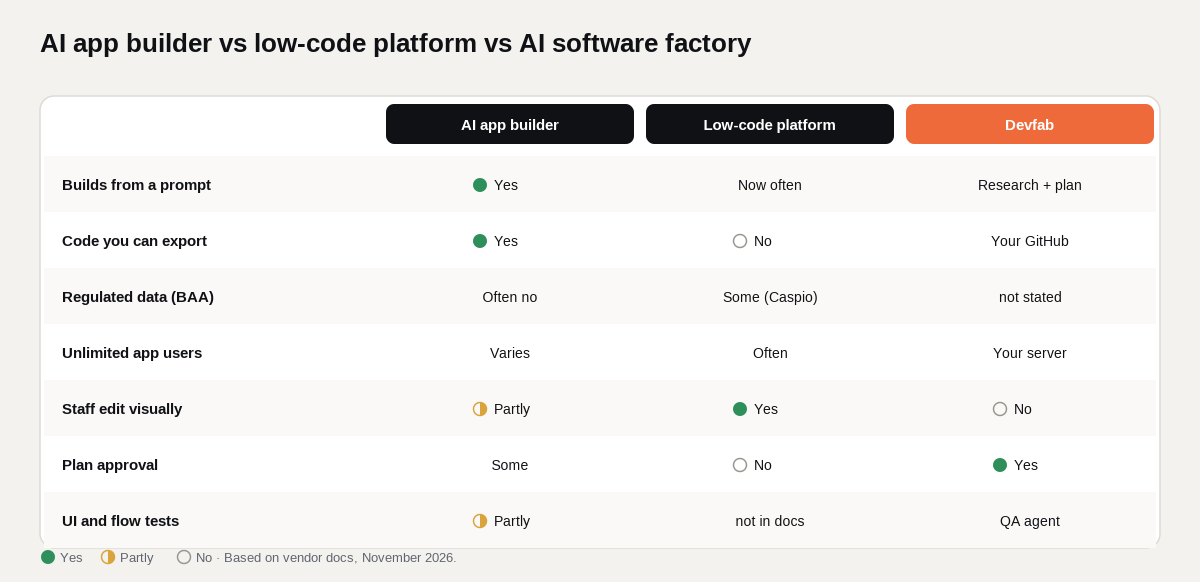
| Question | AI app builder | Low-code platform | Source |
|---|---|---|---|
| Who can sign in? | Login built in (Lovable supports Google, Apple, Microsoft, SAML SSO) | Roles, field-level security, SSO on eligible plans | Lovable FAQ; Caspio |
| Regulated data? | Lovable: not HIPAA-compliant, no BAAs; terms bar health and card data | Caspio: HIPAA, SOC 2 Type II, GDPR certified annually; BAAs | Lovable FAQ; Caspio |
| What you own | Generated code; Lovable syncs to GitHub, GitLab, Bitbucket | The app's configuration on the platform | Lovable GitHub |
| Stack choice | Fixed by the builder; Lovable offers no framework or database choice | Fixed by the platform | Lovable FAQ |
| Who changes it later | Someone who can prompt and read code | Business users and IT, in visual tools | Microsoft |
| Pricing unit | Credits or tokens (Lovable Pro USD 25/month; Bolt Pro USD 25/month) | Flat platform (Quickbase USD 500/month, unlimited users) or per user (Power Apps Premium USD 20/user/month) | Lovable pricing; Bolt pricing; Quickbase pricing; Power Apps pricing |
| Limits to know | Lovable Git sync can't link an existing repo; Bolt stays on main | Caspio Team: 5 app authors, 250K records, 500 task runs a month | Lovable GitHub; Bolt Git; Caspio pricing |
All prices as of November 2026, from each vendor's official pricing page, annual billing where the vendor states it.
When to choose an AI app builder
- The app is new and mostly screens over a simple database. A loan tracker, a booking page or a dashboard fits the builders' built-in backends.
- You want the code. Lovable syncs to GitHub, GitLab or Bitbucket, and paid plans can download the codebase as a ZIP (Lovable FAQ). Base44 offers two-way GitHub sync from its Builder plan (Base44 docs).
- Budget is small and users are few. Credit-based plans start low, and Lovable's Free plan can build and publish (Lovable plans).
- The UI must look custom. You're shaping a generated app, not arranging a platform's blocks.
- You want to test an idea with real users before committing to a platform contract.
Watch for: data rules. Lovable's terms do not allow protected health information, payment card data or government identifiers (Lovable FAQ). From September 9, 2026, Lovable Free and Pro data may be used for model training unless users opt out (Lovable FAQ).
When to choose a low-code platform
- The data is regulated. Caspio offers HIPAA-eligible AI features under signed BAAs and supports FERPA, which matters for student records (Caspio).
- Hundreds or thousands of people sign in. Caspio, Knack and Quickbase offer unlimited app users on their plans (Caspio pricing; Knack pricing; Quickbase pricing).
- Staff will change it for years. Business users edit forms, roles and workflows themselves, without a developer reading code.
- IT needs one governed place for many apps. Quickbase's entry tier covers up to 50 custom apps with roles and a developer sandbox (Quickbase pricing).
- You already pay for the platform. If your organization runs Microsoft 365 and Power Apps, adding one more app there is often the least friction.
Watch for: plan caps and add-ons. Caspio Team caps authors, records and task runs (Caspio pricing). Quickbase audit logs are a paid add-on, and some Pave features, such as API access, are still "coming soon" (Quickbase pricing; Pave pricing).
Where an AI software factory fits
Both answers leave a gap. The AI app builder gives you code fast, but someone still has to plan changes, test user journeys and run deployments. The low-code platform gives you governance, but the app never leaves the vendor.
App builders automate the first version. Devfab automates the development lifecycle. It is an AI software factory, built for business apps that must become maintained software:
- Research before the plan. The Researcher maps the domain first. For the loan tracker, that means asset tags, check-out rules, overdue notices and what similar tools do, then a suggested prototype.
- A plan a person approves. The Planner publishes it; the Coordinator creates tickets only after approval.
- Changes that see their impact. ChainFlow maps which functions and APIs call each other, so a change to check-out also flags overdue notices, inventory counts and parent emails.
- Tests on real journeys. The QA agent runs UI and flow tests (screens, buttons and user journeys clicked end to end) plus logic tests.
- Ownership. Code in your own GitHub account, deployed to your own server, with predictable cost logged per task and per project.
Devfab's limits: it is in Beta, with a smaller community and fewer integrations than mature platforms. It is not a drag-and-drop tool for staff, not an editor for hands-on coding, and it needs a GitHub account. For a deeper look, see Low-code vs AI software factory.
FAQ
Is an AI app builder the same as a low-code platform?
No, though they now overlap. An AI app builder such as Lovable or Bolt generates a web app and its code from a prompt. A low-code platform such as Caspio or Quickbase runs your app on its own engine, with users, roles and data inside the platform. Most low-code vendors now add AI builders on top.
Can I use an AI app builder for health or payment data?
Check the terms first. Lovable says it is not HIPAA-compliant, does not sign BAAs, and its terms do not allow protected health information or payment card data. Caspio, a low-code platform, offers HIPAA-eligible features under signed BAAs and a HIPAA/Compliance Edition.
Which is cheaper for a business app with hundreds of users?
Look at the pricing unit. Lovable and Bolt price by credits or tokens, so app users don't drive the bill directly, but hosting and backend usage do. Caspio, Knack and Quickbase offer unlimited app users on flat plans. Power Apps Premium is priced per user.
Can I get code out of a low-code platform?
Usually not as a normal codebase. Low-code apps run on the vendor's engine. AI app builders differ: Lovable syncs to GitHub, GitLab or Bitbucket, and Base44 offers two-way GitHub sync on its Builder plan and above.
Where does an AI software factory fit?
It fits when the business app must become maintained software: code in your own GitHub, deployed to your own server, with a plan a person approves and tests on user journeys. Devfab is one example, and it is in Beta.
Read next
- What is an AI software factory?
- AI code generation vs low-code
- No-code vs AI app builder
- Caspio vs Quickbase
Want the business app as code you own, with a plan you approve? Try Beta
Sources (checked November 2026): Lovable FAQ; Lovable GitHub integration; Lovable plans and credits; Lovable pricing; What is Base44 (Base44 guide); Base44 GitHub docs; Bolt intro; Bolt Git integration; Bolt pricing; Microsoft: low-code vs no-code; Power Apps pricing; Caspio homepage; Caspio pricing; Quickbase pricing; Quickbase Pave pricing; Quickbase introduces Pave (Apr 28, 2026); Knack pricing; Beyond building blocks: the new Softr (Nov 9, 2026).
Frequently asked questions
Is an AI app builder the same as a low-code platform?
No, though they now overlap. An AI app builder such as Lovable or Bolt generates a web app and its code from a prompt. A low-code platform such as Caspio or Quickbase runs your app on its own engine, with users, roles and data inside the platform. Most low-code vendors now add AI builders on top.
Can I use an AI app builder for health or payment data?
Check the terms first. Lovable says it is not HIPAA-compliant, does not sign BAAs, and its terms do not allow protected health information or payment card data. Caspio, a low-code platform, offers HIPAA-eligible features under signed BAAs and a HIPAA/Compliance Edition.
Which is cheaper for a business app with hundreds of users?
Look at the pricing unit. Lovable and Bolt price by credits or tokens, so app users don't drive the bill directly, but hosting and backend usage do. Caspio, Knack and Quickbase offer unlimited app users on flat plans. Power Apps Premium is priced per user.
Can I get code out of a low-code platform?
Usually not as a normal codebase. Low-code apps run on the vendor's engine. AI app builders differ: Lovable syncs to GitHub, GitLab or Bitbucket, and Base44 offers two-way GitHub sync on its Builder plan and above.
Where does an AI software factory fit?
It fits when the business app must become maintained software: code in your own GitHub, deployed to your own server, with a plan a person approves and tests on user journeys. Devfab is one example, and it is in Beta.