Short answer: For an open-source, self-hosted swap with stronger AI building, pick ToolJet. For approvals and agents in regulated settings, pick Budibase. For a mature commercial platform, Retool. When the internal tool has become a full application that you want as tested code on your own server, Devfab is the better fit.
You picked Appsmith because it was open source and free to self-host. In 2026 the AI story got harder to follow. Appsmith Agents went Legacy, the Appsmith AI datasource was removed in September, and the pricing page lists no AI features on any plan. Meanwhile, rival builders shipped AI app generation and agent access. If your team wants AI to do more of the building, that gap matters.
In this guide, you'll learn:
- Why teams leave Appsmith
- How the alternatives compare
- Each alternative's verdict and trade-off
- Where Appsmith is still the better choice
- How to choose
The sections below follow that order.
Why teams leave Appsmith
Status first. Appsmith is active and open source (Apache-2.0, about 41k GitHub stars). Its separate Appsmith Agents product is labeled "Legacy," is closed to new sign-ups, and Appsmith says agent capabilities will be folded into an upcoming update.
The switching triggers we found:
- The AI datasource is gone. The Appsmith AI datasource was removed on September 30, 2026, and the 2.3 release note names no replacement.
- AI features are thin and unlisted. Appsmith has Ask AI for JavaScript and queries (added to Community Edition in 2.3) and an AI Copilot for custom widgets. But the pricing page lists no AI features on any plan, so buyers can't see what they pay for.
- Upgrade friction for older self-hosted instances. Instances older than v1.96 must step through v1.99 before moving to 2.x, or the upgrade fails.
- Performance on data-heavy apps. Much of the app runs in the browser. G2 reviewers quoted in Superblocks' review (a competitor, Sep 2026) say it "can be slow or buggy at times."
- Enterprise-only extras. SAML and OIDC SSO, air-gapped editions and managed hosting are Enterprise features or add-ons.
Quick comparison
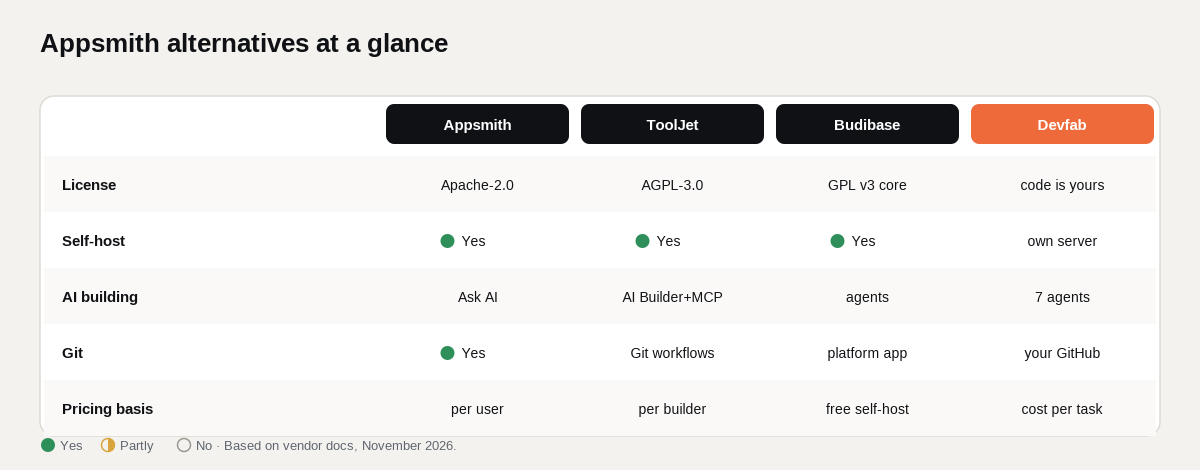
| Tool | Type | Self-host | AI building | Git and code | Pricing model |
|---|---|---|---|---|---|
| Appsmith (baseline) | Open-source internal-tool builder | Yes, any edition | Ask AI, widget Copilot | Git sync with branches and PRs | Free self-hosted; cloud per user; Enterprise base fee |
| ToolJet | Open-source internal-tool builder | Yes, whole platform | AI Builder, MCP for coding agents | Git-based workflows | Per builder, with AI credits |
| Budibase | Open-source apps, automations, agents | Yes, incl. air-gapped | Agents with approval policies | Platform apps | Free self-hosted; Cloud subscription |
| Retool | Internal-tool and AI app builder | Enterprise only | Prompt-first React builder | Git source control on Enterprise | Per builder and per user, plus AI credits |
| Superblocks | Governed enterprise AI builder | Hybrid or Cloud-Prem | Clark AI agent | GitHub, GitLab, Bitbucket, Azure DevOps | Agent units plus per published app |
| Devfab | AI software factory | Deploys to your own server | Research, plan, build, QA, deploy | Normal codebase in your GitHub | Cost logged per task and per project (Beta) |
The alternatives
1. ToolJet
Verdict: the closest open-source swap, with more AI building than Appsmith offers today. Best for: security-sensitive teams that self-host and want coding agents to build governed internal tools. Trade-off: AGPL-3.0 license, and some features are self-hosted only. Pricing: priced per builder, not per end user; free tier; paid tiers include AI credits per builder; Enterprise is custom.
- ToolJet's Community Edition is AGPL-3.0, and you can self-host the whole platform on Docker, Kubernetes, the major clouds or on-prem.
- The "new ToolJet" (September 2026) lets coding agents such as Claude Code, Codex or Cursor create and modify apps through ToolJet MCP, and building that way uses no ToolJet AI credits.
- Its AI Builder creates complete business apps across 100+ integrations, and every generated app stays editable in the visual builder.
- Jet Admin (a competitor, Jul 2026) notes AI-built apps may lack input validation and need developer review.
2. Budibase
Verdict: the best pick for approval-heavy work in regulated organizations. Best for: IT teams building forms, requests and agents around existing systems. Trade-off: Cloud plans have hard monthly action limits. Pricing: free self-hosted Community plan with unlimited users and apps (bring your own AI key); Cloud subscription with creators, end users, actions and AI credits; custom Enterprise.
- Budibase self-hosts on Docker, Kubernetes and more, including air-gapped setups.
- Budibase 4.0 (November 10, 2026) added Approval Policies that decide when a human must step in, agent audit logs and approvals through Slack and Teams.
- It supports any OpenAI-format model through LiteLLM, including open-source models.
- The Community plan has one workspace and one-day automation log retention.
3. Retool
Verdict: the mature commercial choice if you can live without open source. Best for: engineering teams that build many internal tools on company data and want strong governance. Trade-off: self-hosting and Git source control are Enterprise-only. Pricing: free tier for up to 5 users; paid plans per seat with separate builder and internal-user rates; pooled AI credits; agents billed separately by runtime. See Retool's pricing page.
- Retool's AI app builder (GA June 17, 2026) writes React on the frontend and TypeScript on the backend, and you can edit the code in a Code tab.
- Apps inherit central authentication, role-based access and data access policies.
- Retool can import apps built in Lovable, Replit, Cursor or Claude Code and apply the same governance.
- In October 2026 Retool made bring-your-own AI key Enterprise-only, which drew complaints on its forum.
We compare the two head to head in Retool vs Appsmith.
4. Superblocks
Verdict: the enterprise option when security wants everything in your own cloud. Best for: large companies with many semi-technical builders under central IT policy. Trade-off: no free tier, and VPC, SSO, audit logs and source control are Enterprise-only. Pricing: usage-based "Governed Agent Units" for AI work plus a charge per published app; no per-seat builder or end-user fees on the enterprise license.
- Clark, its AI agent, generates an app from chat; you refine it visually or edit the underlying React.
- Superblocks 3.0 (August 2026) added security agents that review each code change, plus SBOM and CVE scanning per app.
- It deploys as Cloud, Hybrid or Cloud-Prem inside your AWS, GCP or Azure account.
5. Devfab
Verdict: a fit when the "internal tool" is really an application with rules, users and a release process. Best for: agencies and product teams that want an approved plan, tested code and their own server. Trade-off: no widget editor and far fewer ready-made data connectors. Pricing: predictable cost: cost is logged after each run, per task and per project. Devfab is in Beta.
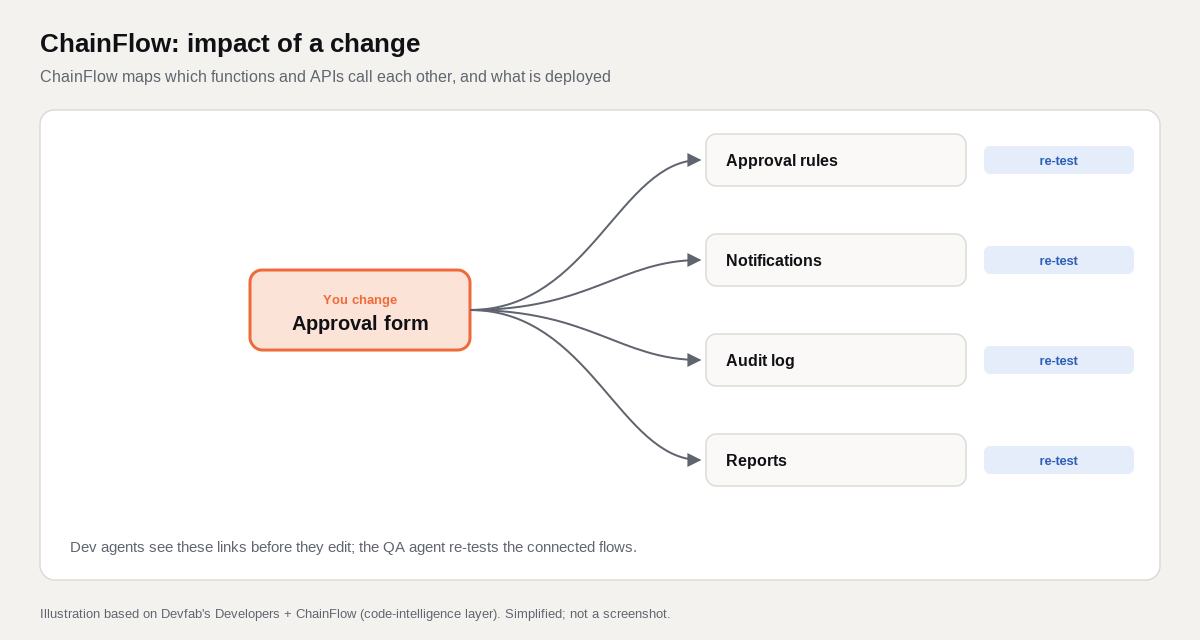
Devfab is an AI software factory, not a low-code builder. Before any plan, its research step maps the domain: key terms, best practices for that kind of app, and competitors, then suggests a prototype. A Planner writes the plan and a person approves it. Developer agents use ChainFlow, Devfab's code-intelligence layer, which maps which functions and APIs call each other so a change to one screen doesn't break a connected flow. The QA agent runs UI and flow tests (screens, buttons and user journeys clicked end to end) plus logic tests. Code lives in your own GitHub account (or your organization's), and Devfab deploys to your own server.
If you already rebuilt part of an Appsmith app as code, choose "Work on an existing project," pick the repo and leave the change box empty. Devfab maps the code first with ChainFlow and suggests three small first tickets.
Coding agents automate the developer. Devfab automates the development lifecycle.
Devfab's honest limits:
- It's new and in Beta, with a much smaller community than Appsmith's open-source project.
- It has fewer integrations than any builder on this list.
- There is no drag-and-drop canvas, and it isn't an editor for hands-on coding.
- It needs a GitHub account, and you own the server and its upkeep.
More detail: Devfab vs Appsmith.
Where Appsmith is still the better choice
- You want a permissive license. Appsmith is Apache-2.0, more permissive than ToolJet's AGPL-3.0 or Budibase's GPL v3 core.
- Many small CRUD screens on existing databases. A visual widget editor with native connectors for PostgreSQL, MongoDB, MySQL, MS SQL, Redis and Snowflake is quicker here than generating full apps.
- Budget. The Community edition is free to self-host, and Appsmith charges no extra for developers who build in the IDE.
- Git-based release flow on a low-code tool. Apps sync to Git for branches, commits, pull requests and merges.
- You don't want AI in the loop yet. If your team builds by hand, the thin AI layer is not a problem.
How to choose
- Same open-source model, more AI building? ToolJet.
- Requests, approvals and agents in Slack or Teams? Budibase.
- Commercial platform, strong governance, budget for seats? Retool.
- Everything inside your own cloud account, large builder base? Superblocks.
- A full application, planned and tested by agents, in your own GitHub? Devfab. Start with What is an AI software factory?
Still unsure whether you need a builder or a custom app? See Internal tool builder vs custom app.
FAQ
Is Appsmith still maintained in 2026?
Yes. The open-source platform shipped its 2.x line in 2026, with a security release in June and version 2.3 in August. The separate Appsmith Agents product is labeled Legacy and closed to new sign-ups.
What replaced the Appsmith AI datasource?
The Appsmith AI datasource was removed on September 30, 2026, and the 2.3 release note names no replacement. Ask AI, an assistant for JavaScript and queries, is now in the Community Edition.
What is the best open-source alternative to Appsmith?
ToolJet is the closest match: an open-source visual builder (AGPL-3.0) you can self-host, now with an AI builder and an MCP server for coding agents. Budibase is the open-source pick for approvals and agents.
Is Devfab a replacement for Appsmith?
Only for some apps. Devfab doesn't give you a widget editor. It researches, plans, builds, tests and deploys a normal codebase in your own GitHub. It fits when an internal tool has become a full application.
Read next
- What is an AI software factory?
- Devfab vs Appsmith
- Retool vs Appsmith
- Appsmith vs Budibase
- Internal tool builder vs custom app
Need the app as code you own? Try the Devfab Beta
Sources (checked November 13, 2026): appsmithorg/appsmith on GitHub; Appsmith pricing; Appsmith Agents (Legacy); Appsmith 2.1: Ask AI, security updates and upgrade notice (Jun 2026); Appsmith 2.3 released; AI datasource EOL (Aug 2026); Appsmith Review 2026 (Superblocks, a competitor, Sep 2026); Meet the new ToolJet (Sep 2026); ToolJet vs Superblocks (ToolJet); ToolJet vs Retool 2026 (Jet Admin, a competitor, Jul 2026); Budibase pricing; Introducing Budibase 4.0 (Nov 2026); Budibase on GitHub; Budibase 2026 roadmap (Dec 2025); Retool pricing; Retool launches a React AI app builder (Jun 2026); Retool extends governance to vibe-coded apps; Retool Forum: BYOK gating (Oct 2026); Superblocks billing overview; Superblocks 3.0 (Aug 2026); Clark AI docs; Superblocks Review 2026 (Jet Admin, a competitor, Sep 2026).
Frequently asked questions
Is Appsmith still maintained in 2026?
Yes. The open-source platform shipped its 2.x line in 2026, with a security release in June and version 2.3 in August. The separate Appsmith Agents product is labeled Legacy and closed to new sign-ups.
What replaced the Appsmith AI datasource?
The Appsmith AI datasource was removed on September 30, 2026, and the 2.3 release note names no replacement. Ask AI, an assistant for JavaScript and queries, is now in the Community Edition.
What is the best open-source alternative to Appsmith?
ToolJet is the closest match: an open-source visual builder (AGPL-3.0) you can self-host, now with an AI builder and an MCP server for coding agents. Budibase is the open-source pick for approvals and agents.
Is Devfab a replacement for Appsmith?
Only for some apps. Devfab doesn't give you a widget editor. It researches, plans, builds, tests and deploys a normal codebase in your own GitHub. It fits when an internal tool has become a full application.