Short answer: Choose an internal tool builder when the app is a set of screens on data you already have, used by staff, and you're happy to run it on the vendor's platform. Choose a custom app when outside users, unusual rules, your own servers or full code ownership matter, or when per-user fees would grow faster than the team.
Your operations team runs on spreadsheets and a shared inbox. The tool they need sits in the backlog, behind every customer-facing feature.
Builder vendors say you can ship it on their platform without waiting for developers. Developers say you'll regret the lock-in. Both are describing real trade-offs, and AI has changed both options in 2026. This page compares them fairly, with the facts from each vendor's own pages.
In this comparison:
- Definitions
- Side-by-side comparison
- When to choose an internal tool builder
- When to choose a custom app
- Where an AI software factory fits
Use the table to narrow it down, then read the section for your case.
Definitions
Internal tool builder
An internal tool builder is a platform for building admin panels, dashboards and approval screens on top of your databases and APIs, mostly for staff. Most started as low-code tools, which IBM defines as building through "visual building blocks" with the option to extend in code (IBM). In 2026 almost all of them added AI app generation:
- Retool made its React AI app builder generally available on June 17, 2026. Apps are "written in React on the frontend and TypeScript on the backend", and a Code tab lets you inspect and edit them (Retool).
- Microsoft Power Apps lets users "describe what they need in natural language" and stores data in Dataverse, with IT policies for data loss prevention, access and auditing (Microsoft).
- Superblocks builds apps with its Clark agent and can run inside your own AWS, GCP or Azure account (Superblocks).
- Appsmith (Apache-2.0), ToolJet (AGPL-3.0 community edition) and Budibase (GPL v3 core) are open source and can be self-hosted (Appsmith on GitHub; ToolJet; Budibase on GitHub).
Custom app
A custom app is software built for your process, with its own codebase that you own. It can be built by your developers, an agency, or AI agents. It runs wherever you deploy it, and nothing about it depends on a platform vendor staying in business or keeping its pricing.
The line is blurring
Builders now accept apps made elsewhere. Retool imports apps from Lovable, Replit, Cursor, Codex, Kiro and Claude Code and applies its governance to them (Retool newsroom). ToolJet lets coding agents such as Claude Code, Codex and Cursor build ToolJet apps over MCP (ToolJet). Microsoft added guidance to "convert a vibe app to a code app" (Microsoft). The question is less "code or no code" and more "whose platform does the app run on?"
Side-by-side comparison
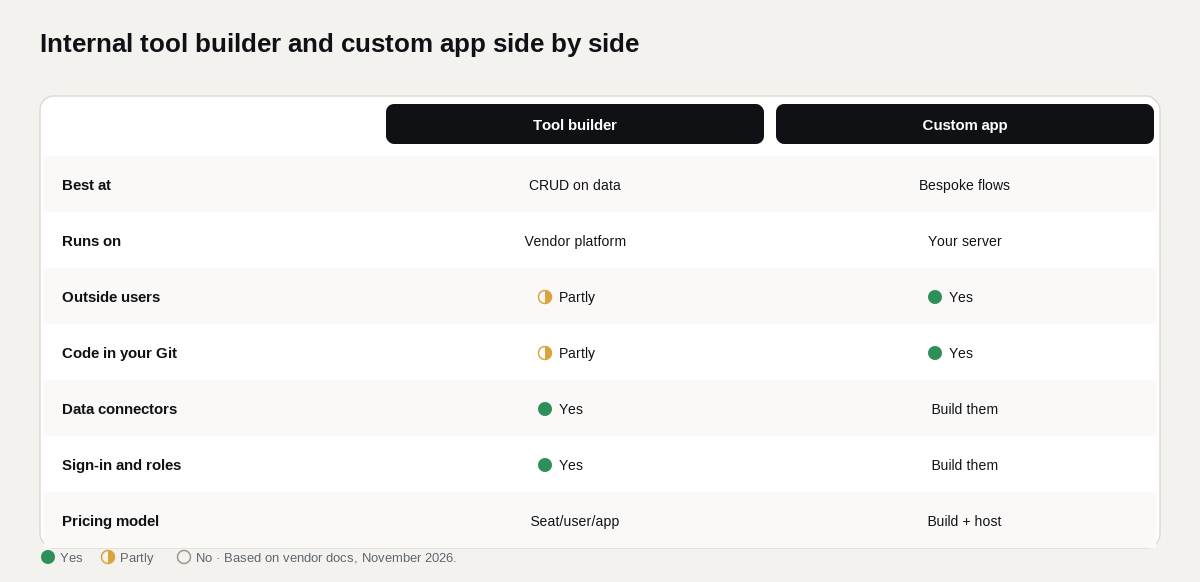
| Aspect | Internal tool builder | Custom app |
|---|---|---|
| Best at | CRUD screens, admin panels, approvals on existing data | Bespoke workflows, outside users, products you resell |
| Who builds | Builders, IT, semi-technical staff, AI in the builder | Developers, an agency, or AI agents |
| Data | Connectors to databases and APIs out of the box | Whatever you build or integrate |
| Users | Mostly staff; outside users often priced separately | Anyone you choose |
| Hosting | Vendor cloud; VPC or self-host on some plans or editions | Your own server or cloud |
| Code ownership | Varies; Git sync is Enterprise-only on Retool | Full repository in your account |
| Sign-in and roles | Built in; custom SSO often on top tiers | You build or integrate it |
| Pricing model | Per seat, per builder, per end user or per app, plus AI credits | Development plus hosting; no platform fee |
| Main risk | Pricing or feature changes you don't control | Build effort and ongoing maintenance |
Sources: Retool pricing; Appsmith pricing; Budibase pricing; Superblocks billing; ToolJet; Bolt blog.
Four questions that decide it
- Who uses it? Staff only points to a builder. Customers, partners or the public point to a custom app, because builders price and design for internal users first. Retool, for example, has tiered pricing for external users (Retool pricing).
- How does pricing scale? Retool charges per seat with separate builder and internal-user rates. Budibase Cloud includes a set number of end users, with more as paid add-ons. ToolJet prices per builder, not per end user. Superblocks charges per published app plus usage. Appsmith charges no extra for developers (Retool; Budibase; ToolJet; Superblocks; Appsmith). Model it for your user count in two years, not today.
- Who controls the rules? Platform changes land on your app. In October 2026 Retool made bring-your-own AI key an Enterprise-only feature, and users complained when managed AI credits ran out; staff acknowledged poor communication (Retool Forum). Appsmith removed its AI datasource on September 30, 2026 (Appsmith).
- Where must it run? If the answer is "on our servers, without a vendor runtime", a custom app is the direct path. Self-hosted builders are an option, but you then run the platform as well as the app.
When to choose an internal tool builder
A builder is the better choice when speed on standard patterns matters more than control. Pick one when:
- The app is a screen on data you already have. Admin panels, lookups and approval queues on PostgreSQL, Snowflake or a REST API are what Appsmith, Retool and ToolJet are built for.
- IT wants one governed place for many small tools. Retool apps inherit "centralized authentication, role-based access controls, and data access policies" (Retool newsroom). Power Apps centralizes environment, DLP and audit policies (Microsoft).
- You live in Microsoft 365. Power Apps fits Dataverse, SharePoint and Teams, and some Microsoft 365 licenses include limited Power Apps use (Microsoft Learn).
- You need open source and self-hosting on a budget. Appsmith's community edition is free to self-manage, and Budibase's Community plan is free to self-host with your own AI key (Appsmith; Budibase).
- Security requires everything inside your cloud. Superblocks can run the build-and-run stack, including AI inference, inside your AWS account (Superblocks).
When to choose a custom app
A custom app is the better choice when the app is part of how you deliver to others, or when the rules are yours alone. Pick one when:
- Outside users need access. Customer portals, citizen request forms and partner tools need their own sign-up, branding and pricing that doesn't count every user as a seat.
- The logic is unusual. Even a builder vendor's blog lists unusual compliance needs, offline-heavy field work, extreme performance demands and deeply bespoke business logic as cases where custom engineering still wins (Bolt blog, Aug 26, 2026).
- You must own the code outright. On Retool, Git source control is Enterprise-only (Retool pricing). A custom app's repository is yours from day one.
- You build for clients. Agencies that deliver internal systems want each client's app in the client's own repository and on the client's own servers, not on a platform account they must keep paying for.
- Per-user fees would outgrow the team. If a tool will reach hundreds of staff or the public, a custom app's cost is mostly build and hosting, not seats.
The honest cost: custom apps need maintenance. Schema changes, permissions and API drift become yours to own (Bolt blog). Name a maintainer before you build.
Where an AI software factory fits
The old reason to pick a builder was that a custom app needed a team you didn't have. An AI software factory changes that trade-off: you get a custom app with code you own, without staffing every stage yourself. Devfab is one. Coding agents automate the developer. Devfab automates the development lifecycle.
- Research, then a plan a person approves. Devfab's research step maps the domain, such as leave policies or work-order states, then the Planner writes the plan. A person approves it before any tickets exist.
- Screens, code and tests. Blueprint drafts the screens. Dev agents work tickets with ChainFlow, which maps which functions and APIs call each other so a change doesn't break connected features. A separate QA agent runs UI and flow tests plus logic tests, such as "a manager can't approve their own leave."
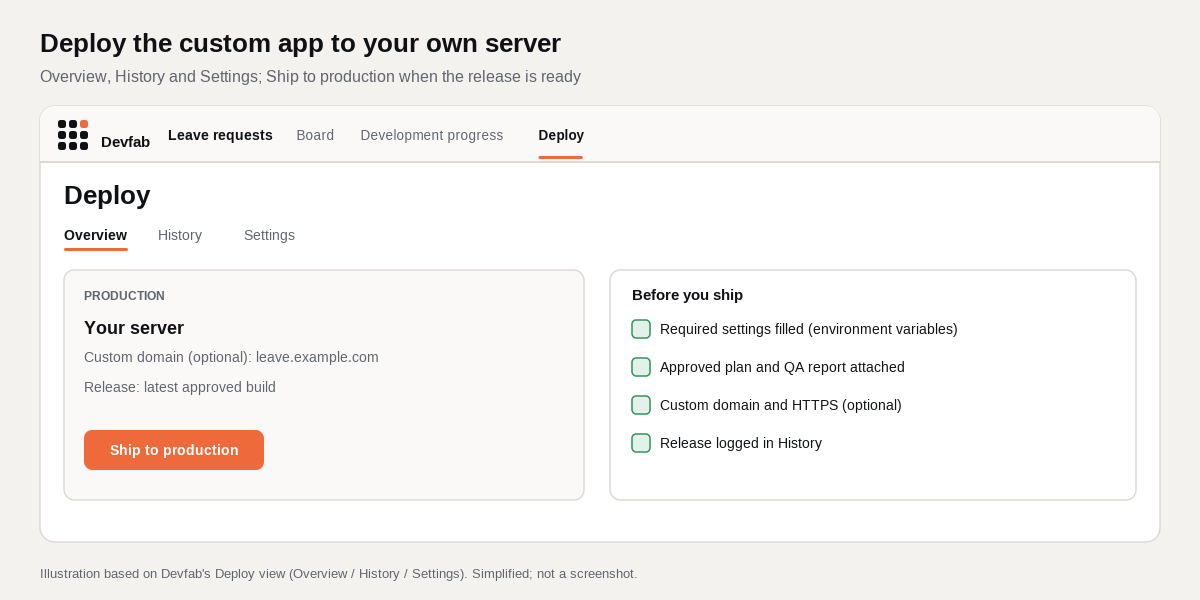
- Your repo, your server. Code lives in your own GitHub account (or your organization's). Deploy ships to your own server, with a custom domain if you want one.
- Docs for staff. Devfab produces blueprints, sequence flows and user manuals, which internal apps need and rarely get.
- Predictable cost. Cost is logged after each run, per task and per project. You can choose the model for each agent or keep Devfab's default.
Devfab's honest limits: it is new and in Beta, with a smaller community and far fewer data connectors than Retool, Appsmith or Power Apps. It is not a drag-and-drop editor and not an editor for hands-on coding. It needs a GitHub account. For a quick admin panel on a single database, a builder is the shorter path.
FAQ
Is an internal tool builder cheaper than a custom app?
At the start, usually yes: several builders have free tiers, and you avoid writing the plumbing. Over time it depends on how pricing scales. Retool charges per seat with separate builder and user rates, Budibase Cloud charges for end users, while ToolJet prices per builder and Superblocks per published app. A custom app has no platform fee, but you pay for development, hosting and maintenance.
Can I export my app from an internal tool builder?
It varies. Retool's new builder writes React and TypeScript you can inspect in a Code tab, but Git source control is an Enterprise feature. Appsmith, ToolJet and Budibase are open source and can be self-hosted. Even then, the app usually still needs the platform to run, so check the export path before you build.
When should an internal tool become a custom app?
Common signals: outside users such as customers or citizens need access, the business rules no longer fit the builder's widgets, the app must run offline or on your own servers without the platform, per-user fees grow faster than the team, or a vendor change breaks something you rely on.
Can AI build a custom internal app without a development team?
AI can do much of the building, but someone still has to define the rules, approve the plan and check the result. In Devfab, a person approves the plan, a QA agent runs UI, flow and logic tests, and the code lives in your own GitHub account so a developer can take over at any point.
Read next
- What is an AI software factory?
- AI software factory vs AI coding tools: what's the difference?
- Retool alternatives (2026)
- Power Apps vs Retool
- Build: HR leave request system
- How to deploy an AI-built app to your own server
Build the internal app you own. Try Beta
Sources (checked November 13, 2026): IBM: Low-code vs no-code; Retool launches a React AI app builder; Retool extends governance to vibe-coded apps; Retool pricing; Retool Forum: AI resources changes; Microsoft Power Apps; Power Platform licensing FAQ; What's new in Power Platform, September 2026; Superblocks: AI-native enterprise tooling stack; Superblocks 3.0; Superblocks billing overview; appsmithorg/appsmith; Appsmith pricing; Appsmith 2.3 release note; Meet the new ToolJet; ToolJet at the start of 2026; ToolJet vs Superblocks (ToolJet); Budibase pricing; budibase/budibase; Can an internal tool builder replace custom dev work? (Bolt blog).
Frequently asked questions
Is an internal tool builder cheaper than a custom app?
At the start, usually yes: several builders have free tiers, and you avoid writing the plumbing. Over time it depends on how pricing scales. Retool charges per seat with separate builder and user rates, Budibase Cloud charges for end users, while ToolJet prices per builder and Superblocks per published app. A custom app has no platform fee, but you pay for development, hosting and maintenance.
Can I export my app from an internal tool builder?
It varies. Retool's new builder writes React and TypeScript you can inspect in a Code tab, but Git source control is an Enterprise feature. Appsmith, ToolJet and Budibase are open source and can be self-hosted. Even then, the app usually still needs the platform to run, so check the export path before you build.
When should an internal tool become a custom app?
Common signals: outside users such as customers or citizens need access, the business rules no longer fit the builder's widgets, the app must run offline or on your own servers without the platform, per-user fees grow faster than the team, or a vendor change breaks something you rely on.
Can AI build a custom internal app without a development team?
AI can do much of the building, but someone still has to define the rules, approve the plan and check the result. In Devfab, a person approves the plan, a QA agent runs UI, flow and logic tests, and the code lives in your own GitHub account so a developer can take over at any point.