Short answer: For an open-source agent in VS Code or JetBrains, pick Cline. For a free terminal or desktop agent with any model, pick OpenCode, the engine Kilo now runs on. For strong enterprise controls, pick Claude Code or GitHub Copilot. If you need the whole project planned, tested and deployed, look at Devfab.
You chose Kilo Code for open source and any model at provider rates. Then three things changed. Anaconda bought Kilo in July. The extension was rebuilt on OpenCode in April. And the open issue count kept growing.
None of that means Kilo is broken. It does mean a team lead should have a plan B ready. This list compares six alternatives using vendor docs and dated reviews from November 2026.
In this guide, you'll learn:
- Why teams leave Kilo Code
- Quick comparison
- The alternatives
- Where Kilo Code is still the better choice
- How to choose
Start with the reasons, then match a tool to yours.
Why teams leave Kilo Code
New owner, new direction. Anaconda announced it acquired Kilo Code on July 15, 2026. It says Kilo "remains available today with no changes to existing products, plans, or support for current users," and plans to bring Kilo's agent features into the Anaconda Platform, with deeper links to its governed packages and environments (Anaconda). For a team that only wants a coding agent, a data-science platform owner is a reason to watch the roadmap.
A rebuilt extension. Kilo's VS Code extension was rebuilt on the open-source OpenCode server and became the default on April 2, 2026 (Kilo blog). Rebuilds change behavior, and some users prefer to pick their own base.
Breadth and backlog. A June 2026 review lists a crowded market, a broad product range and 1,300+ open GitHub issues (rywalker.com).
Billing has moving parts. Inference is billed at provider rates with a 5% fee on credit purchases, Kilo Pass adds a credit subscription, and cloud agents and code review bill per second; Teams and Enterprise include no credits (Kilo pricing; Kilo plans docs).
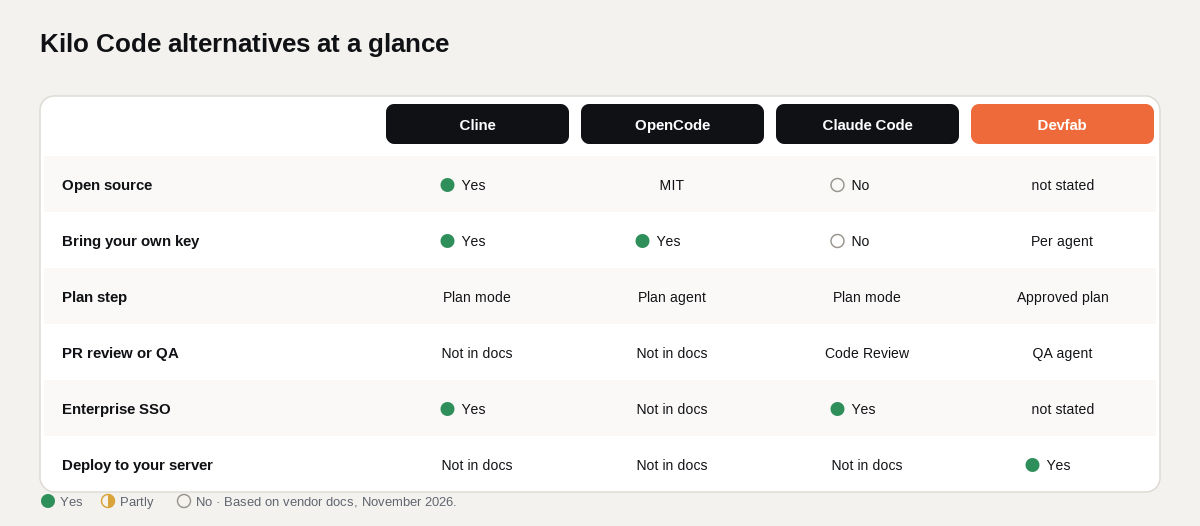
Quick comparison
| Tool | Where it runs | Model choice | Review or QA | Team admin | Price, as of November 2026 |
|---|---|---|---|---|---|
| Kilo Code (baseline) | VS Code, JetBrains, CLI, cloud agents, desktop | 500+ models, BYOK, local | Diff reviewer, cloud code review | Teams; Enterprise SSO, SCIM, audit logs | Free; Teams USD 15 per user per month |
| Cline | VS Code, JetBrains, CLI, desktop, SDK, Kanban | Cline billing, ClinePass, BYOK, local | Not covered in the docs we checked | Enterprise: SSO, RBAC, provider limits | Free (inference extra); Enterprise custom |
| OpenCode | Terminal UI, desktop, mobile, SDK | 200+ providers, local, ChatGPT or Copilot plans | Not covered in the docs we checked | Zen workspaces with per-member budgets | Free; OpenCode Go from USD 10 per month |
| Claude Code | Terminal, IDEs, desktop, web, mobile | Claude models only | Managed Code Review on GitHub PRs | Teams: SSO, managed settings; Enterprise roles | Pro USD 20 per month; Team Standard USD 25 per user per month |
| Cursor | Editor, CLI, cloud agents, mobile | Claude, Gemini, GPT, Grok, Composer | Bugbot PR reviews | SSO on Teams; SCIM, audit logs on Enterprise | Free; Teams USD 30+ per user per month |
| GitHub Copilot | GitHub, IDEs, CLI, desktop app | OpenAI, Anthropic, Google and others | PR code review on paid plans | Policies, audit logs, agent control plane | Pro USD 10 per user per month; Business USD 19 per seat |
| Devfab | Web workspace; code in your GitHub | Choose per agent or keep the default | QA agent: UI, flow and logic tests | Roles, workspace permissions | Cost logged per task and project (Beta) |
The alternatives
1. Cline
Verdict: the closest match to Kilo for developers who want an open-source agent in the editor. Best for: VS Code or JetBrains users who want to approve every action. Trade-off: you approve each action, which slows long multi-step work; Enterprise features need a custom plan. Pricing: free extension, inference billed separately; Enterprise custom (Cline pricing).
- Runs as a VS Code extension, JetBrains plugin, CLI (interactive or headless for CI/CD), desktop app, SDK and Kanban board for parallel agents (Cline docs).
- Plan mode reads and discusses without edits; Act mode carries out the plan, with a different model per mode (Plan and Act).
- Model choice through Cline billing, ClinePass for open-weight models, or your own key, including local runtimes (Cline docs).
- In January 2026, OpenAI hired at least seven Cline staff; OpenAI said it was not an acquisition (TEXXR).
2. OpenCode
Verdict: go to the source. Kilo's extension is built on the OpenCode server. Best for: terminal-first developers who want the widest model choice for free. Trade-off: a June 2026 review reports high RAM use, frequent releases that sometimes break features and permissive defaults (rywalker.com). Pricing: agent free; OpenCode Go from USD 10 per month, as of November 2026 (OpenCode).
- MIT-licensed, with a terminal UI, desktop app (beta), mobile clients and an SDK (OpenCode; GitHub).
- 200+ providers via Models.dev, local models, and reuse of ChatGPT Plus/Pro or GitHub Copilot plans (OpenCode).
- A read-only "plan" agent that denies edits by default and asks before bash commands (GitHub).
- Zen workspaces add member invites, model enablement and per-member budgets (Zen docs).
3. Claude Code
Verdict: the strongest documented enterprise controls among terminal agents. Best for: teams that can standardize on Claude models and want managed settings. Trade-off: Claude models only; usage limits reset on rolling windows shared with Claude chat. Pricing: Pro USD 20 per month; Team Standard USD 25 per user per month; Enterprise USD 20 per seat per month plus API usage, as of November 2026 (Claude pricing).
- Runs in the terminal, VS Code, JetBrains, a desktop app, the web and mobile (Claude Code docs).
- Plan mode explores the codebase and proposes an approach before editing (costs docs).
- Managed Code Review runs several agents on each GitHub PR and posts ranked inline comments; it never approves or blocks a PR (Code Review docs).
- Inference can run through Anthropic, Amazon Bedrock, Google Cloud or Microsoft Foundry (enterprise docs).
4. Cursor
Verdict: pick it if your team wants an AI editor rather than an extension. Best for: developers who live in one editor and want cloud agents and PR reviews. Trade-off: you switch editors; cloud agents need Premium or higher. Pricing: Free; Plus USD 8 per month (Grok models only); Premium USD 30 per month; Teams USD 30+ per user per month, as of November 2026 (Cursor pricing).
- Cursor is now a SpaceX subsidiary; the deal closed per Cursor's August 14, 2026 post (Cursor blog).
- Plan Mode drafts an editable plan before code (Cursor docs).
- Cloud agents run in isolated VMs on GitHub, GitLab, Bitbucket Cloud or Azure DevOps (cloud agents).
- Bugbot reviews PRs, and Autofix can push fixes to a branch (Bugbot).
5. GitHub Copilot
Verdict: the low-friction choice when code, issues and reviews already live on GitHub. Best for: organizations that want per-seat pricing and GitHub-native agent governance. Trade-off: the cloud agent only works with GitHub-hosted repos, and Actions-based sessions are scoped to one repository and one PR per task. Pricing: Free; Pro USD 10 per user per month; Business USD 19 per granted seat per month; Enterprise USD 39, as of November 2026 (Copilot plans).
- Agent mode in the IDE asks for approval on changes and terminal commands (Copilot features).
- The cloud agent can research a repository and create an implementation plan first (same source).
- Models from OpenAI, Anthropic, Google, Microsoft, Moonshot AI and xAI (supported models).
- Enterprise AI Controls and the agent control plane went GA on February 26, 2026 (GitHub changelog).
6. Devfab
Verdict: not an editor agent, so it is not a like-for-like swap. It fits when the real need is to deliver whole apps, not faster edits. Best for: agencies and IT teams shipping client projects that need an approved plan, tests and deployment. Trade-off: in Beta, smaller community, fewer integrations, needs a GitHub account, and not an editor for hands-on coding. Pricing: predictable cost; cost is logged after each run, per task and per project.
- The Researcher maps the domain, best practices and competitors before the Planner writes a plan, then suggests a prototype.
- A person approves the plan; the Coordinator then splits it into tickets for dev agents.
- Dev agents work with ChainFlow, which maps which functions and APIs call each other and what is deployed, so a change to checkout doesn't break payments or notifications.
- The QA agent runs UI and flow tests plus logic tests, and Deploy ships to your own server. You can choose the model for each agent or keep Devfab's default.
Where Kilo Code is still the better choice
- You want the biggest model menu in the editor. Kilo Gateway lists 500+ models from 60+ providers at provider rates (Kilo pricing).
- You run several agents side by side. Agent Manager runs tabs in git worktrees and can compare one prompt across several models (Kilo blog).
- You want cheap seats with governance. Teams at USD 15 per user per month adds usage analytics and shared BYOK; Enterprise adds SSO, SCIM and audit logs.
- You came from Roo Code. Kilo published a Roo migration path after Roo shut down (Kilo blog).
- Nothing has changed for you yet. Anaconda says current products, plans and support are unchanged.
How to choose
- Keep the same workflow, lower risk: Cline in the same editors, or OpenCode if you like Kilo's engine.
- Need enterprise controls and support: Claude Code or GitHub Copilot.
- Want a full AI editor: Cursor.
- Need projects planned, tested and shipped, not just edited: Devfab. Coding agents automate the developer. Devfab automates the development lifecycle.
Whichever you pick, test it on one real ticket in a branch before you move a team. For head-to-head detail, see Kilo Code vs Cline, Claude Code vs Kilo Code and Devfab vs Kilo Code.
FAQ
Is Kilo Code still available after the Anaconda acquisition?
Yes. Anaconda announced the acquisition on July 15, 2026 and said Kilo remains available with no changes to existing products, plans or support for current users. Anaconda plans to bring Kilo's agent features into the Anaconda Platform over time.
What is the closest open-source alternative to Kilo Code?
Cline, if you want an open-source agent inside VS Code or JetBrains with bring-your-own-key model choice. OpenCode, if you prefer a terminal or desktop app; Kilo's own VS Code extension is now built on the OpenCode server.
Which Kilo Code alternative is best for enterprise admin?
GitHub Copilot and Claude Code have the most documented controls. Copilot Enterprise adds audit logs and the agent control plane; Claude Code Teams and Enterprise add SSO, managed settings and spend limits. Cline Enterprise adds SSO, RBAC and provider restrictions.
I moved from Roo Code to Kilo. Where should I go now?
Roo Code shut down on May 15, 2026, and its README recommends Zoo Code, a community fork, and Cline. If Kilo still works for you, the Anaconda deal changed nothing for current users yet; Cline is the closest editor-based option if you want to move.
Read next
- What is an AI software factory?
- Devfab vs Kilo Code
- Kilo Code vs Cline
- Claude Code vs Kilo Code
- Single-agent vs multi-agent coding
Looking past the editor? Try a factory that runs the whole project. Try Beta
Sources (checked November 2026): Anaconda acquires Kilo Code (Jul 15, 2026); Kilo blog: The new Kilo for VS Code (Apr 2, 2026); Kilo blog: Thank you, Roo (Apr 21, 2026); Kilo pricing; Kilo docs: About plans; rywalker.com: Kilo (Jun 2026); RooCodeInc/Roo-Code on GitHub; Cline docs; Cline Plan and Act; Cline pricing; TEXXR (Jan 29, 2026); OpenCode; anomalyco/opencode on GitHub; OpenCode Zen docs; rywalker.com: OpenCode (Jun 2026); Claude Code docs; Claude Code costs; Claude Code Code Review; Claude Code enterprise deployment; Claude pricing; Cursor pricing; Cursor blog: Joining SpaceX; Cursor Plan Mode; Cursor cloud agents; Cursor Bugbot; GitHub Copilot plans; Copilot features; Copilot supported models; GitHub changelog: Enterprise AI Controls GA (Feb 26, 2026).
Frequently asked questions
Is Kilo Code still available after the Anaconda acquisition?
Yes. Anaconda announced the acquisition on July 15, 2026 and said Kilo remains available with no changes to existing products, plans or support for current users. Anaconda plans to bring Kilo's agent features into the Anaconda Platform over time.
What is the closest open-source alternative to Kilo Code?
Cline, if you want an open-source agent inside VS Code or JetBrains with bring-your-own-key model choice. OpenCode, if you prefer a terminal or desktop app; Kilo's own VS Code extension is now built on the OpenCode server.
Which Kilo Code alternative is best for enterprise admin?
GitHub Copilot and Claude Code have the most documented controls. Copilot Enterprise adds audit logs and the agent control plane; Claude Code Teams and Enterprise add SSO, managed settings and spend limits. Cline Enterprise adds SSO, RBAC and provider restrictions.
I moved from Roo Code to Kilo. Where should I go now?
Roo Code shut down on May 15, 2026, and its README recommends Zoo Code, a community fork, and Cline. If Kilo still works for you, the Anaconda deal changed nothing for current users yet; Cline is the closest editor-based option if you want to move.