Short answer: If you want to stay on spreadsheet data with a no-code builder, pick Softr (client portals and internal apps) or Airtable (data-first apps built with its Omni AI). If you need self-hosting, pick Budibase. If the app must become software you own, tested and deployed to your own server, Devfab fits better.
You built your operations on a Glide app. Then Glide rebuilt itself as GlideOS, and the bill started moving with AI credits. Glide's own community says credit costs are hard to predict, and agent mistakes still use credits. Some teams also find the app has outgrown "internal" and now needs code they control. That is when people start comparing.
In this guide, you'll learn:
- Why teams leave Glide
- How the six alternatives compare
- Which tool fits which job
- Where Glide is still the better choice
Each section uses vendor pages and community threads we opened on November 13, 2026.
Why teams leave Glide
Status first. Glide is active, but it is a different product than it was in 2025. On March 5, 2026, Glide announced "an entirely new version of our product, built from the ground up for the AI age." Staff said the new platform was live on June 4, 2026, and the GlideOS launch event followed in August. The previous builder continues as Glide Classic, with no stated sunset date.
The main switching triggers we found, all from public sources:
- Credit costs are hard to predict. GlideOS pricing is credit-based, and credits meter AI token use. A Glide community thread from June 2026 reports that costs are hard to forecast and that agent mistakes still consume credits. A Glide staff member replied in July 2026 that credit transparency is "one of the biggest pieces of feedback."
- Caps on lower plans. Lower tiers cap team members, published apps and enabled workflows. The Free plan cannot publish apps, and extra credits are only on paid plans.
- SSO only on Enterprise. Teams with an identity provider need the top plan.
- No documented code export. We found no export path to GitHub in Glide's pages, and a Glide community answer from April 2025 says it isn't possible. If you need the source code, Glide isn't built for that.
- Roadmap gaps at launch. "Build with MCP" was still a Q3 roadmap item at the August 2026 launch, not a shipped feature.
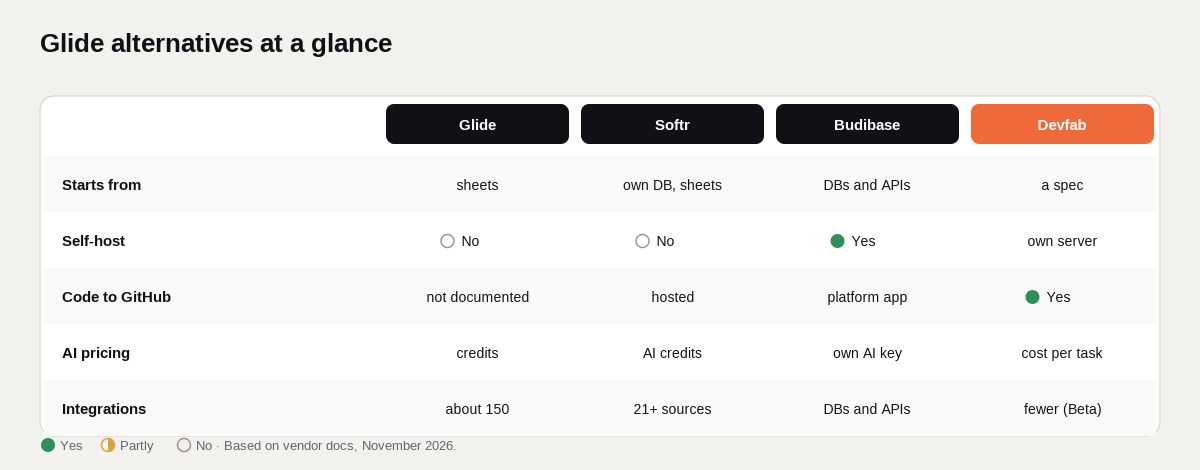
Quick comparison
| Tool | Type | Data it starts from | Self-host | Code ownership | Pricing model |
|---|---|---|---|---|---|
| Glide (baseline) | AI app builder for internal apps | Excel, Google Sheets, ~150 integrations | No, hosted | No documented export | Credits, plan caps, Pro by seat |
| Softr | No-code portal and app builder | Softr Databases, Airtable, Sheets, 21+ sources | No, hosted | Hosted apps | Workspace plans with builders, users, AI credits |
| Airtable | No-code database and apps (Omni AI) | Airtable bases, spreadsheets, PDFs | No, hosted | Custom element code downloadable | Per collaborator, pooled AI credits |
| Microsoft Power Apps | Low-code platform | Dataverse, Microsoft 365, connectors | Microsoft cloud | Platform apps in Dataverse solutions | Per user or per app, plus capacity |
| Budibase | Open-source apps, automations, agents | Your databases and APIs | Yes, incl. air-gapped | Open-source platform apps | Free self-hosted; Cloud subscription |
| Lovable | AI app builder | Prompts; built-in backend or Supabase | Export and host elsewhere | Git sync to GitHub | Monthly credits |
| Devfab | AI software factory | A description, spec or existing repo | Deploys to your own server | Code in your own GitHub | Cost logged per task and per project (Beta) |
The alternatives
1. Softr
Verdict: the closest swap for teams that want to keep building without engineers. Best for: client portals and internal apps on Airtable, Google Sheets or Notion data. Trade-off: hosted only, and app users are capped per plan. Pricing: workspace plans (Free, Basic, Pro, Business, Enterprise) that include a set number of builders and app users, a monthly workflow limit and monthly AI credits that don't roll over. See Softr's pricing page.
- From a prompt, Softr generates the pages, database, permissions and workflows; you then refine visually or with AI.
- It connects to its own Softr Databases plus 21+ sources, with Airtable, Google Sheets, Notion and REST APIs on every plan.
- User groups control which pages and buttons each person sees, and AI agents can wait for human approval before acting.
- Softr says client portals are "the most common starting point." Jet Admin's review (a competitor, Sep 2026) notes there is no native App Store or Google Play publishing.
2. Airtable
Verdict: the best pick when the "app" is mostly structured data and simple workflows. Best for: teams that would rather move the spreadsheet into a real database than wrap it. Trade-off: new ownership and some Omni gaps. Pricing: Free, Team and Business self-serve plans billed per billable collaborator, with pooled monthly AI credits. Building with Omni does not use credits; Q&A does.
- Status: Bending Spoons closed its acquisition of Airtable in early September 2026 and announced layoffs on October 12, 2026; Airtable said plans and pricing were unchanged.
- Omni builds tables, fields, automations, dashboards and interface pages from a prompt. Omni 2.0 (October 2026) builds data models from spreadsheets, PDFs and images.
- Omni asks before deletions and leaves publishing interfaces and turning on automations to you.
- Omni can't create new views, set up syncs or export data, per Airtable's support docs.
3. Microsoft Power Apps
Verdict: the natural move if your spreadsheets already live in Microsoft 365. Best for: organizations on Microsoft 365, Entra and Dataverse that want apps inside tenant governance. Trade-off: licensing has many parts. Pricing: per-user or per-app licenses, pay-as-you-go via Azure (preview), a free non-production Developer Plan, and paid Dataverse capacity. Check Microsoft's licensing FAQ.
- Makers describe what they need in plain language and Power Apps generates the app.
- IT can centralize policies for environments, data loss prevention, access and auditing.
- Premium, on-premises and custom connectors need a standalone license beyond Microsoft 365 seeded rights.
- We compare it in more depth in Microsoft Power Apps alternatives.
4. Budibase
Verdict: the pick when data must stay on your own infrastructure. Best for: IT teams in regulated settings that want forms, approvals and agents on existing systems. Trade-off: you run the servers if you self-host, and Cloud has hard monthly action limits. Pricing: a free self-hosted Community plan (unlimited users, apps and agents; bring your own AI key), a Cloud subscription, and custom Enterprise.
- Budibase runs on its Cloud or self-hosted on private cloud, on-premise or air-gapped setups.
- The core platform is open source under GPL v3.
- Budibase 4.0 (November 10, 2026) added Approval Policies that decide when a human must step in, and approvals through Slack and Teams.
5. Lovable
Verdict: the fastest route from a prompt to a polished, customer-facing web app. Best for: founders and small teams who want a hosted web app with login and a database in one bill. Trade-off: no choice of framework, database or model. Pricing: credit-based plans (Free, Pro, Business, Enterprise), priced by monthly credits rather than seats.
- Plan mode writes a plan for approval before Lovable changes the project.
- Git sync works with GitHub, GitLab or Bitbucket, and paid plans can download the codebase.
- Lovable's terms don't allow protected health information or payment card data, which rules out some operations apps.
6. Devfab
Verdict: the right move when the Glide app has become real software that must be owned, tested and deployed by you. Best for: agencies and teams turning a spreadsheet process into a custom app for production. Trade-off: no drag-and-drop editor, and someone owns the code and the server. Pricing: predictable cost: cost is logged after each run, per task and per project. Devfab is in Beta.
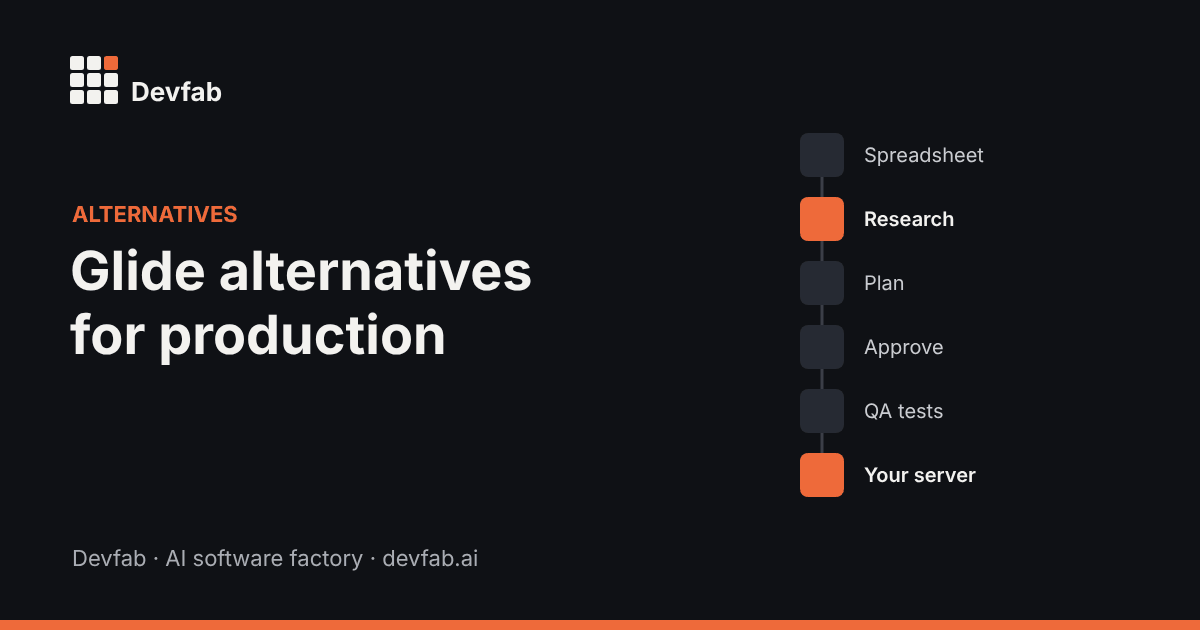
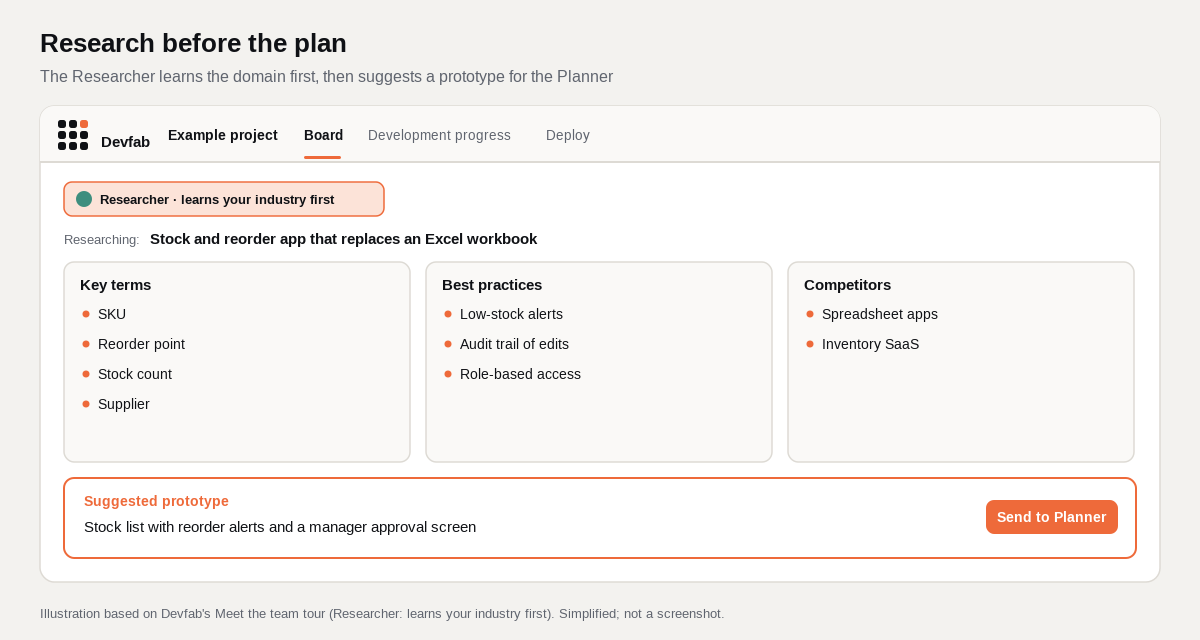
Devfab is an AI software factory. You describe the app, or attach the spreadsheet as a spec. Devfab's research step maps the domain before any plan: key terms, best practices for that kind of app, and competitors, then suggests a prototype. For a stock app, that puts reorder points, stock counts and audit trails on the table first. A Planner writes the plan, and a person approves it (Human in the loop is the default). Developer agents build with ChainFlow, which maps which functions and APIs call each other, so a change doesn't break connected features. The QA agent runs UI and flow tests (screens, buttons and user journeys clicked end to end) plus logic tests. The code lives in your own GitHub account (or your organization's), and the Deploy agent ships to your own server.
Coding agents automate the developer. Devfab automates the development lifecycle.
Devfab's honest limits:
- It's new and in Beta, with a smaller community than any tool above.
- It has far fewer ready-made integrations than Glide's catalog of about 150.
- It isn't a no-code editor, and it isn't an editor for hands-on coding either.
- It needs a GitHub account, and you are responsible for the server you deploy to.
See the full side-by-side in Devfab vs Glide.
Where Glide is still the better choice
- Your operations live in Excel or Google Sheets, and ops staff will run the app. SheetSense scans spreadsheets for formulas, macros, pivot tables and charts, and asks you to confirm before it builds.
- You want the agent to keep working after the build. Glide's agent can operate the app, query data and run code, and Ask Glide answers questions from live business data.
- Integrations matter more than code. Glide shows about 150 integrations, including Salesforce, NetSuite, HubSpot, Shopify and Jira.
- AI governance in one hosted product. Glide sets AI spend budgets by team and model, allows approved models only, and keeps apps private to the company by default.
- Ready-made systems. Glide's App Store has pre-built multi-app systems that are free to copy.
How to choose
- Non-engineers will build and maintain it, on Airtable, Sheets or Notion? Softr.
- The data itself is the product? Airtable.
- You're a Microsoft 365 shop? Power Apps.
- Data must stay on your servers, maybe air-gapped? Budibase.
- A customer-facing web app from prompts, fast? Lovable.
- A custom app you own, with an approved plan, UI and flow tests, and your own server? Devfab. Read What is an AI software factory? first.
If you can't decide between staying low-code and owning code, Low-code vs AI software factory walks through that choice.
FAQ
Is Glide shutting down?
No. Glide relaunched as GlideOS in 2026. It announced the new platform in March, said it was live in June and held a launch event in August. The older builder continues as Glide Classic, and its page gives no sunset date.
What is the closest alternative to Glide for spreadsheet-based apps?
Softr is the closest match. It builds client portals and internal apps on Airtable, Google Sheets, Notion and other sources, plus its own database, and non-engineers can maintain the permissions and workflows.
Can I export a Glide app's code to GitHub?
We found no documented export in the Glide pages we checked, and a Glide community answer from April 2025 says it isn't possible. Your data stays in your own sources, such as Google Sheets or Excel, so it moves with you.
Which Glide alternative can I self-host?
Budibase has a free self-hosted Community plan and supports private cloud, on-premise and air-gapped setups. Devfab deploys the app it builds to your own server. Softr, Airtable and Glide are hosted services.
Is Devfab a no-code tool like Glide?
No. Devfab is an AI software factory. Its agents research, plan, build, test and deploy a normal codebase in your own GitHub account. There is no drag-and-drop editor, and someone must approve the plan and own the server.
Read next
Outgrown your spreadsheet app? Try the Devfab Beta
Sources (checked November 13, 2026): Glide homepage; Glide pricing; GlideOS launch recap (Aug 2026); Glide Classic; Introducing a new Glide, built for the AI age (Glide community, Mar 2026); Pricing issues with GlideOS (Glide community, Jun–Jul 2026); Is it possible to export a Glide app into a GitHub repository? (Glide community, Apr 2025); Softr homepage; Softr AI App Builder; Softr pricing and plans (docs); Softr Review 2026 (Jet Admin, a competitor, Sep 2026); Back to bases (Airtable, Oct 2026); Airtable Fall Release: Omni 2.0 (Oct 2026); Using Omni AI in Airtable; Airtable AI billing; Microsoft Power Apps; Power Platform licensing FAQ; Budibase homepage; Budibase pricing; Introducing Budibase 4.0 (Nov 2026); Budibase on GitHub; Lovable FAQ; Lovable GitHub integration.
Frequently asked questions
Is Glide shutting down?
No. Glide relaunched as GlideOS in 2026. It announced the new platform in March, said it was live in June and held a launch event in August. The older builder continues as Glide Classic, and its page gives no sunset date.
What is the closest alternative to Glide for spreadsheet-based apps?
Softr is the closest match. It builds client portals and internal apps on Airtable, Google Sheets, Notion and other sources, plus its own database, and non-engineers can maintain the permissions and workflows.
Can I export a Glide app's code to GitHub?
We found no documented export in the Glide pages we checked, and a Glide community answer from April 2025 says it isn't possible. Your data stays in your own sources, such as Google Sheets or Excel, so it moves with you.
Which Glide alternative can I self-host?
Budibase has a free self-hosted Community plan and supports private cloud, on-premise and air-gapped setups. Devfab deploys the app it builds to your own server. Softr, Airtable and Glide are hosted services.
Is Devfab a no-code tool like Glide?
No. Devfab is an AI software factory. Its agents research, plan, build, test and deploy a normal codebase in your own GitHub account. There is no drag-and-drop editor, and someone must approve the plan and own the server.