Short answer: goose wins for developers who want a free, Apache 2.0 agent on their own machine, any of 15+ model providers including local models, and foundation governance instead of a vendor. Claude Code wins for engineering teams that want a managed agent with plan mode, PR code review, SSO, managed permissions and spend controls across terminal, IDE, desktop and web.
You write code most of the day and pay for your own AI tools. Or you lead a platform team and must pick one agent for many developers.
The open-source crowd says goose: free, model-agnostic, no lock-in. The other crowd says Claude Code: one vendor, more polish, more controls. Both sides are right about something. This page sorts it out with sources checked on November 20, 2026.
In this comparison:
- Goose and Claude Code at a glance
- Feature comparison
- Cost model by team size
- Where goose wins
- Where Claude Code wins
Start with who now runs goose.
Goose and Claude Code at a glance
goose left Block. goose moved to the Agentic AI Foundation (AAIF) at the Linux Foundation; the repository moved from block/goose to aaif-goose/goose and the docs to goose-docs.ai (goose blog, April 7, 2026). TechCrunch reported in December 2025 that OpenAI, Anthropic and Block joined the new Linux Foundation effort, and that thousands of Block engineers used goose weekly at the time (TechCrunch). Releases v1.58 and v1.59 in mid-November 2026 added a context window viewer, deferred MCP tools and resumable subagent delegates (goose releases).
goose is a free, open-source, general-purpose AI agent built in Rust. It runs as a desktop app on macOS, Linux and Windows, as a CLI, and through an API for embedding (goose README).
Claude Code is Anthropic's coding agent. It reads your codebase, edits files, runs commands and opens pull requests. It runs in the terminal, VS Code, JetBrains, a desktop app, the web and the Claude mobile app (Claude Code docs). In 2026, "routines" were renamed cloud scheduled tasks, which run even when your computer is off (same source).
Feature comparison
| Aspect | goose | Claude Code | Source |
|---|---|---|---|
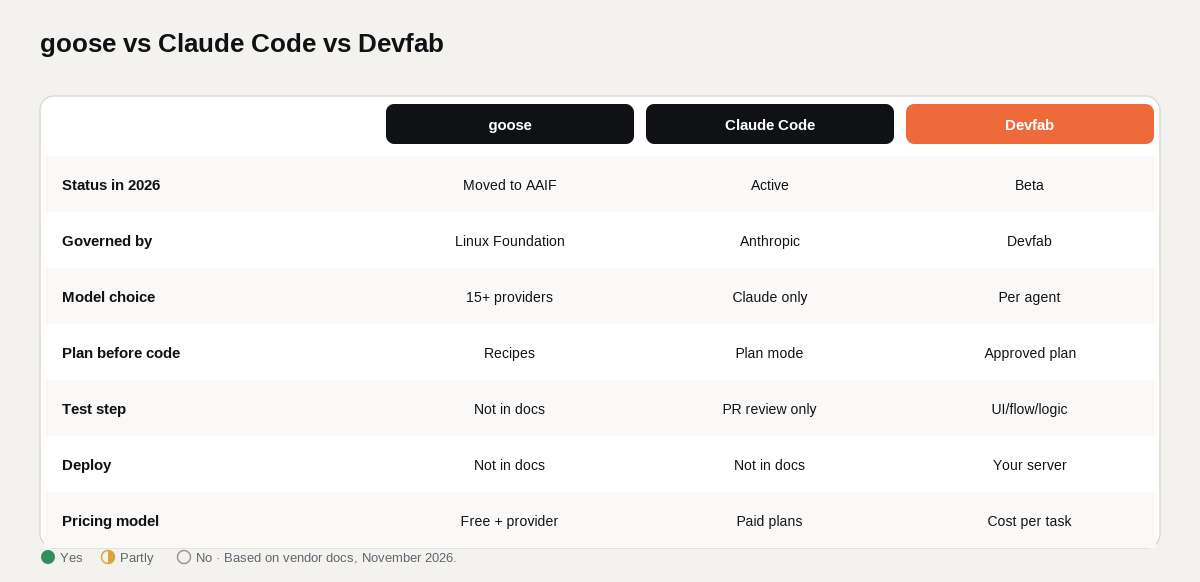
| Where it runs | Desktop app (macOS, Linux, Windows), CLI, API | Terminal, VS Code, JetBrains, desktop, web, mobile; GitHub Actions, GitLab CI/CD, Slack | goose README; Claude Code docs |
| Planning | Recipes save workflows as portable YAML | Plan mode explores the code and proposes an approach for approval | goose docs; Claude Code costs |
| Agent autonomy | Parallel subagents | Subagents, background agents, agent teams (experimental) | goose docs; Claude Code docs |
| Review and testing | Not covered in the docs we checked | Managed Code Review on GitHub PRs (Team and Enterprise) | Claude Code Code Review |
| Automation | Recipes can run in CI | Cloud scheduled tasks triggered by API calls or GitHub events | goose docs; Claude Code docs |
| Extensions | 70+ extensions via MCP; works as an ACP server | MCP servers, skills, hooks, CLAUDE.md or AGENTS.md | goose README; Claude Code docs |
| Team and admin | Custom distributions with preset providers and extensions | SSO on Team; managed permissions; spend limits and OpenTelemetry export | goose README; Claude Code enterprise; Claude Code costs |
| Model choice | 15+ providers incl. Anthropic, OpenAI, Google, Ollama, Bedrock; ACP agents as providers | Claude models only, switchable with /model; inference via Anthropic, Bedrock, Google Cloud or Foundry | goose README; Claude Code costs; Claude Code enterprise |
| Pricing model | Free (Apache 2.0); you pay your model provider | Included in paid Claude plans; usage limits; API rates beyond | goose docs; Claude pricing |
Cost model by team size
| Team size | goose | Claude Code | Devfab |
|---|---|---|---|
| 1 person | Free; pay your provider, or run local models via Ollama | Pro, USD 20 per month (USD 17 per month billed annually); Max USD 100 or Ultra USD 200 per month | Cost logged per task and per project (Beta) |
| 5 people | Free; each developer's provider usage, or a shared provider account | Team Standard, USD 25 per user per month (USD 20 annual); Team Premium USD 125 (USD 100 annual) | Cost logged per task and per project (Beta) |
| 25 people | Free; consider a custom distribution with preset providers | Team, or Enterprise at USD 20 per seat per month billed annually (20-seat minimum) plus usage at API rates | Cost logged per task and per project (Beta) |
Prices as of November 2026 from Claude pricing. goose has no vendor pricing (goose docs). Claude Code is not in the Free plan, and usage limits are shared across Claude web, desktop, mobile and Claude Code. Devfab is in Beta and offers predictable cost: cost is logged after each run, per task and per project.
Where goose wins
- You want zero license cost. goose is free under Apache 2.0.
- You want any model, including local. 15+ providers, plus Ollama for models on your own machine.
- You don't want a single vendor. Governance sits with a Linux Foundation project, not one company.
- You want to brand or embed it. Custom distributions preset providers, extensions and branding.
- You already pay for another AI subscription. goose can use Claude, ChatGPT or Gemini subscriptions through ACP.
Where Claude Code wins
- You want reviews on every PR. Managed Code Review runs several agents and posts severity-ranked comments.
- Security needs central control. Managed permissions can't be overridden by local config.
- Work should run while you're away. Cloud scheduled tasks run when your laptop is off.
- You use many surfaces. Terminal, IDEs, desktop, web, mobile, Slack and CI from one product.
- Finance wants spend controls. Org spend limits, an analytics dashboard and per-user reporting.
Both have documented limits. A September 2026 review of goose notes no default sandbox per run, no built-in model and community-only support with no SLA (PromptQuorum). Anthropic says Claude Code's Code Review reads the diff without building or running it, and a review with no findings "doesn't mean your code is error-free or secure" (Claude Code Code Review). Agent teams use roughly 7x more tokens than standard sessions when teammates run in plan mode (Claude Code costs).
Switching from one to the other
From Claude Code to goose. You don't have to drop Claude Code. goose can use ACP agents such as Claude Code as providers, so you can try goose as the front end first (goose docs). Then point goose at your preferred provider and recreate your MCP servers as goose extensions.
From goose to Claude Code. Install Claude Code and move project rules into CLAUDE.md or AGENTS.md, which Claude Code reads. Reconnect your MCP servers. Turn recurring goose recipes into skills or cloud scheduled tasks (Claude Code docs).
Where Devfab fits
Both tools are developer agents. They make one developer faster inside a repo. Neither, in the docs we checked, researches the domain before planning a whole project, sends that plan to a person for approval, runs a separate UI and flow test pass, and deploys.
Coding agents automate the developer. Devfab automates the development lifecycle. Its Researcher maps key terms, best practices and competitors before the Planner writes a plan. A person approves the plan, the Coordinator splits it into tickets, and dev agents use ChainFlow to see which functions and APIs a change touches. The QA agent runs UI, flow and logic tests. You can choose the model for each agent or keep Devfab's default. Devfab is in Beta, has a smaller community, is not an editor for hands-on coding, and needs a GitHub account. See Devfab vs goose and Devfab vs Claude Code.
FAQ
Is goose still made by Block?
No longer. Block created goose, but it moved to the Agentic AI Foundation at the Linux Foundation. The repository moved from block/goose to aaif-goose/goose and the docs to goose-docs.ai, per the goose blog post of April 7, 2026.
Is goose free compared with Claude Code?
goose is free and open source under Apache 2.0; you pay your model provider or run local models through Ollama. Claude Code comes with paid Claude plans: as of November 2026, Pro is USD 20 per month and Team Standard USD 25 per user per month. It is not in the Free plan.
Can goose use Claude Code?
Yes. goose can use ACP agents such as Claude Code and Codex as providers, and it can use existing Claude, ChatGPT or Gemini subscriptions through ACP. Some developers keep goose as the front end and switch the agent or model behind it.
Which is safer to run on a company laptop?
Claude Code has more built-in controls: managed permissions that local config cannot override, SSO on Team, and spend limits. A September 2026 review notes goose has no default sandbox per run and community-only support. Either way, review what each agent is allowed to run.
Read next
- What is an AI software factory?
- Claude Code alternatives
- Best open-source AI coding agents
- AI software factory vs AI coding tools
Ready to automate the lifecycle, not just the developer? Try Beta
Sources (checked November 2026): goose moves to AAIF (goose blog, Apr 7, 2026); goose docs; goose README; goose releases; TechCrunch: OpenAI, Anthropic and Block join Linux Foundation effort (Dec 9, 2025); PromptQuorum: goose review (Sep 12, 2026); Claude Code docs: Overview; Claude Code docs: Enterprise deployment; Claude Code docs: Code Review; Claude Code docs: Manage costs; Claude pricing.
Frequently asked questions
Is goose still made by Block?
No longer. Block created goose, but it moved to the Agentic AI Foundation at the Linux Foundation. The repository moved from block/goose to aaif-goose/goose and the docs to goose-docs.ai, per the goose blog post of April 7, 2026.
Is goose free compared with Claude Code?
goose is free and open source under Apache 2.0; you pay your model provider or run local models through Ollama. Claude Code comes with paid Claude plans: as of November 2026, Pro is USD 20 per month and Team Standard USD 25 per user per month. It is not in the Free plan.
Can goose use Claude Code?
Yes. goose can use ACP agents such as Claude Code and Codex as providers, and it can use existing Claude, ChatGPT or Gemini subscriptions through ACP. Some developers keep goose as the front end and switch the agent or model behind it.
Which is safer to run on a company laptop?
Claude Code has more built-in controls: managed permissions that local config cannot override, SSO on Team, and spend limits. A September 2026 review notes goose has no default sandbox per run and community-only support. Either way, review what each agent is allowed to run.