Short answer: goose wins when a developer wants a free, open-source agent on their own machine, with any of 15+ model providers, local models and shareable recipes. Devfab wins when a team ships client work and needs domain research, a plan a person approves, tickets, a separate QA agent and deployment to the client's own server.
Your developers installed goose, and they like it. It's free, it's open source, and it works with whatever model they prefer. Then a client asks for a project plan, a test report and the app running on their own servers. goose can help with each step if someone drives it. The question is who drives the project. One camp says a good open agent is enough. The other says client work needs a delivery line. This page referees, using sources checked in November 2026.
In this comparison:
- What each tool is built for
- Switching triggers
- Cost model by team size
- Where goose is the better choice
- Where Devfab is the better choice
Start with what each product is for.
What each tool is built for
goose
Status: goose moved from Block to the Linux Foundation. In a post dated April 7, 2026, the goose project announced it now lives at the Agentic AI Foundation (AAIF). The repo moved from block/goose to aaif-goose/goose, and the docs moved to goose-docs.ai (goose blog). When Block donated it, it said thousands of its engineers used goose every week (TechCrunch, Dec 2025). If you bookmarked old block/goose links, update them.
goose is a general-purpose AI agent that runs on your own machine, for coding as well as research, writing, automation and data work:
- Where it runs: a native desktop app for macOS, Linux and Windows, a CLI, and an API for embedding. It is built in Rust (goose README).
- Model freedom: 15+ providers, including Anthropic, OpenAI, Google, Ollama, OpenRouter, Azure and Bedrock. It can also use existing Claude, ChatGPT or Gemini subscriptions through ACP (same source).
- Extensions: connects to 70+ extensions through MCP.
- Recipes and subagents: save a workflow as a portable YAML recipe, share it or run it in CI, and spawn independent subagents in parallel (goose docs).
- ACP both ways: goose can act as an ACP server for editors and can use ACP agents such as Claude Code and Codex as providers.
- Open source: Apache 2.0, with support for custom distributions that preset providers, extensions and branding.
- Active releases: versions 1.58 and 1.59 in November 2026 added a context window viewer, deferred MCP tools and resumable subagent delegates (goose releases).
goose's main user is a developer or power user who wants full control of the agent, the model and the machine.
Devfab
Devfab is an AI software factory, in the Autonomous Software Lifecycle category. Its unit of work is a project, run by seven agents: Researcher, Planner, Coordinator, Developers, Blueprint, QA agent and Deploy.
- The Researcher runs before any plan. It maps the domain: key terms, best practices for that kind of app, and competitors. Then it suggests a prototype.
- The Planner publishes the plan, and a person approves it. The Coordinator splits the plan into tickets and assigns dev agents.
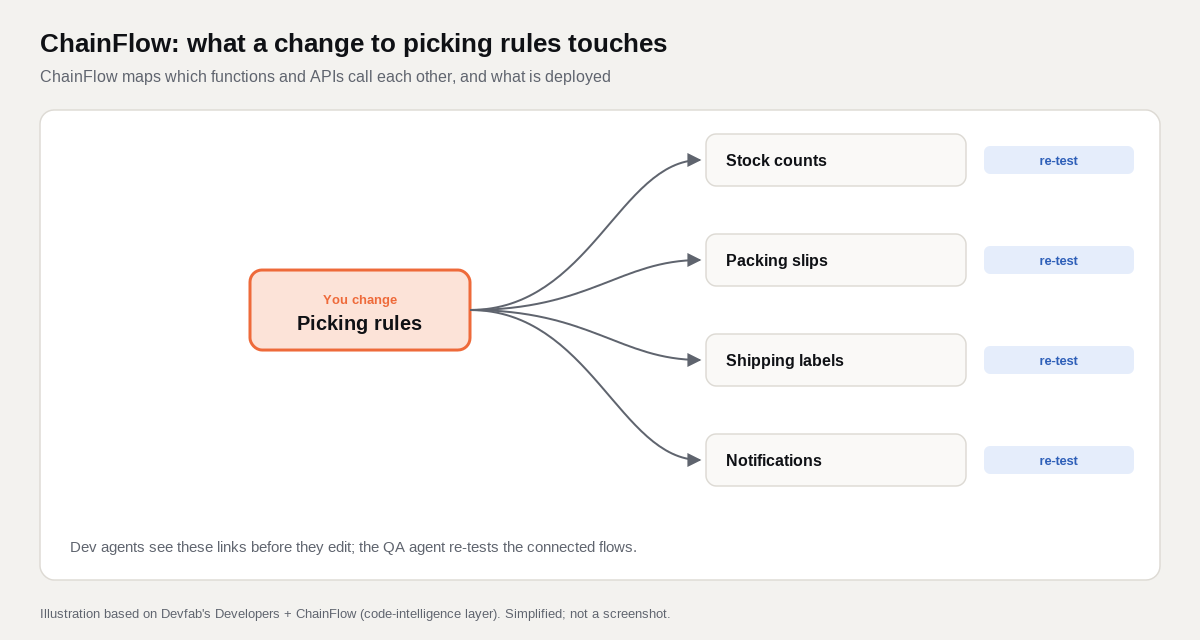
- Developers work with ChainFlow, Devfab's code-intelligence layer. It maps which functions and APIs call each other and what is deployed, so a change doesn't break connected features.
- The QA agent runs UI and flow tests (screens, buttons and user journeys clicked end to end) plus logic tests. Deploy ships to your own server.
Coding agents automate the developer. Devfab automates the development lifecycle.
Take a warehouse picking app for a logistics client. A developer with goose can write the pick-list screen quickly. Devfab's Researcher first maps how picking works (waves, bins, short picks), the Planner proposes epics, and the client's lead approves them before any code. Later, when the picking rules change, ChainFlow shows dev agents that the change also touches stock counts, packing slips and shipping labels.
Switching triggers
| Trigger | goose | Devfab | Source |
|---|---|---|---|
| Client needs a plan approved before work starts | Agent works on the task you give it; project planning is yours to run | Researcher maps the domain, Planner publishes, a person approves | goose docs |
| Runs need isolation | No default sandbox per run (Sep 2026 review) | Work runs as tickets on your repository; per-run sandbox details not stated | PromptQuorum review |
| Team needs vendor support | Community-only support, no SLA (Sep 2026 review) | Support terms not stated on this page; Devfab is in Beta | PromptQuorum review |
| Someone must pick, pay for and manage models | No built-in model; bring your own provider or local model | Choose the model for each agent or keep Devfab's default; cost logged per task | goose README; PromptQuorum review |
| Client wants a QA report and a deployed app | QA and deploy are workflows you build, for example with recipes | QA agent runs UI, flow and logic tests; Deploy ships to your server | goose docs |
| Project moved, links and governance changed | Repo and docs moved to AAIF in Apr 2026 | Not applicable | goose blog |
Cost model by team size
| Team size | goose | Devfab |
|---|---|---|
| 1 person | Free and open source; pay your model provider, reuse a Claude, ChatGPT or Gemini subscription, or run local models with Ollama | Cost logged per task and per project (Beta) |
| 5 people | Same; no seats or vendor fees found, each person brings model access | Cost logged per task and per project (Beta) |
| 25 people | Same; optional custom distribution with preset providers and extensions | Cost logged per task and per project (Beta) |
goose's pricing model as of November 2026, from the goose docs and README; we found no vendor pricing page. Devfab: predictable cost; cost is logged after each run, per task and per project; Devfab is in Beta.
Moving from goose to Devfab
goose already works in your local repository, so there is no code to export.
- Push the repo to GitHub. Devfab works with a repository in your own GitHub account or your organization's.
- Open Devfab and choose "Work on an existing project". Connect GitHub and pick the repo.
- Leave the change box empty. ChainFlow maps the code first: which functions and APIs call each other and what is deployed. Then it suggests three small first tickets.
- Approve the plan. The Planner publishes it; the Coordinator creates tickets only after a person approves.
- Turn on "QA agent · review before Done". The QA agent runs UI, flow and logic tests before a ticket is marked done.
- Keep goose where it shines. Developers can keep goose and their recipes for personal automation and hands-on fixes on the same repository.
Where goose is the better choice
- You want free and open source. Apache 2.0, foundation-governed, with no vendor fee.
- Model control is a requirement. 15+ providers, local models through Ollama, and existing subscriptions through ACP.
- The work isn't only code. goose is built for research, writing, automation and data analysis too.
- You want to build your own agent. Custom distributions let you ship a branded or embedded agent with preset providers and extensions.
- A full delivery pipeline would be overkill. For personal scripts, terminal workflows and one-off fixes, a local agent is the simpler tool.
Where Devfab is the better choice
- Research before the plan. The Researcher maps key terms, best practices and competitors for the client's domain, then suggests a prototype.
- A plan the client can approve. The Planner publishes a plan and a person approves it before tickets exist.
- Changes that don't break neighbors. ChainFlow shows dev agents the impact of a change across connected functions and APIs.
- QA that clicks through the app. The QA agent runs UI, flow and logic tests, not only unit checks.
- Delivery and records. Deploy to your own server, docs such as blueprints and user manuals, and cost logged per task and per project.
Honest limits: Devfab is new and in Beta, it has a smaller community and fewer integrations than mature tools, it is not an editor for hands-on coding, and it needs a GitHub account.
FAQ
Who owns goose now?
goose was created by Block and moved to the Agentic AI Foundation (AAIF) at the Linux Foundation. The goose blog announced the move on April 7, 2026. The repository moved from block/goose to aaif-goose/goose, and the docs moved to goose-docs.ai.
Is goose free?
Yes. goose is open source under the Apache 2.0 license, and we found no vendor pricing. You pay your own model provider, use an existing Claude, ChatGPT or Gemini subscription through ACP, or run local models with Ollama.
Can an agency use goose and Devfab together?
Yes. They work on the same GitHub repository. Developers can keep goose on their own machines for hands-on tasks and personal automation, while Devfab runs the client project: research, a plan a person approves, tickets, QA and deployment to the client's server.
Does Devfab let me pick the model like goose does?
goose supports more than 15 model providers, including local models. In Devfab you can choose the model for each agent or keep Devfab's default. Devfab logs cost after each run, per task and per project.
Read next
- What is an AI software factory?
- AI software factory vs AI coding tools
- Goose vs Claude Code
- Devfab vs OpenHands
Keep goose for your own work. Let Devfab run the client project. Try Beta
Sources (checked November 2026): goose blog: goose moves to AAIF (Apr 7, 2026); goose docs; goose README; goose releases; TechCrunch: OpenAI, Anthropic and Block join new Linux Foundation effort (Dec 9, 2025); PromptQuorum: goose review (Sep 12, 2026).
Frequently asked questions
Who owns goose now?
goose was created by Block and moved to the Agentic AI Foundation (AAIF) at the Linux Foundation. The goose blog announced the move on April 7, 2026. The repository moved from block/goose to aaif-goose/goose, and the docs moved to goose-docs.ai.
Is goose free?
Yes. goose is open source under the Apache 2.0 license, and we found no vendor pricing. You pay your own model provider, use an existing Claude, ChatGPT or Gemini subscription through ACP, or run local models with Ollama.
Can an agency use goose and Devfab together?
Yes. They work on the same GitHub repository. Developers can keep goose on their own machines for hands-on tasks and personal automation, while Devfab runs the client project: research, a plan a person approves, tickets, QA and deployment to the client's server.
Does Devfab let me pick the model like goose does?
goose supports more than 15 model providers, including local models. In Devfab you can choose the model for each agent or keep Devfab's default. Devfab logs cost after each run, per task and per project.