Short answer: Choose an open-source agent (Cline, Kilo Code, OpenCode, Aider, OpenHands) when you need to audit the code, self-host, pick any model including local ones, and pay only for inference. Choose a commercial agent (Cursor, GitHub Copilot, Claude Code, Devin) when you want one vendor for support, admin controls and polished features. Either way, keep your code in your own repo.
You want an AI coding agent you can still use next year. Then 2026 happened. An open-source favorite was acquired and switched off. Another was archived. A cloud agent from a tech giant announced its shutdown. Commercial tools changed owners and pricing. Open source vs commercial is no longer only about cost. It's about what you keep when things change.
In this guide, you'll learn:
- Definitions
- Side by side
- When to choose open source
- When to choose commercial
- Where an AI software factory fits
Use it as a checklist for your next tool decision.
Definitions
Open-source AI coding agents publish their source code under an open license, so you can read, run, modify and fork them. Examples: OpenCode (MIT), OpenHands (MIT), Aider (Apache-2.0), and Cline and Kilo Code, which describe their extensions as open source. The OpenAI Codex CLI and Gemini CLI are also open source under Apache-2.0, even though their vendors are commercial.
Commercial AI coding agents are proprietary products you license from a vendor: Cursor, GitHub Copilot, Claude Code, Devin, Kiro and Tabnine, among others.
Three things blur the line:
- Open source isn't the same as free. Cline's extension is free and you pay only for inference; Kilo Code bills inference at provider rates with a 5% fee on credit purchases; Aider has you pay your model provider directly.
- Open-source vendors sell paid tiers. Cline Enterprise adds SSO, RBAC and audit logs. Kilo's Teams and Enterprise plans add SSO, SCIM and model limits. OpenHands has a paid Teams plan with SSO and RBAC.
- Some projects are open core. Dyad's code is Apache-2.0 outside its
src/profolder, which uses a fair-source license.
Side by side
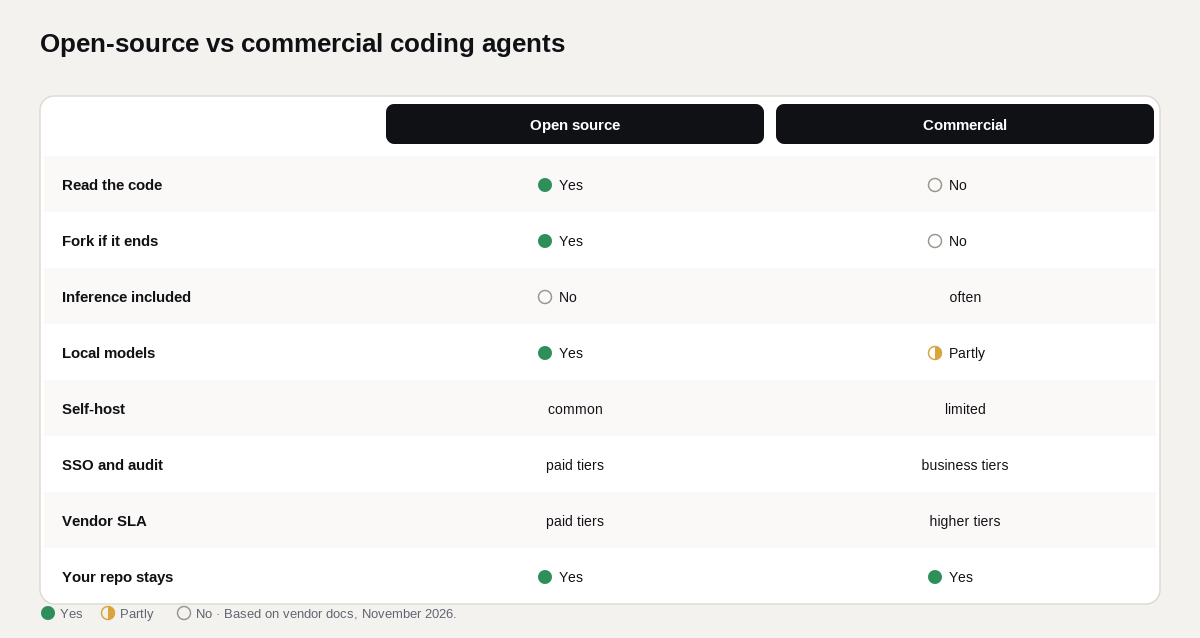
| Aspect | Open-source agents | Commercial agents |
|---|---|---|
| Source code | Public; you can audit and fork | Closed; you trust the vendor's docs and attestations |
| Cost model | Free agent plus your inference; paid tiers for teams | Seats, credits or usage, often including inference |
| Model choice | Wide: Kilo 500+ models, OpenCode 200+ providers, local models | Varies: Cursor and Copilot offer several vendors; Claude Code uses Claude models |
| Self-hosting | Common: OpenHands in your VPC, local agents with local models | Limited: Devin's dedicated VPC still runs its core in Cognition's cloud; Cursor offers Self-Hosted Machines |
| Admin and SSO | On paid tiers (Cline, Kilo, OpenHands) | Standard on business tiers (Copilot, Cursor, Claude Code, Devin) |
| Support | Community, plus vendor support on paid tiers | Vendor support and SLAs on higher tiers |
| Polish and integrations | Varies; a 2026 review notes OpenCode releases sometimes break features | Usually deeper: Cursor lists Slack, Jira, Linear, GitHub, GitLab and more |
| If the vendor exits | You can keep running and fork the code | Service ends; your repo and its branches remain |
What 2026 taught us about continuity
Both kinds of tools changed under their users this year:
- Continue (open source) was acquired by Cursor around June 16, 2026 and discontinued. Users could export data until July 15. The Apache-2.0 code remains available to fork.
- Roo Code (open source) shut down its extension on May 15, 2026 and archived its repo. The README recommends Zoo Code, a community fork, and Cline; Kilo Code published a migration guide.
- Gemini CLI (open source) is transitioning individual users to Antigravity CLI, which "won't be open source", according to FOSS Force.
- Google Jules (commercial) stopped new tasks on November 11, 2026 and shuts down on December 31, 2026.
- Tabnine (commercial) was acquired by Tricentis in July 2026, with no stated roadmap for the standalone assistant.
- Cursor (commercial) became a SpaceX subsidiary, and its plans now bundle Grok products.
The pattern: open source protects your right to keep running the tool, not anyone's duty to maintain it. Commercial tools protect neither. Your real insurance is to keep code, branches and agent instructions (such as AGENTS.md) in a repository you own.
When to choose open source
Open-source agents are the better choice when:
- You must audit what runs on developer machines. Public code can go through your own security review, and you can pin a version.
- Data must stay inside your walls. Pair a self-hosted agent with local or self-hosted models: OpenHands runs in your VPC with open-weight models; Aider works with Ollama and LM Studio.
- You want any model, at cost. Kilo Code offers 500+ models at provider rates; OpenCode works with 200+ providers and can reuse existing ChatGPT or Copilot subscriptions.
- You want to build your own workflows. OpenHands runs other agent harnesses such as Claude Code and Codex, plus scheduled and event-triggered automations.
- You can't risk a vendor shutdown stranding you. When Continue and Roo Code ended, their code stayed available to fork.
Know the costs: you run and govern the setup yourself, and community projects can slow down. Aider's only 2026 release came in February.
When to choose commercial
Commercial agents are the better choice when:
- You want one accountable vendor. Support, SLAs, security attestations and a contract your procurement team understands.
- You need enterprise admin out of the box. Copilot Business and Enterprise offer policy management, usage data and audit logs; Cursor Enterprise adds SCIM and model access controls; Devin offers SSO, SCIM and RBAC.
- You want the most integrated experience. Cloud agents that start from Slack or Linear (Cursor), agents inside GitHub issues and pull requests (Copilot), and managed code review on every PR (Claude Code).
- Your developers shouldn't manage models and keys. Commercial plans bundle inference and pick sensible defaults.
- You want predictable seat budgets. Seat plans with pooled credits (Copilot Business) are easier to forecast than raw inference bills, as long as you watch usage beyond the pool.
Know the costs: closed code, vendor-defined model lists, and pricing or ownership that can change, as Cursor's 2026 move under SpaceX showed.
Where an AI software factory fits
Open source or commercial, a coding agent helps a developer finish a task. Coding agents automate the developer. Devfab automates the development lifecycle.
To be clear: Devfab is a commercial product, not open source. It takes the continuity lesson seriously in a different way:
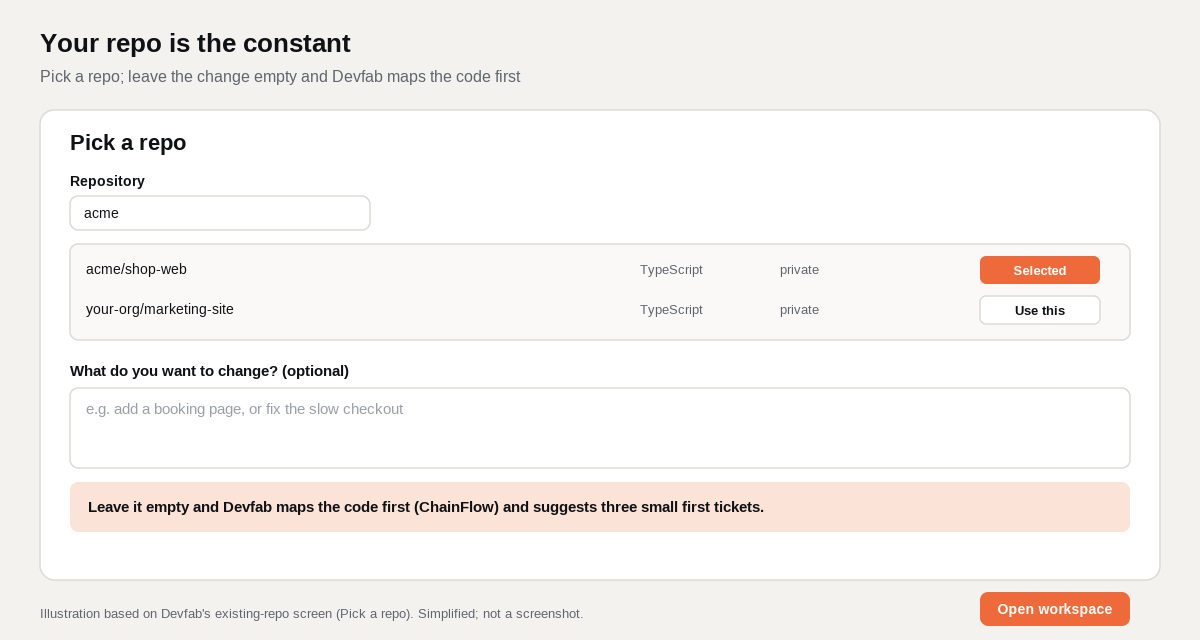
- Your code, your repo. The code lives in your own GitHub account (or your organization's), and you deploy to your own server. No lock-in.
- Model choice. You can choose the model for each agent or keep Devfab's default.
- Research before the plan. The Researcher maps the domain before the Planner writes a plan a person approves.
- ChainFlow maps which functions and APIs call each other, so changes don't break connected features. On an existing repo, leave the change box empty and Devfab maps the code first and suggests three small first tickets.
- QA agent runs UI and flow tests plus logic tests.
Your developers can keep any open-source or commercial agent for hands-on work in the same repository. Honest limits: Devfab is new and in Beta, with a smaller community and fewer integrations. It is not an editor, it needs a GitHub account, and as a commercial product it can't be forked. Cost is predictable: logged after each run, per task and per project.
FAQ
Are open-source AI coding agents free?
The agent usually is; the inference isn't. Cline's extension is free but you pay for model usage or bring your own key, Kilo Code bills inference at provider rates, and Aider has you pay your model provider directly. Only local models remove the inference bill, and they need capable hardware.
Is open source safer than a commercial AI coding agent?
It's more auditable, not automatically safer. You can read the code and self-host it, which suits strict data rules. But open-source tools have supply-chain risks too: Cline published a post-mortem after an unauthorized npm publish of its CLI in February 2026. Review either kind the same way.
What happens if an open-source coding agent is discontinued?
You can keep running and forking it, but nobody fixes it for you. In 2026, Continue was acquired and discontinued and Roo Code was shut down with its repo archived. Community forks and successors (Zoo Code, Kilo Code) appeared, but your team must choose and maintain one.
Which open-source AI coding agents are popular in 2026?
Cline, Kilo Code, OpenCode, Aider and OpenHands are widely used open-source options. The OpenAI Codex CLI and Gemini CLI are also open source under Apache-2.0, though Google is moving individual Gemini CLI users to a proprietary successor.
Read next
- What is an AI software factory?
- AI software factory vs AI coding tools: which does your team need?
- Continue alternatives for teams that ship to production
- Cline alternatives
- Devfab vs OpenCode
- OpenHands vs Devin
Whatever agent you pick, keep the code yours. Try Beta
Sources (checked November 13, 2026): Cline docs overview; Cline pricing; Cline blog archive; Cline Desktop announcement; Kilo pricing; Kilo docs: about plans; Thank you, Roo (Kilo blog); OpenCode; anomalyco/opencode on GitHub; OpenCode research note (rywalker.com); Aider on GitHub; Aider documentation; aider-chat on PyPI; Aider review 2026 (CodeMySpec); OpenHands; OpenHands pricing; Introducing Agent Canvas (OpenHands blog); openai/codex on GitHub; google-gemini/gemini-cli on GitHub; Gemini CLI and Antigravity (FOSS Force); dyad-sh/dyad on GitHub; Cursor acquires Continue (The New Stack); RooCodeInc/Roo-Code on GitHub; Jules changelog; Tricentis acquires Tabnine; Tricentis bought Tabnine's context engine (beri.net); Cursor: Joining SpaceX; Cursor pricing; Cursor docs; Cursor enterprise; GitHub Copilot features; Plans for GitHub Copilot; Claude Code costs; Claude Code Code Review; Devin pricing; Devin enterprise deployment.
Frequently asked questions
Are open-source AI coding agents free?
The agent usually is; the inference isn't. Cline's extension is free but you pay for model usage or bring your own key, Kilo Code bills inference at provider rates, and Aider has you pay your model provider directly. Only local models remove the inference bill, and they need capable hardware.
Is open source safer than a commercial AI coding agent?
It's more auditable, not automatically safer. You can read the code and self-host it, which suits strict data rules. But open-source tools have supply-chain risks too: Cline published a post-mortem after an unauthorized npm publish of its CLI in February 2026. Review either kind the same way.
What happens if an open-source coding agent is discontinued?
You can keep running and forking it, but nobody fixes it for you. In 2026, Continue was acquired and discontinued and Roo Code was shut down with its repo archived. Community forks and successors (Zoo Code, Kilo Code) appeared, but your team must choose and maintain one.
Which open-source AI coding agents are popular in 2026?
Cline, Kilo Code, OpenCode, Aider and OpenHands are widely used open-source options. The OpenAI Codex CLI and Gemini CLI are also open source under Apache-2.0, though Google is moving individual Gemini CLI users to a proprietary successor.