Short answer: Pick an open-source low-code platform (Appsmith, Budibase, ToolJet) when you must self-host, want to read the code and have people to run upgrades. Pick a commercial one (Retool, OutSystems, Mendix, Power Apps) when you need a vendor SLA, compliance attestations and support. Pick neither if the app must be plain code you own.
You run IT for a school district, and the parent portal can't leave your servers. Procurement wants a vendor with a support contract. Your engineers want something they can inspect and patch.
Both requests are reasonable. The choice decides who you call when the portal breaks at enrollment time, and who holds the keys to the data. This page sets out the trade-offs with sources checked on November 20, 2026.
In this guide, you'll learn:
- Definitions
- Side-by-side comparison
- When to choose open source
- When to choose commercial
- Where an AI software factory fits
The license comes first, because it sets every other limit.
Definitions
Low-code. IBM calls low-code "a rapid application development (RAD) approach that enables automated code generation through visual building blocks," aimed at professional developers and extendable with custom code (IBM). Microsoft adds that "low-code development requires some custom coding" (Microsoft).
Open-source low-code. The platform's source is published under a license that lets you run, read and change it. In practice, the big three are open core: a free community edition plus paid features.
- Appsmith uses Apache-2.0, a permissive license, and has about 41.0k GitHub stars (GitHub).
- Budibase puts its core under GPL v3, client libraries under MPL, and paid features under the Business Source License (GitHub).
- ToolJet puts its Community Edition under AGPL-3.0 and its MCP server under MIT (ToolJet).
The license type matters. Copyleft licenses such as GPL and AGPL set conditions on sharing changes; ask your legal team before you modify and distribute.
Commercial low-code. The vendor owns the code and sells licenses. Retool, OutSystems, Mendix and Power Apps all offer a free tier or edition, but production use is paid.
Side-by-side comparison
| Aspect | Appsmith | Budibase | ToolJet | Retool | OutSystems | Mendix | Power Apps |
|---|---|---|---|---|---|---|---|
| License | Apache-2.0 | GPL v3 core + BSL | AGPL-3.0 (Community) | Commercial | Commercial | Commercial | Commercial |
| Free self-host | Yes (Community) | Yes (Community, unlimited users) | Yes (Community) | No; self-host on Enterprise | Free Personal Edition, cloud | Free plan on Mendix Cloud | Developer Plan, non-production |
| Air-gapped | Enterprise add-on | Enterprise | Self-hosted Enterprise add-on | Enterprise | On-prem and sovereign options | Own servers, Kubernetes | Not covered in the docs we checked |
| SSO and access | SAML/OIDC on Enterprise | SSO and SCIM; enforced on Enterprise | Instance SSO with SCIM | No SSO on Free | Not covered in the docs we checked | Admin roles and approved domains | Central access and DLP policies |
| AI building | Ask AI in Community (2.3) | Agents with approval policies | AI Builder; build from Claude Code or Codex via MCP | React AI app builder | Mentor generates apps | Maia plans and builds | Natural-language app generation |
| Paid entry (Nov 2026) | Business USD 15 per user per month | Cloud from USD 299 per month | Basic USD 23 per builder per month | Team USD 10 per builder plus USD 5 per internal user per month | By quote | Standard One App from USD 1,090 per month | Premium USD 20 per user per month |
Sources: Appsmith pricing; Budibase pricing; ToolJet pricing; Retool pricing; OutSystems pricing; Mendix pricing; Power Apps pricing. Retool prices are billed annually; Power Apps is paid yearly; Mendix lists "starting at" prices.
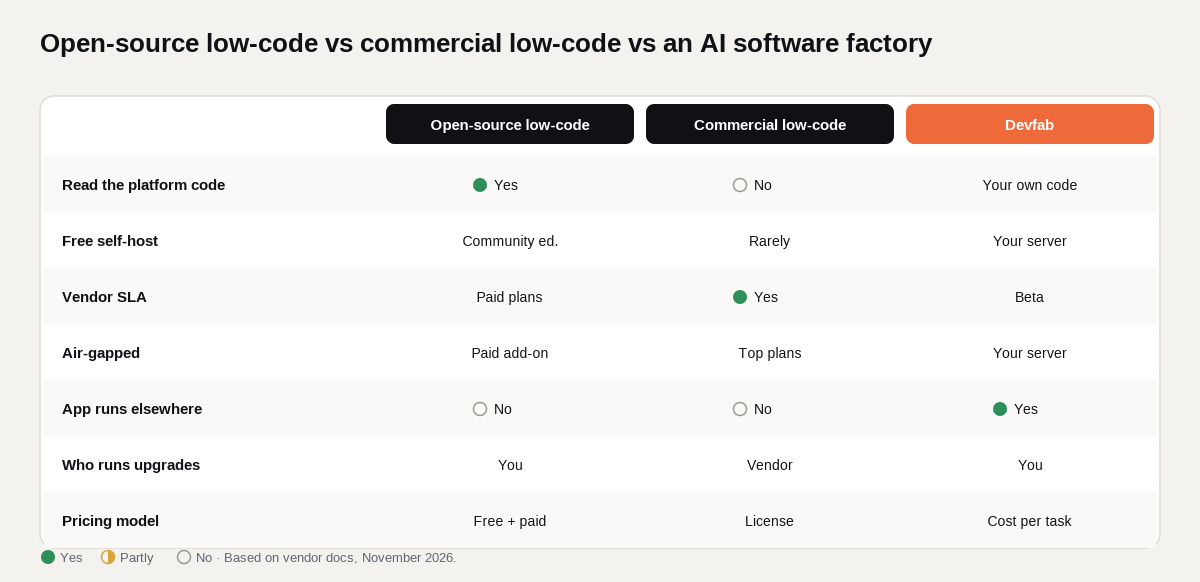
Two things stand out. First, "free" is real at the community tier: Budibase Community allows unlimited users, apps, agents and automations, with your own AI key (Budibase pricing). Second, the features enterprises ask for first (SAML SSO, air-gapped hosting, vendor AI) sit on paid plans at almost every vendor, open source or not.
When to choose open source
- The app can't leave your network. All three open-source tools self-host on Docker or Kubernetes, and Budibase and ToolJet support air-gapped setups on paid tiers (Budibase; ToolJet).
- You need to audit the code. Security reviewers can read the platform, not just your app.
- You have many users and few builders. ToolJet prices per builder, not per end user, and Appsmith charges nothing extra for developers who build (ToolJet blog; Appsmith pricing).
- You want your own models. Budibase connects any OpenAI-format model through LiteLLM, including open-source models (Budibase blog).
- Budget is tight and you have ops staff. The community editions carry no license fee.
Plan for the costs open source moves onto you. A competitor review says ToolJet is production-ready only "with proper DevOps practices" (Jet Admin, July 2026). Appsmith self-hosts older than v1.96 must step through v1.99 before moving to 2.x, or the upgrade fails (Appsmith community). And features can disappear: Appsmith removed its AI datasource on September 30, 2026 (Appsmith community).
When to choose commercial
- You need attestations on file. OutSystems lists HIPAA, PCI DSS and FedRAMP requirements plus SOC 2 Type II (OutSystems ODC).
- You want one throat to choke. Commercial plans include SLAs and enterprise support; OutSystems sells 24x7 support and higher uptime as add-ons (OutSystems pricing).
- Your company runs on one ecosystem. Power Apps keeps apps inside Microsoft 365 governance and DLP (Power Apps); Mendix ties into Siemens and SAP BTP (Mendix pricing).
- You'd rather not run servers. Managed cloud is the default for Retool, OutSystems, Mendix and Power Apps.
- AI features should work on day one. Mendix Maia, OutSystems Mentor and Retool's AI app builder ship as part of the product, not as a key you bring.
Commercial has its own surprises. In October 2026 Retool made bring-your-own AI key an Enterprise-only feature, and staff acknowledged poor communication on the forum (Retool community). Mendix's pricing page doesn't list AI features by plan (Mendix pricing).
A short decision table
| Your situation | Lean toward |
|---|---|
| Data must stay on-prem, staff can run Docker or Kubernetes | Open source (Appsmith, Budibase, ToolJet) |
| Regulated industry, auditors want vendor attestations | Commercial (OutSystems, Mendix) |
| Microsoft 365 shop with many internal users | Commercial (Power Apps) |
| Many end users, few builders, tight budget | Open source (ToolJet, Appsmith) |
| Public-facing app with custom logic, code must be yours | AI software factory |
Where an AI software factory fits
Open-source and commercial low-code share one trait: your app is built for the platform's runtime. Open source lets you read and patch the platform, but your screens, queries and workflows still don't run anywhere else.
Coding agents automate the developer. Devfab automates the development lifecycle. It produces a normal codebase in your own GitHub account and deploys to your own server, so the district's parent portal is code you can hand to any team. Before the plan, Devfab's Researcher maps the domain: enrollment terms, best practices for school portals, and competing products. A person approves the plan. The QA agent runs UI and flow tests that click through screens and journeys, plus logic tests. Cost is logged after each run, per task and per project.
Devfab is not a low-code platform and has no drag-and-drop canvas. It is in Beta, with a smaller community and fewer integrations than these platforms, and it needs a GitHub account. For more on the trade-off, read Low-code vs AI software factory and Devfab vs Appsmith.
FAQ
What is the best open source low code platform?
It depends on the license and the job. Appsmith (Apache 2.0) is the most permissive and suits admin panels on existing databases. Budibase (GPL v3 core) suits regulated teams that self-host apps and agents. ToolJet (AGPL-3.0 Community Edition) suits teams that want coding agents to build governed internal tools.
Is an open source low-code platform really free?
The community edition is free to run, but you pay for servers, upgrades and the people who run them. Most vendors keep enterprise features such as SAML SSO, air-gapped hosting or AI features in paid plans. Budget for operations, not just licenses.
Can I self-host a commercial low-code platform?
Often, yes, but usually on the top plan. Retool lists self-hosted and air-gapped deployment under Enterprise. OutSystems lists on-premises, private and sovereign cloud. Mendix deploys to Kubernetes, SAP BTP or your own servers. Power Apps runs in Microsoft's cloud.
Does open source mean I own my apps?
You own your data and can read the platform's code, but your apps are still built for that platform's runtime. Moving them elsewhere means a rebuild. If you need apps as plain code in your own repository, look at code-generating options instead.
Read next
- What is an AI software factory?
- Open-source vs commercial AI coding agents
- Appsmith vs Budibase
- Best internal tool builders
Want the portal as code on your own server? Try Beta
Sources (checked November 2026): IBM: Low-code vs no-code; Microsoft: Low-code vs no-code; Appsmith on GitHub; Appsmith pricing; Appsmith 2.1 notice; Appsmith 2.3 and AI datasource EOL; Budibase; Budibase pricing; Budibase on GitHub; Budibase 2026 roadmap; ToolJet pricing; ToolJet vs Superblocks (ToolJet); ToolJet at the start of 2026; Jet Admin: ToolJet vs Retool (competitor, Jul 2026); Retool pricing; Retool community thread (Oct 2026); OutSystems pricing; OutSystems Developer Cloud; Mendix pricing; Power Apps; Power Apps pricing.
Frequently asked questions
What is the best open source low code platform?
It depends on the license and the job. Appsmith (Apache 2.0) is the most permissive and suits admin panels on existing databases. Budibase (GPL v3 core) suits regulated teams that self-host apps and agents. ToolJet (AGPL-3.0 Community Edition) suits teams that want coding agents to build governed internal tools.
Is an open source low-code platform really free?
The community edition is free to run, but you pay for servers, upgrades and the people who run them. Most vendors keep enterprise features such as SAML SSO, air-gapped hosting or AI features in paid plans. Budget for operations, not just licenses.
Can I self-host a commercial low-code platform?
Often, yes, but usually on the top plan. Retool lists self-hosted and air-gapped deployment under Enterprise. OutSystems lists on-premises, private and sovereign cloud. Mendix deploys to Kubernetes, SAP BTP or your own servers. Power Apps runs in Microsoft's cloud.
Does open source mean I own my apps?
You own your data and can read the platform's code, but your apps are still built for that platform's runtime. Moving them elsewhere means a rebuild. If you need apps as plain code in your own repository, look at code-generating options instead.