Short answer: For a vendor-backed terminal agent with admin controls, pick Claude Code. For an open-source agent that keeps model freedom, pick goose (terminal and desktop) or Cline and Kilo Code (inside the editor). If the gap is the process around the code, such as plans, QA and deployment, look at Devfab.
You picked OpenCode for the freedom: MIT license, any model, no seat bill. Then it met a team. A June 2026 review names the friction: the terminal UI can use over a gigabyte of memory, frequent releases sometimes break features, default permissions are permissive, and enterprise compliance features are immature (rywalker.com, Jun 2026). None of that matters on a side project. All of it matters on client work.
In this guide, you'll learn:
- Why teams leave OpenCode
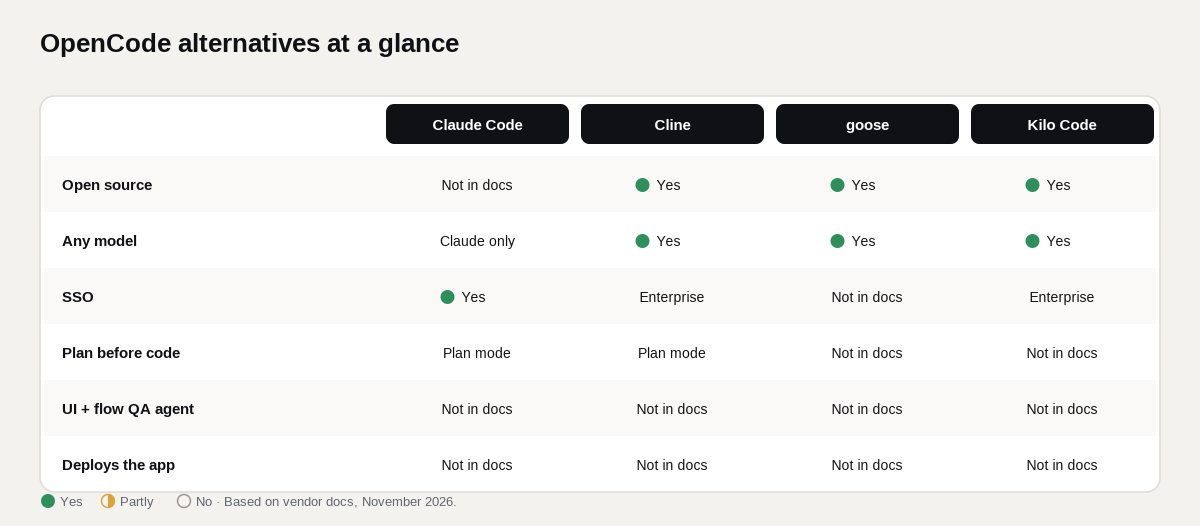
- How the six options compare
- Each alternative's best use and trade-off
- Where OpenCode is still the better choice
Use the sections below as your shortlist.
Why teams leave OpenCode
First, the status. OpenCode is active. Its GitHub repo moved from sst/opencode to anomalyco/opencode, under Anomaly, the team behind SST (GitHub). It is MIT-licensed with over 225,000 GitHub stars, and it runs as a terminal UI, a desktop app (marked beta), a mobile app and an SDK (OpenCode). It ships with a "build" agent with full access and a read-only "plan" agent (GitHub).
The reasons people look elsewhere, as reported in public sources:
- Resource use and stability. The review above reports 1GB+ RAM use by the TUI and releases that sometimes break features.
- Safety defaults. Permissions are permissive by default, which matters more on shared client repos.
- Team and compliance controls. The same review calls OpenCode's enterprise compliance features immature. OpenCode Zen does offer workspaces with member invites, model enablement and per-member budgets (Zen docs).
- Model access changes. In January 2026, Anthropic blocked third-party tools from using Claude subscription credentials, and OpenCode added a Codex and ChatGPT login in response (rywalker.com). Teams that relied on one subscription had to rethink.
- Scope. OpenCode is a coding agent. It does not plan a whole project, test user flows or deploy, and teams sometimes need that more than a better terminal.
How we compared
We read vendor docs, pricing pages and dated reviews, re-checked in November 2026. We did not run hands-on tests for this article. We looked at where each tool runs, model choice, team controls, pricing model and what happens before and after the code. Devfab is our product; we list its limits too.
Quick comparison
| Tool | Type | Where it runs | Model choice | Team controls | Pricing model (Nov 2026) |
|---|---|---|---|---|---|
| Claude Code | Vendor coding agent | Terminal, IDEs, desktop, web, mobile | Claude models only | SSO, admin tools, spend limits | In paid Claude plans; Pro USD 20 per month |
| Cline | Open-source agent | VS Code, JetBrains, CLI, desktop, Kanban | Any, incl. BYOK and local | Enterprise: SSO, RBAC, central billing | Free; pay for inference |
| goose | Open-source agent | Desktop app, CLI, API | 15+ providers, local models | Not covered in the docs we checked | Free; pay your model provider |
| Kilo Code | Open-source agent | VS Code, JetBrains, CLI, cloud agents | 500+ models, BYOK, local | Teams and Enterprise: SSO, audit logs | Free; Teams USD 15 per user per month |
| Devfab | Software Factory | Web workspace + your GitHub repo | Choose per agent or keep the default | Roles, workspace permissions | Cost logged per task and project (Beta) |
| Aider | Open-source CLI | Terminal, browser | Almost any LLM | None | Free; pay your model provider |
The alternatives
Claude Code
Verdict: the vendor-backed terminal agent for teams that want admin controls and one model family. Best for: engineering teams that want plan mode, PRs and managed code review with SSO. Trade-off: Claude models only; usage limits are shared across Claude apps. Pricing: included in paid Claude plans; Pro USD 20 per month, Team Standard USD 25 per user per month, as of November 2026 (Claude pricing).
- Runs in the terminal, VS Code, JetBrains, a desktop app, the web and the Claude mobile app (Claude Code docs).
- Plan mode explores the codebase and proposes an approach for approval before editing (Claude Code costs).
- Managed Code Review runs several agents on each GitHub PR and posts ranked inline comments, but never approves or blocks a PR (Code Review docs).
- Org spend limits, an analytics dashboard and per-user reporting help with cost (Claude Code costs).
Cline
Verdict: the closest open-source match if you want the agent inside your editor. Best for: developers who want to approve every action and keep any model. Trade-off: approval on every action slows multi-step work; 2026 brought staff departures to OpenAI. Pricing: free extension, inference billed separately; Enterprise custom (Cline pricing).
- Every action requires your approval (Cline docs).
- Plan and Act modes, with a different model per mode and Checkpoints to roll back (Plan & Act).
- Runs in VS Code, JetBrains, a CLI, a desktop app and a Kanban board for parallel agents (Cline docs).
- In January 2026, OpenAI hired at least seven Cline employees and said it was not an acquisition (TEXXR).
goose
Verdict: the best fit for OpenCode users who want the same open-source spirit with foundation governance. Best for: developers who want a local agent with a desktop app, CLI and any model. Trade-off: no default sandbox per run and community-only support. Pricing: free and open source; you pay your model provider (goose docs).
- Status: goose moved from Block to the Linux Foundation's Agentic AI Foundation; the repo is now aaif-goose/goose (post dated April 7, 2026) (goose blog).
- Native desktop app, CLI and API, built in Rust, Apache 2.0 (goose README).
- 15+ providers, plus existing Claude, ChatGPT or Gemini subscriptions through ACP; 70+ MCP extensions (same source).
- Workflows save as portable YAML recipes you can share or run in CI (goose docs).
- A September 2026 review notes no built-in model and no SLA (PromptQuorum).
Kilo Code
Verdict: OpenCode under the hood, with an editor front end and team billing. Best for: teams that want an open-source agent in VS Code or JetBrains plus seat-based admin. Trade-off: a broad product range and many open GitHub issues, per a June 2026 review. Pricing: free and open source; Teams USD 15 per user per month; Enterprise custom, as of November 2026 (Kilo pricing).
- Status: Anaconda acquired Kilo Code (announced July 15, 2026) and says existing products and plans are unchanged (Anaconda).
- The VS Code extension was rebuilt on the open-source OpenCode server, generally available April 2, 2026 (Kilo blog).
- Kilo Gateway routes 500+ models from 60+ providers at provider rates, or BYOK and local models (Kilo pricing).
- Enterprise adds model limits, audit logs and SSO, OIDC and SCIM (same source).
Devfab
Verdict: not another terminal agent; the option when the missing piece is the process around the code. Best for: agencies and IT teams that ship client apps and need research, an approved plan, QA and deployment. Trade-off: in Beta, with a smaller community and fewer integrations; not an editor for hands-on coding; needs a GitHub account. Pricing: predictable cost; cost is logged after each run, per task and per project.
- The Researcher maps the domain before the Planner runs: key terms, best practices and competitors, then suggests a prototype.
- A person approves the plan, and the Coordinator splits it into tickets for dev agents.
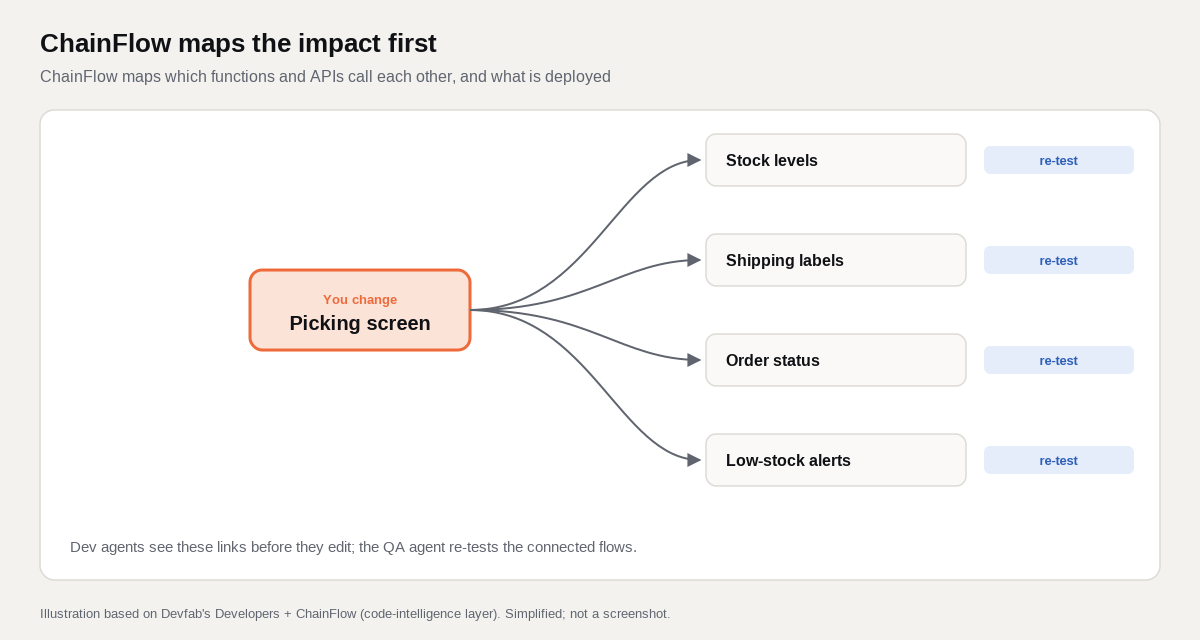
- ChainFlow maps which functions and APIs call each other and what is deployed, so a change to a warehouse picking screen shows its link to stock levels and shipping labels before agents edit.
- The QA agent runs UI and flow tests plus logic tests; Deploy ships to your own server.
- You can choose the model for each agent or keep Devfab's default.
Coding agents automate the developer. Devfab automates the development lifecycle.
Aider
Verdict: the lightest option, if you accept slow releases. Best for: solo developers who want a free CLI, local models and clean git commits. Trade-off: one PyPI release in 2026; no MCP, no team features. Pricing: free and open source; pay your LLM provider (PyPI).
- Status: the latest PyPI release is 0.86.2 from February 12, 2026; work continues on the main branch (Aider history).
- Builds a repo map of your git repository and commits changes automatically (Aider docs).
- Lints and tests after each change and fixes errors (same source).
- A 2026 review notes manual context management, no native MCP and a solo-maintainer risk (CodeMySpec).
Where OpenCode is still the better choice
- You want maximum model choice at no seat cost. OpenCode supports 200+ providers via Models.dev, including local models.
- You already pay for ChatGPT Plus or Pro, or GitHub Copilot, and want to reuse that subscription.
- You want parallel agents, plugins and custom agents in one MIT-licensed tool you can fork.
- You want one agent across terminal, desktop and phone, plus an SDK for scripts and CI.
- You want hosted models with EU options. Zen hosts models in the US and EU, with most providers on zero retention.
How to choose
- The agent itself was fine, but the team needs controls: Claude Code or Kilo Code.
- Open source and governance matter most: goose.
- You want an agent inside the editor, approving each step: Cline.
- You want the smallest possible tool: Aider, accepting the slow release pace.
- The problem is everything around the code, such as client sign-off, tests and deploys: Devfab, with a terminal agent kept for hands-on work.
See also OpenCode vs Claude Code and Cline vs OpenCode.
FAQ
What is the best open-source alternative to OpenCode?
For a terminal or desktop agent with any model, goose (Apache 2.0, now governed by the Linux Foundation's Agentic AI Foundation) is the closest match. For an agent inside VS Code or JetBrains, Cline or Kilo Code. Kilo's VS Code extension is itself built on the OpenCode server.
Why do teams move away from OpenCode?
A June 2026 review lists the common reasons: high memory use by the terminal UI, frequent releases that sometimes break features, permissive default permissions, a steeper learning curve than Claude Code, and immature enterprise compliance features. Teams that need admin controls often look for a vendor with SSO and audit logs.
Is OpenCode still free?
Yes. As of November 2026, the OpenCode agent is free and MIT-licensed. You can use free models, your own API keys or an existing ChatGPT or GitHub Copilot subscription. OpenCode Go, a subscription for curated open-weight models, starts at USD 10 per month, and Zen is pay-as-you-go.
Is Devfab a drop-in replacement for OpenCode?
No. OpenCode is an agent a developer drives in the terminal. Devfab is a software factory: it researches the domain, writes a plan a person approves, splits it into tickets for dev agents, runs a QA agent and deploys to your own server. You can keep a terminal agent alongside it.
Read next
Keep your terminal agent. Add the plan, the tests and the deploy. Try Beta
Sources (checked November 2026): OpenCode; anomalyco/opencode on GitHub; OpenCode Zen docs; OpenCode research note (rywalker.com, Jun 2026); Claude Code overview; Claude Code: manage costs; Claude Code: Code Review; Claude pricing; Cline docs; Cline Plan & Act; Cline pricing; TEXXR: OpenAI hires seven employees from Cline (Jan 29, 2026); goose moves to AAIF (Apr 7, 2026); goose docs; goose README; PromptQuorum: goose review (Sep 12, 2026); Kilo pricing; Kilo blog: new Kilo for VS Code (Apr 2, 2026); Anaconda acquires Kilo Code (Jul 15, 2026); Kilo research note (rywalker.com, Jun 2026); Aider docs; aider-chat on PyPI; Aider release history; CodeMySpec: Aider in 2026.
Frequently asked questions
What is the best open-source alternative to OpenCode?
For a terminal or desktop agent with any model, goose (Apache 2.0, now governed by the Linux Foundation's Agentic AI Foundation) is the closest match. For an agent inside VS Code or JetBrains, Cline or Kilo Code. Kilo's VS Code extension is itself built on the OpenCode server.
Why do teams move away from OpenCode?
A June 2026 review lists the common reasons: high memory use by the terminal UI, frequent releases that sometimes break features, permissive default permissions, a steeper learning curve than Claude Code, and immature enterprise compliance features. Teams that need admin controls often look for a vendor with SSO and audit logs.
Is OpenCode still free?
Yes. As of November 2026, the OpenCode agent is free and MIT-licensed. You can use free models, your own API keys or an existing ChatGPT or GitHub Copilot subscription. OpenCode Go, a subscription for curated open-weight models, starts at USD 10 per month, and Zen is pay-as-you-go.
Is Devfab a drop-in replacement for OpenCode?
No. OpenCode is an agent a developer drives in the terminal. Devfab is a software factory: it researches the domain, writes a plan a person approves, splits it into tickets for dev agents, runs a QA agent and deploys to your own server. You can keep a terminal agent alongside it.