Short answer: Agencies should stop pricing AI-built work by the hour and price the outcome instead: a fixed scope the client signs, value-based pricing where results are measurable, or a retainer for ongoing work. To do it safely, you need a tight scope, a change process and your real cost per task and project.
Your agents now do much of the build, but your invoices still count time. Bill by effort, and faster delivery shrinks your revenue. Quote too low, and one change request can wipe out the margin. Clients also hear AI makes software cheap, and ask why prices stayed put.
In this guide, you'll learn:
- Why time-based billing breaks with AI agents
- How to price AI-built work, step by step
- The pricing mistakes to avoid
- A checklist for your next quote
Use the steps below as your playbook.
Why hourly billing breaks with AI agents
Most IT agencies and outsourcing firms grew up on hourly or day-rate billing. It was simple: more work, more hours, more revenue. AI agents change that math. If agents write a large share of the code and run many of the tests, the hours a person spends on a feature fall. Under hourly billing, so does your revenue.
An April 2026 guide to agency pricing models from Upbase puts it plainly: "Under hourly billing, getting better at your job means earning less." The same guide notes that clients scrutinize timesheets, which can wear down trust.
The opposite problem also exists. Clients read that AI makes software cheap and start asking why the quote didn't drop. If your price is tied to hours, you have no good answer. If it is tied to an outcome, you do.
Step by step
Step 1: Stop selling hours for work agents do
Separate your work into two kinds:
- Build work with a clear output: a booking system, a client portal, a new module.
- Open-ended work with no clear end: discovery, advice, unpredictable maintenance.
For build work, stop quoting hours. Quote the result. Keep hourly or day rates only for open-ended work, where the Upbase guide notes they still fit undefined scopes, consulting and maintenance.
Step 2: Write a scope a client can sign
Outcome pricing only works with a clear scope. A good one-page scope covers:
- The problem the app solves.
- The users and their roles.
- The must-have flows, written as journeys.
- The data the app stores.
- The business rules.
- What "done" means, including which tests must pass.
AI agents help here. A research step can map the client's domain and a planner can turn the scope into a plan with epics and tickets. A person on your team still reviews and approves that plan before anyone commits to a price.
Step 3: Know your real delivery cost
You can't price for margin if you don't know your cost. With AI-built work, delivery cost has more parts than before:
- People: planning, review, client calls, QA sign-off.
- AI usage: the runs the agents make for each task.
- Hosting and third-party services.
- Rework when a change breaks something.
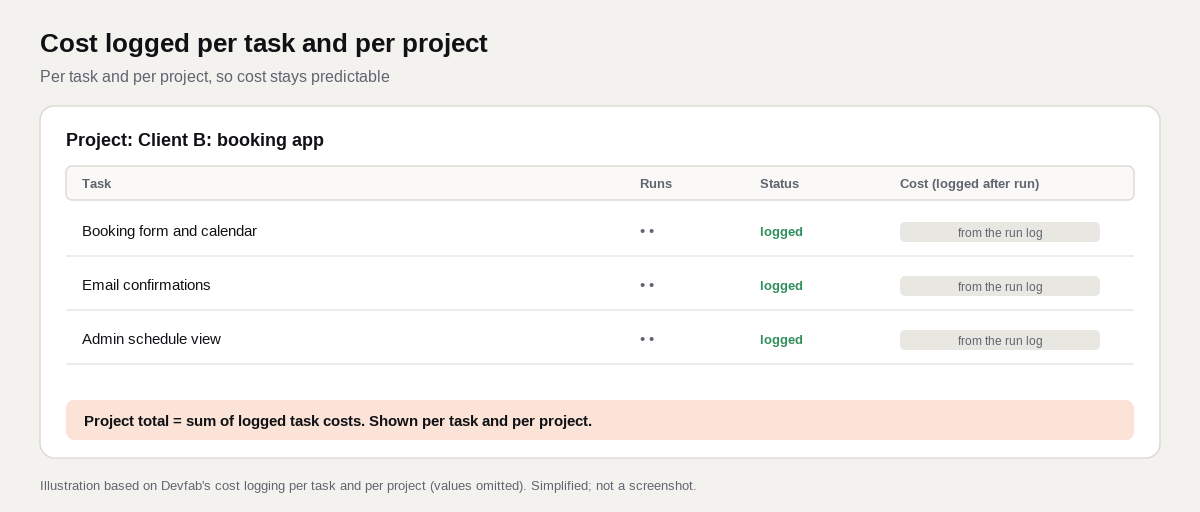
Track AI cost the same way you track people's time: per task and per project. Our guide on how to track AI cost per task and per project shows how. After a few projects you will have your own data instead of a guess.
Step 4: Pick the pricing model for each kind of work
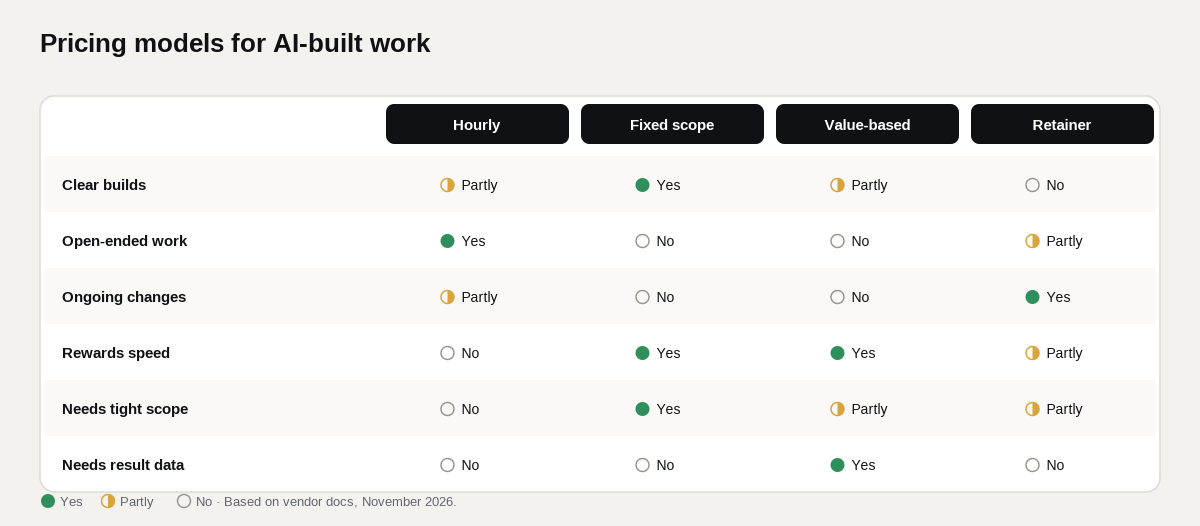
The Upbase guide compares seven agency pricing models. Four matter most for software:
| Model | Fits best | Main risk |
|---|---|---|
| Hourly or day rate | Discovery, advice, unpredictable maintenance | Faster delivery means less revenue |
| Fixed scope (project fee) | Clear builds: portals, booking apps, modules | Scope shifts without a change process |
| Value-based | Work with a measurable business result | Hard when results are hard to attribute |
| Retainer | Ongoing improvements, support, small releases | Scope creep over months |
The guide describes value-based pricing as having "the highest profit potential of any pricing structure," but warns that it "fails when results are hard to attribute." It also warns that without tight scoping and change orders, fixed fees become "a slow leak in your profitability."
Many agencies mix them: a fixed fee for the first build, then a monthly retainer for improvements and support.
Step 5: Price change requests before you need them
Every client changes their mind. Agree in the contract how changes work: the client asks, you write a short plan, the client approves it with its price, then the work starts. AI agents make small changes faster, but a change to a connected feature (checkout, permissions, billing) can still ripple. Price changes by their scope and risk, not by how fast the agent typed.
Step 6: Show the client what they are paying for
Clients trust a price more when they can see the work behind it. Useful things to share:
- The approved plan, with epics and tickets.
- Progress on the board as tickets move to Done.
- The QA report: which UI, flow and logic tests passed.
- A working prototype early, before the full build.
None of this needs your internal cost numbers. It shows the client what they are buying and that a person is accountable for it.
Step 7: Review margin after every project
At the end of each project, compare the price with your real cost: people's time, AI cost per task, hosting and rework. Note which kinds of tasks cost more than you expected. Use that to adjust the next quote. Over time this is the data that lets you price fixed-scope work with confidence.
Where Devfab fits
Devfab is a software factory. Its agents research the domain, plan, build, test and deploy, and a person approves the plan before work starts. For agency pricing, three things matter:
- Predictable cost. Cost is logged after each run, per task and per project, so you can see what each job cost to deliver and compare it with what you charged.
- Plan approval. The Planner publishes a plan with epics, and a person approves it before the Coordinator creates tickets. That plan is a good base for a scope a client can sign.
- QA you can show. The QA agent runs UI, flow and logic tests, which gives you something concrete to share with the client.
Devfab does not tell you what to charge. It gives you the delivery-side numbers so the decision is yours and based on data.
Common mistakes
- Passing every efficiency gain to the client. If agents speed up delivery and you cut your price by the same amount, your margin never improves.
- Fixed price without a fixed scope. A vague scope and a fixed fee is the fastest way to lose money.
- No change process. Small requests pile up until the project is underwater.
- Ignoring AI cost. Agent runs cost money. If you don't track them per task, you can't see which jobs are profitable.
- Hiding how the work is done. Be open about agents, review and testing.
Checklist
- [ ] Build work and open-ended work priced separately
- [ ] One-page scope signed for every fixed-scope job
- [ ] Plan approved by a person before the price is final
- [ ] Change process written into the contract
- [ ] AI cost tracked per task and per project
- [ ] QA report and progress shared with the client
- [ ] Margin reviewed after every project
FAQ
Should agencies keep billing hourly for AI-built work?
Hourly billing still fits open-ended consulting and maintenance. For builds where AI agents do much of the work, it tends to punish you for being faster. Fixed-scope, value-based or retainer pricing usually fits better.
Should agencies tell clients they use AI?
Yes. Being open builds more trust than being found out. Be clear about what agents do, what people review, who approves the plan and how the work is tested. Price the outcome and the accountability, not the typing.
How do I avoid losing money on a fixed-scope AI project?
Write a tight scope, agree a change process before work starts, and track your real delivery cost per task and per project so you know your margin on each job, not just your guess.
Does Devfab tell me what to charge clients?
No. Devfab gives you predictable cost on the delivery side: cost is logged after each run, per task and per project. What you charge is your decision.
Read next
- What is an AI software factory?
- How to track AI cost per task and per project
- The AI-native software agency: an operating model for 2027
- Build: CRM for a small agency
- Software agency vs AI software factory: which should build your app?
- In-house developers vs AI agents: what each does best
Devfab is in Beta. See your delivery cost per task and per project. Try the Devfab Beta
Sources (checked November 2026): Upbase: Agency pricing models: 7 options compared (Paul Wilson, April 2026).
Frequently asked questions
Should agencies keep billing hourly for AI-built work?
Hourly billing still fits open-ended consulting and maintenance. For builds where AI agents do much of the work, it tends to punish you for being faster. Fixed-scope, value-based or retainer pricing usually fits better.
Should agencies tell clients they use AI?
Yes. Being open builds more trust than being found out. Be clear about what agents do, what people review, who approves the plan and how the work is tested. Price the outcome and the accountability, not the typing.
How do I avoid losing money on a fixed-scope AI project?
Write a tight scope, agree a change process before work starts, and track your real delivery cost per task and per project so you know your margin on each job, not just your guess.
Does Devfab tell me what to charge clients?
No. Devfab gives you predictable cost on the delivery side: cost is logged after each run, per task and per project. What you charge is your decision.