Short answer: If you want a hosted full-stack app from prompts, try Lovable or Bolt.new. If you want a cloud IDE with more hosting shapes, Replit. If your developers want an editor, Cursor. If the app must pass a reviewed plan and UI and flow tests before it runs on your own server, Devfab. Google AI Studio suits Gemini prototypes.
Your designer made a great-looking quote tool in v0. Sales loved the demo. Now it needs pricing rules, approvals, a database and somewhere to run that isn't a preview link.
v0 is excellent at UI and at shipping into a Next.js repo on Vercel. Teams look elsewhere when the stack must change, when credits burn on retries, or when the work around the UI (rules, tests, hosting) becomes the bigger job.
In this guide, you'll learn:
The rest of this page covers it in order.
Why teams leave v0
v0 is active at v0.app. One plan change worth knowing: the legacy Premium plan is being phased out and isn't available to new users; current plans are Free, Plus, Business and Enterprise. The reasons teams switch, from v0's own docs:
- One stack. v0 builds with Next.js, React, TypeScript, Tailwind CSS and shadcn/ui. Teams on Angular, Python back ends or mobile need something else.
- Vercel for the full experience. You can export code and deploy elsewhere, but one-click deploys and per-branch previews assume Vercel.
- Credits on retries. The FAQ warns that output "may be incomplete," may contain bugs, and that agents can fail repeatedly and consume credits.
- Branch protection friction. Protection rules can block v0's merges, and deleting the repo may make code unrecoverable.
- Per-user pricing plus credits. Plus and Business are per user, with included monthly credits and paid shared credits on top.
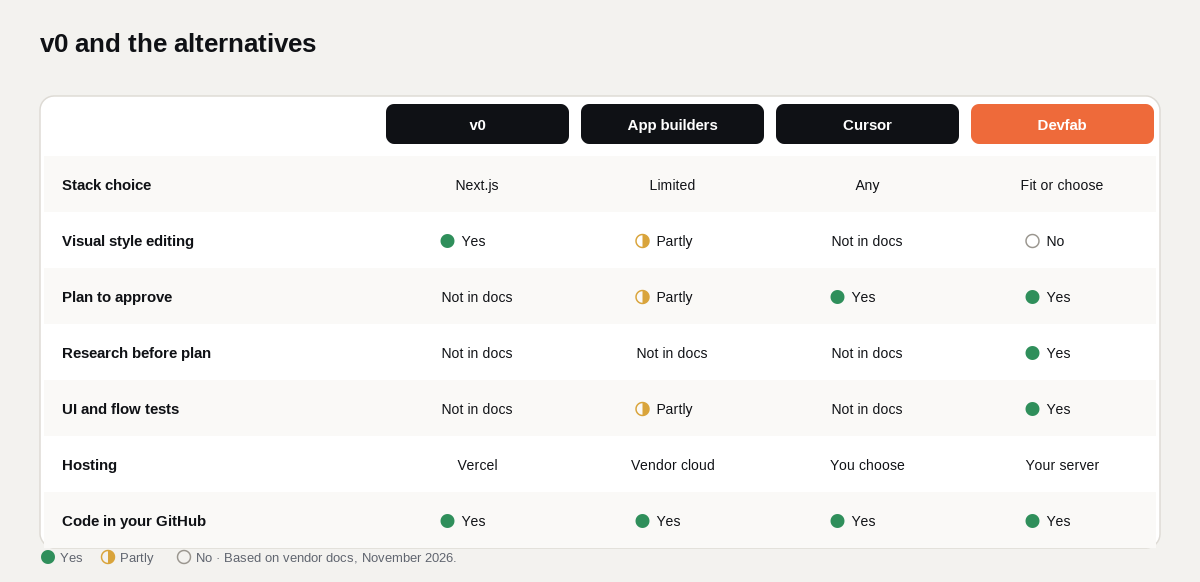
Quick comparison
| Tool | Best at | Stack choice | Testing | Hosting | Pricing model |
|---|---|---|---|---|---|
| v0 (baseline) | UI and Next.js features into your repo | Next.js only | Not covered in the docs we checked | Vercel; export possible | Per user plus credits |
| Lovable | Full-stack web app from prompts | No choice of framework or database | Browser and frontend tests on request; security scan on publish | Lovable or external | Credits, not seats |
| Bolt.new | Zero-setup builds, Figma import, Expo mobile | Web and Expo | Not covered in the docs we checked | Bolt Cloud | Tokens |
| Replit | Cloud IDE plus agent | Many languages | App Testing for JS full-stack and Streamlit | Replit deployments | Plans with credits, effort-based Agent work |
| Google AI Studio | Gemini-powered prototypes | React, Next.js, Angular, Android | Not covered in the docs we checked | Cloud Run | Gemini API free and paid tiers |
| Cursor | Hands-on coding with agents | Any | Bugbot PR review | You choose | Subscription tiers plus usage |
| Devfab | Planned, tested app on your server | Picks a fit, or you choose | QA agent: UI, flow and logic tests | Your own server | Cost logged per task and per project (Beta) |
The alternatives
Lovable
Verdict: the nearest match if you liked v0's prompt-first feel but want the back end built in. Best for: founders and product teams who want login, database and hosting from one product. Trade-off: no choice of framework, database or model. Pricing: Free USD 0; Pro USD 25 per month; Business USD 50 per month, as of November 2026, priced by credits rather than seats.
Lovable generates full-stack web apps with a built-in backend (managed PostgreSQL, login, file storage) or Supabase. Plan mode writes a plan for approval first. It syncs two ways with GitHub on one branch and can download the full codebase as a ZIP on paid plans. Its terms don't allow protected health information or payment card data. See Lovable vs v0.
Bolt.new
Verdict: the quickest way from a Figma frame to a running app, including mobile. Best for: agencies and solo builders who want hosting, auth, database and Stripe bundled. Trade-off: the project stays on main and can't switch branches. Pricing: Free USD 0; Pro USD 25 per month; Teams USD 30 per member per month, as of November 2026.
Bolt runs in the browser on WebContainers and can start from a prompt, Figma, Google Stitch designs, a GitHub repo or a Lovable project. Bolt Cloud handles hosting, databases and server functions, and Expo covers native mobile. Teams tokens are per member and not shared. See Bolt.new vs v0.
Replit
Verdict: a full cloud IDE with an agent, for teams that want to see and edit everything. Best for: builders who want varied runtime shapes (always-on VM, scheduled jobs, autoscale). Trade-off: effort-based pricing for paid Agent work is harder to forecast. Pricing: Starter USD 0; Core USD 20 per month; Pro USD 100 per month, as of November 2026.
Replit's Agent 4 builds, tests and publishes apps; Plan mode produces a task list to approve first. App Testing clicks through the app in a real browser for Full Stack JavaScript and Streamlit apps. Enterprise admins can require private deployments and security scans. Our Replit alternatives page covers it from the other side.
Google AI Studio
Verdict: the free starting point for apps built around Gemini features. Best for: prototypes using image, voice or Live API features with a Firebase backend. Trade-off: no team, SSO or role features described in the Build mode docs. Pricing: part of the Gemini API free plan, with a paid tier billed per token; see Google's pricing page.
Build mode creates web apps (React by default; Next.js and Angular supported) and native Android apps. It can set up Firestore and Firebase Authentication after you approve, deploys to Cloud Run, and syncs two ways with GitHub. API keys are injected server-side and never shipped in client code.
Cursor
Verdict: for engineers who want to take a v0 prototype into their own workflow. Best for: teams with their own CI, hosting and review process. Trade-off: testing, hosting and deploy are yours to set up. Pricing: Free USD 0; Plus USD 8 per month; Premium USD 30 per month; Teams USD 30+ per user per month, as of November 2026.
Cursor is an AI editor with Plan Mode, a CLI, and cloud agents that run in isolated VMs and push branches. Bugbot reviews pull requests for bugs and security issues. Cursor is now a wholly owned subsidiary of SpaceX (deal announced June 16, 2026).
Devfab
Verdict: the choice when a prototype must become a tested app you own and host. Best for: agencies and product teams turning a v0 or Figma prototype into production software. Trade-off: in Beta, no visual Design Mode, not an editor for hands-on coding, needs GitHub. Pricing: predictable cost: cost is logged after each run, per task and per project.
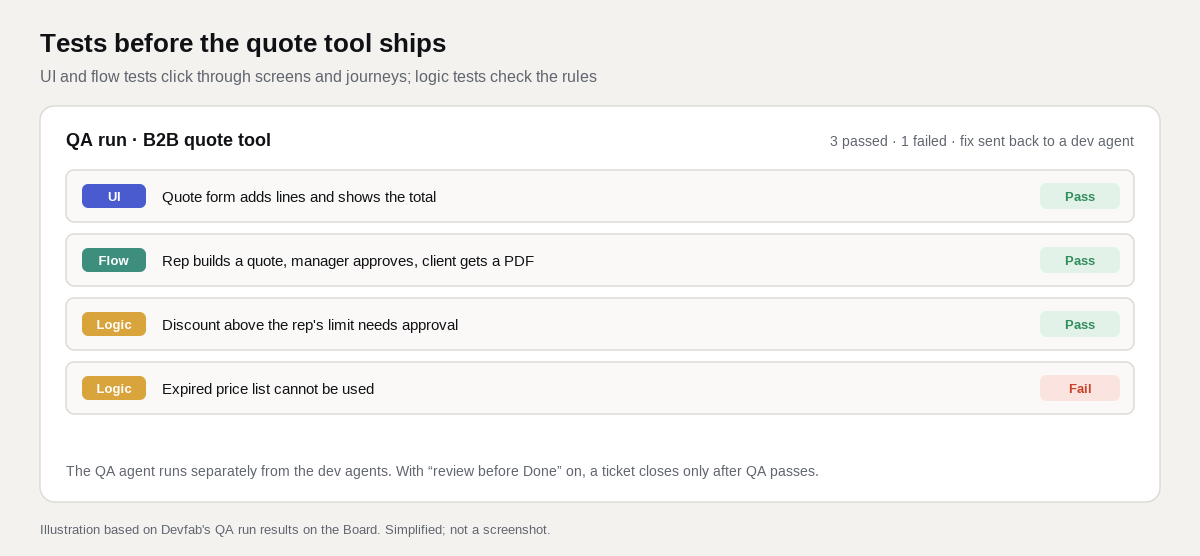
Devfab is an AI software factory. You describe the app (and can attach screenshots of the v0 prototype), and its research step maps the domain first: for a B2B quote tool, terms like price lists and discount tiers, practices like approval limits, and how competing tools work. A person approves the plan before the Coordinator creates tickets. ChainFlow shows which functions and APIs each change affects. The QA agent runs UI and flow tests (screens, buttons and user journeys clicked end to end) plus logic tests. You can choose the model for each agent or keep Devfab's default.
App builders automate the first version. Devfab automates the development lifecycle.
If your v0 code is already in GitHub, choose "Work on an existing project" in Devfab, pick the repo and leave the change box empty; Devfab maps it with ChainFlow and suggests three small first tickets. Read Devfab vs v0 for the full comparison.
Devfab's honest limits: new and in Beta, a smaller community and fewer integrations than v0 and Vercel, no visual editing of styles, and you run the server you deploy to.
Where v0 is still the better choice
- Your team is on Next.js and Vercel, and you want UI and features generated straight into your repo as pull requests.
- Designers want to edit visually. Design Mode writes style changes from the preview back to code.
- Safe repo workflow. v0 works on a branch with per-branch previews and never pushes directly to
main. - shadcn/ui prototypes that engineers keep using as real code.
- Clear ownership. Vercel states it doesn't own the code v0 generates.
How to choose
- Staying on Next.js and Vercel? Stay with v0.
- Need the back end built for you? Lovable or Bolt.new.
- Want a cloud IDE and more hosting shapes? Replit.
- Building around Gemini features? Google AI Studio.
- Engineers taking over the code? Cursor.
- Client or production app with rules, tests and your own server? Devfab. See What is an AI software factory? for how it works.
FAQ
What is the best alternative to v0?
For a hosted full-stack app from prompts, Lovable or Bolt.new. For a cloud IDE with varied hosting options, Replit. For developers who want an editor, Cursor. For a client or production app with plan approval, QA tests and your own server, Devfab.
Can I use v0 without Vercel?
Yes. v0's FAQ says you can export the code and deploy elsewhere; Vercel is needed only for the full experience, such as one-click deploys and per-branch previews.
Is there a v0 alternative that isn't tied to Next.js?
Yes. Google AI Studio supports React, Next.js and Angular and native Android. Bolt.new builds web apps and Expo mobile apps. Devfab picks a stack that fits by default, or lets you choose the languages.
What happened to the v0 Premium plan?
v0's FAQ says the legacy Premium plan is being phased out and isn't available to new users. Current plans are Free, Plus, Business and Enterprise.
Read next
Have a v0 prototype that needs to become a real app? See the plan before any code. Try the Devfab Beta
Sources (checked November 2026): v0 docs introduction; v0 FAQs; v0 pricing; v0 GitHub; v0 Design Mode; Lovable FAQ; Lovable pricing; Intro to Bolt; Bolt Git integration; Bolt pricing; Replit Agent overview; Replit App Testing; Replit pricing; Replit Enterprise; Google AI Studio Build mode; Gemini API pricing; Cursor docs; Cursor pricing; The Next Web: SpaceX makes its Cursor takeover official.
Frequently asked questions
What is the best alternative to v0?
For a hosted full-stack app from prompts, Lovable or Bolt.new. For a cloud IDE with varied hosting options, Replit. For developers who want an editor, Cursor. For a client or production app with plan approval, QA tests and your own server, Devfab.
Can I use v0 without Vercel?
Yes. v0's FAQ says you can export the code and deploy elsewhere; Vercel is needed only for the full experience, such as one-click deploys and per-branch previews.
Is there a v0 alternative that isn't tied to Next.js?
Yes. Google AI Studio supports React, Next.js and Angular and native Android. Bolt.new builds web apps and Expo mobile apps. Devfab picks a stack that fits by default, or lets you choose the languages.
What happened to the v0 Premium plan?
v0's FAQ says the legacy Premium plan is being phased out and isn't available to new users. Current plans are Free, Plus, Business and Enterprise.