Short answer: Use agile for the product: ship small slices, learn from users and change course. Use a short waterfall inside each slice: an agent needs a written spec and an approved plan before it codes, and a test pass after. Pure waterfall still fits fixed-scope, regulated work, now with agents doing the build phase.
You run delivery, and your agents now write code faster than your team can review it. The old debate came back with a twist. One camp says agents need big specs up front, so waterfall wins. The other says agents make change cheap, so agile matters more than ever. Both sides have a point, and both miss where the work moved. This page sorts out which parts of each method still hold.
In this guide, you'll learn:
- What agile and waterfall mean today
- How AI agents change each step
- When to choose agile
- When to choose waterfall
- Where an AI software factory fits
The method you pick matters less than where you put people.
Definitions
Waterfall is "a linear, sequential approach where each phase of a project must be completed before the next one begins" (The Digital Project Manager). The phases usually run from requirements and design through coding, testing, deployment and maintenance (Wikipedia).
The history is often told wrong. Winston Royce's 1970 paper gave the first detailed diagram, but he criticized the pure sequence. He called testing only at the end "risky" and said it invited failure. He proposed extra steps, including involving the customer and doing the job "twice if possible" (same source).
Agile is "an iterative approach to managing projects that focuses on flexibility, collaboration, and continuous improvement" (The Digital Project Manager). The 2001 Agile Manifesto values individuals and interactions over processes and tools, working software over comprehensive documentation, customer collaboration over contract negotiation, and responding to change over following a plan (Agile Manifesto).
Spec-driven development is the new middle ground. GitHub's open-source Spec Kit runs four phases, Specify, Plan, Tasks and Implement, and treats the spec as "a contract for how your code should behave" for agents such as GitHub Copilot, Claude Code and Gemini CLI (GitHub Blog). That is a waterfall order, applied to one piece of work at a time.
Side by side with AI agents
| Step | Waterfall | Agile | What changes when agents code |
|---|---|---|---|
| Requirements | Written in full before design | Captured as a backlog, refined each cycle | The spec becomes the agent's input; vague specs give vague code |
| Planning | One plan for the whole project | Planning each cycle | An agent can draft the plan; a person should approve it |
| Documentation | Heavy, up front | Light, "working software over comprehensive documentation" | Docs are cheap to generate; reviewing them is not |
| Building | One long phase | Small increments | Fast and parallel; cloud agents often open one pull request per task |
| Testing | At the end (Royce's main warning) | Continuous | More code means more to verify; testing must run every loop |
| Change | Expensive late | Expected | Rewriting code is cheap; changing a shared feature still breaks others |
| Who decides | Plan owners at phase gates | Product owner each cycle | Humans own the consequential decisions; agents do the handoffs |
Sources: The Digital Project Manager; Agile Manifesto; Wikipedia: Waterfall model; GitHub Docs: Copilot coding agent; Augment.
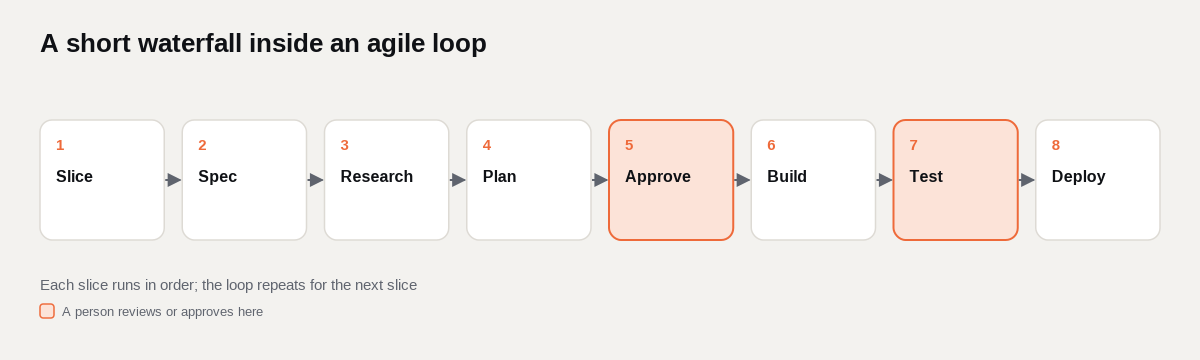
Two things stand out. First, building stopped being the slow step, so the queue moves to the gates: approving plans and checking results. Second, Royce's old warning got louder. If agents produce more code and testing waits until the end, the end gets bigger.
There is also a caution on the spec side. Birgitta Böckeler, writing on Martin Fowler's site, found agents often did not follow the spec, which gave "a false sense of control." She is "very skeptical that lots of up-front spec design is a good idea" and notes that "small, iterative steps" have kept teams in control (martinfowler.com). In short, spec first, but keep the spec small.
When to choose agile
- The product is new and users will surprise you. The Digital Project Manager says agile suits "fast-changing, evolving projects."
- You can ship small slices to real users. Agents make each slice cheap to build, so learn from every one.
- Requirements will move. "Responding to change over following a plan" still applies, and agents make rework cheaper.
- Your reviewers can keep pace with small pull requests, not one giant drop at the end.
- The client wants to see progress, such as a clinic that wants to try online booking before adding reminders and waitlists.
When to choose waterfall
- Scope is fixed and clearly defined up front. The same source lists fixed-scope, predictable and regulated projects.
- The rules come from outside, such as a regulator or a contract that defines every field and report.
- You must sign off documents before any build, for example in public procurement.
- You are porting a known system, where the old app is the spec and the job is to match it.
Even here, don't keep testing at the end. Let agents build in phases, but run the test pass after every phase. That is what Royce asked for in 1970.
The hybrid most teams end up with
Most teams that put agents to work land on a loop like this:
- Pick one slice of the product, such as "patients book and cancel appointments."
- Write a short spec in plain words: users, must-have flows, data, rules, what "done" means.
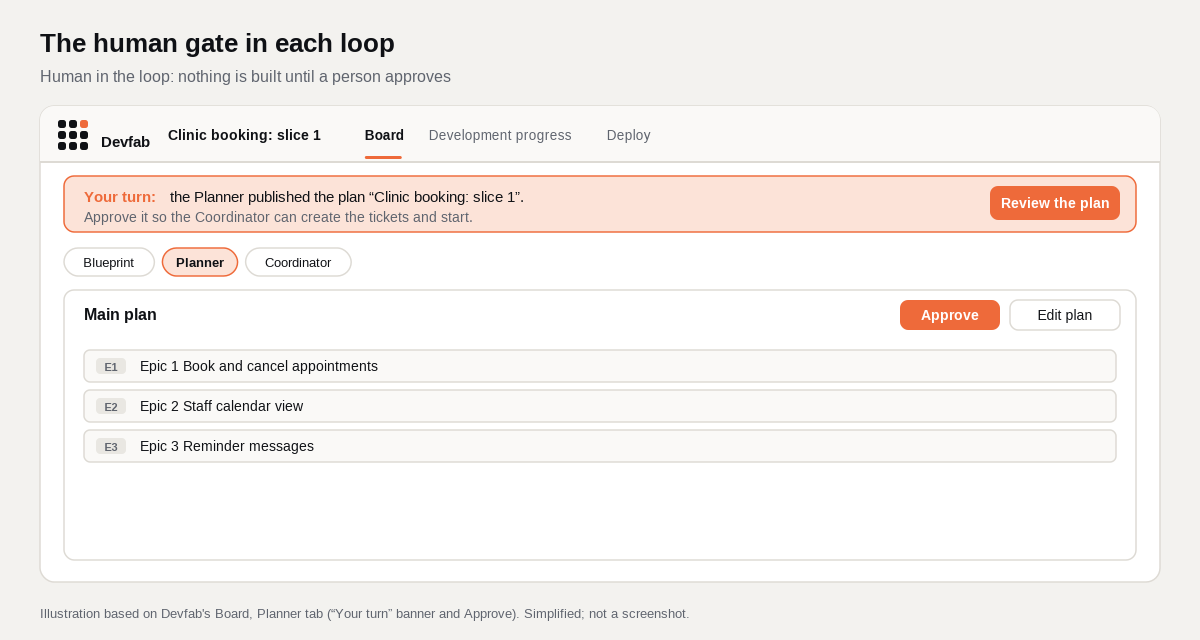
- Draft the plan with an agent, and have a person approve it.
- Split the plan into small tickets and let agents build them in parallel.
- Test the user flows, not just the functions, before merging.
- Ship, learn, and pick the next slice.
Steps 2 to 5 run in a waterfall order. The loop around them is agile. The Digital Project Manager calls this kind of blend a hybrid: upfront planning with iterative execution.
Where an AI software factory fits
The hybrid loop has many handoffs, and handoffs are where things slip. A software factory puts each handoff on one line. Augment describes it as work moving across requirements, ticket, PR and production, with specialized agents at each step while humans own consequential decisions (Augment).
Coding agents automate the developer. Devfab automates the development lifecycle. Each slice starts with the Researcher, which maps the domain, key terms, best practices and competitors before the Planner writes a plan. A person approves the plan in Human in the loop mode, and the Coordinator splits it into tickets for dev agents. ChainFlow maps which functions and APIs call each other, so a change to booking shows its impact on reminders, payments and the staff calendar. The QA agent runs UI and flow tests plus logic tests, and Deploy ships to your own server. Cost is logged after each run, per task and per project, so each slice has a visible cost.
Devfab is in Beta, with a smaller community and fewer integrations than mature platforms, and it is not an editor for hands-on coding. If your team already has a strong agile process and only wants faster coding, a coding agent may be enough.
FAQ
Is waterfall back because of AI coding agents?
Partly, but only inside each small piece of work. Agents need a clear spec and plan before they write code, which looks like waterfall. Spec-driven toolkits such as GitHub's Spec Kit run Specify, Plan, Tasks and Implement in order. But teams still ship in short increments and change course, which is agile.
Do AI agents make agile sprints obsolete?
No. They change what fills a sprint. When code is cheap to produce, the scarce work is deciding what to build, approving plans and checking results. The agile values of working software and responding to change still apply; the review and test steps just get more of the team's attention.
What did Winston Royce actually say about waterfall?
His 1970 paper is often cited as the source of waterfall, but he criticized the pure version. He said testing only at the end was risky and invited failure, and he proposed extra steps, including involving the customer and doing the job twice if possible.
How should a team plan work for AI coding agents?
Write a short spec for one slice of the product, have a plan drafted and approved by a person, split it into small tickets, let agents build, then test the user flows before you merge. Repeat for the next slice. Keep each spec small enough that a reviewer can read it.
Read next
- What is an AI software factory?
- Spec-driven development vs vibe coding
- How to review a plan written by an AI agent
- Agentic SDLC: how planner, coordinator, dev and QA agents work together
- Best spec-driven development tools
Run each slice through research, an approved plan and QA. Try Beta
Sources (checked November 2026): Agile Manifesto (2001); The Digital Project Manager: Agile vs waterfall (updated May 15, 2026); Wikipedia: Waterfall model; GitHub Blog: Spec-driven development with AI (Sep 2, 2025); martinfowler.com: Understanding Spec-Driven Development (Oct 15, 2025); GitHub Docs: About Copilot coding agent; Augment: How we built Augment's software factory (Sep 2026).
Frequently asked questions
Is waterfall back because of AI coding agents?
Partly, but only inside each small piece of work. Agents need a clear spec and plan before they write code, which looks like waterfall. Spec-driven toolkits such as GitHub's Spec Kit run Specify, Plan, Tasks and Implement in order. But teams still ship in short increments and change course, which is agile.
Do AI agents make agile sprints obsolete?
No. They change what fills a sprint. When code is cheap to produce, the scarce work is deciding what to build, approving plans and checking results. The agile values of working software and responding to change still apply; the review and test steps just get more of the team's attention.
What did Winston Royce actually say about waterfall?
His 1970 paper is often cited as the source of waterfall, but he criticized the pure version. He said testing only at the end was risky and invited failure, and he proposed extra steps, including involving the customer and doing the job twice if possible.
How should a team plan work for AI coding agents?
Write a short spec for one slice of the product, have a plan drafted and approved by a person, split it into small tickets, let agents build, then test the user flows before you merge. Repeat for the next slice. Keep each spec small enough that a reviewer can read it.