Short answer: For a vendor-backed agent with admin controls and support, pick Claude Code. For open source with sandboxed runs and team plans, pick OpenHands. For the closest like-for-like local agent, pick OpenCode. If the gap is the project process, not the agent, Devfab runs research, plan approval, QA and deploy as one line.
You run IT for a nonprofit, and a developer built your grant application portal with goose on their laptop. It worked. Then the auditor asked who supports the tool, where the agent ran and what stopped it touching production credentials. A September 2026 review of goose answers bluntly: no default sandbox per run, no built-in model, community-only support with no SLA, and no IDE-embedded assistant (PromptQuorum). Those are fair trade-offs for a free tool. They are also why teams shop around.
In this guide, you'll learn:
- Why teams leave goose
- The alternatives in one table
- Where goose is still the better choice
- How to choose
Each alternative below fixes one of those gaps, and none fixes all of them.
Why teams leave goose
Status first: goose changed owners, not direction. goose moved from Block to the Agentic AI Foundation (AAIF) at the Linux Foundation; the repository moved from block/goose to aaif-goose/goose and the docs to goose-docs.ai, per a post dated April 7, 2026 (goose blog). It is active: v1.58 and v1.59, released November 9–14, 2026, added a context window viewer, deferred MCP tools and resumable subagent delegates (goose releases). It remains free under Apache 2.0, with 15+ model providers and 70+ extensions via MCP (goose README).
The reasons teams look elsewhere come from how goose is built:
- No default sandbox per run. The agent works on your machine unless you set up isolation (PromptQuorum).
- No built-in model. You pay a model provider or run local models through Ollama (goose docs; same review).
- Community support only, no SLA (same review). Foundation governance is good for longevity, not for a contract.
- Not inside the IDE (same review). goose is a desktop app, a CLI and an API.
- It is an agent, not a process. Recipes and subagents automate work, but planning, approval, QA and deployment are up to you (goose docs).
Quick comparison
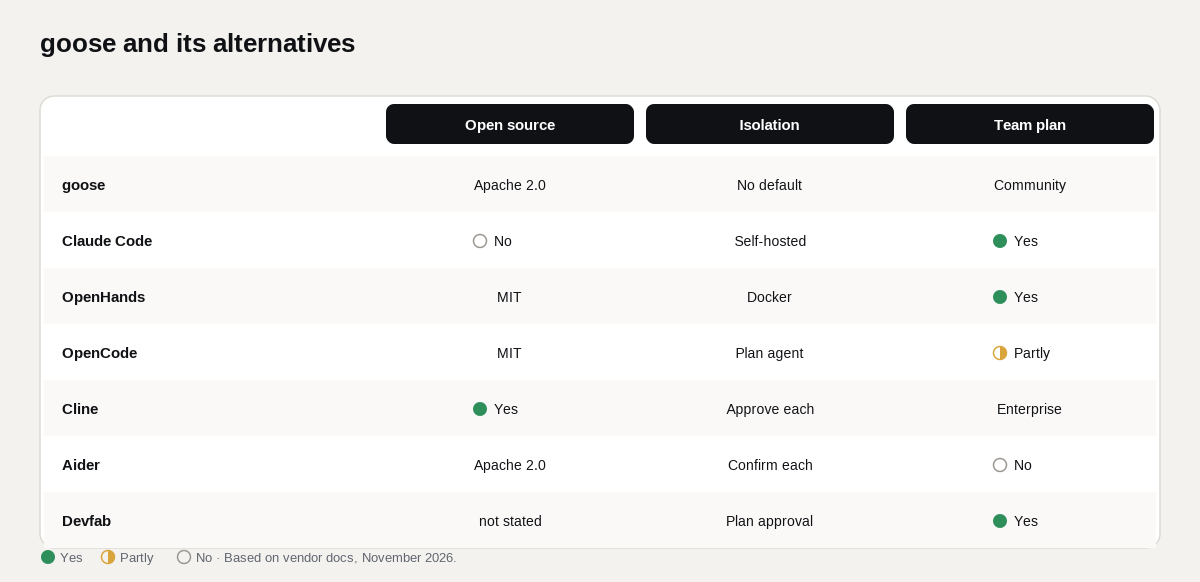
| Tool | Type | Open source | Where it runs | Isolation | Team and admin | Pricing (as of November 2026) |
|---|---|---|---|---|---|---|
| goose | General-purpose agent | Apache 2.0 | Desktop app, CLI, API | No default sandbox per run (review) | Community support | Free; pay your model provider |
| Claude Code | Coding agent | No | Terminal, IDEs, desktop, web, mobile | Cloud sessions can run on self-hosted environments | SSO on Team; roles on Enterprise | Pro USD 20 per month; Team Standard USD 25 per user per month |
| OpenHands | Agent workspace | MIT | Agent Canvas, local or cloud | Optional Docker container per conversation | Teams: RBAC, SSO/SAML | Free self-hosted; Teams USD 500 per month for 10 users |
| OpenCode | Coding agent | MIT | Terminal, desktop, mobile, SDK | Read-only plan agent | Workspaces with per-member budgets (Zen) | Free agent; OpenCode Go from USD 10 per month |
| Cline | Coding agent in the editor | Open source | VS Code, JetBrains, CLI, desktop | Every action needs approval | Enterprise: SSO, RBAC, audit logs | Free for individuals; Enterprise custom |
| Aider | Terminal pair programmer | Apache 2.0 | Terminal, browser | User confirms each step | No team features | Free; pay your model provider |
| Devfab | Software factory | Not stated | Devfab workspace | A person approves the plan | Roles, workspace permissions, delivery report | Cost logged per task and per project (Beta) |
The alternatives
1. Claude Code
Verdict: the pick when you want a vendor contract, admin controls and one agent across every surface. Best for: engineering teams that can standardize on one model family. Trade-off: Claude models only, switchable with /model (Claude Code costs). goose lets you pick from 15+ providers. Pricing: included in paid Claude plans: Pro USD 20 per month; Team Standard USD 25 per user per month (USD 20 billed annually); Team Premium USD 125 per user per month; Enterprise USD 20 per seat per month billed annually plus usage, as of November 2026 (Claude pricing).
- Runs in the terminal, VS Code, JetBrains, a desktop app, the web and the Claude mobile apps (Claude Code overview).
- Plan mode explores the codebase and proposes an approach for approval before editing (Claude Code costs).
- Team includes SSO and server-managed settings; security teams can set managed permissions that local config cannot override (Claude Code enterprise).
- Cloud sessions can run on self-hosted environments (same source).
2. OpenHands
Verdict: the open-source answer to goose's sandbox and team gaps. Best for: teams that want governed agents in their own environment, with isolation per conversation. Trade-off: you run and govern the agents yourself, and the Teams plan is capped at 5,000 sessions per month (OpenHands blog; OpenHands pricing). Pricing: Open Source USD 0 self-hosted; Teams USD 500 per month flat for 10 users plus USD 50 per extra seat; Enterprise custom, as of November 2026 (same source).
- MIT-licensed; the homepage showed 93.8K GitHub stars on November 20, 2026 (OpenHands).
- Agent Canvas, launched June 16, 2026, is its main interface, with backends from local and Docker to Kubernetes and enterprise VPCs (OpenHands blog).
- An optional Docker runtime gives each conversation its own isolated container (OpenHands blog).
- It can run Claude Code and Codex as harnesses via the Agent Client Protocol, much as goose can use ACP agents (OpenHands blog).
3. OpenCode
Verdict: the closest like-for-like swap: free, local, model-agnostic. Best for: developers who want goose's freedom with a terminal UI, desktop app and mobile app. Trade-off: a June 2026 review reports heavy memory use, frequent releases that sometimes break features and permissive default permissions (rywalker.com). Pricing: the agent is free; OpenCode Go starts at USD 10 per month, as of November 2026 (OpenCode).
- MIT license, 225.7k GitHub stars; the repo moved to anomalyco/opencode (GitHub).
- 200+ providers via Models.dev, including local models (OpenCode).
- A read-only "plan" agent denies edits by default and asks before bash commands (GitHub).
- Zen workspaces add member invites, model enablement and per-member budgets (OpenCode Zen).
4. Cline
Verdict: the pick when developers want the agent inside the editor, with a human approving every step. Best for: VS Code and JetBrains users who want Plan and Act modes. Trade-off: seven or more staff left for OpenAI in January 2026, reported as a continuity challenge (TEXXR). Pricing: free for individual developers, with inference billed separately; Enterprise custom; no plan prices shown, as of November 2026 (Cline pricing).
- Runs in VS Code, JetBrains, a CLI, a desktop app and a Kanban board for parallel agents (Cline docs).
- Every action requires your approval (same source).
- Plan mode reads and discusses without editing; Act mode executes the plan (Cline Plan and Act).
- Enterprise adds SSO, RBAC, audit logs and provider restrictions (Cline pricing).
5. Aider
Verdict: the smallest, most transparent option for one developer in a terminal. Best for: cost-conscious developers who want git commits for every change and any model. Trade-off: slow-moving: the latest PyPI release is 0.86.2 from February 12, 2026, and a dated review calls it effectively "dormant" (PyPI; CodeMySpec). Pricing: free and open source; you pay your model provider (same sources).
- Apache-2.0, 49.8k GitHub stars (GitHub).
- Builds a repo map of your git repository for context (Aider docs).
- Lints and tests after each change and commits automatically (same source).
- No native MCP support and no team features (CodeMySpec), which goose does have.
6. Devfab
Verdict: not a swap for goose; the pick when the missing piece is the project process around the agent. Best for: agencies and IT teams that ship client or public-facing apps and need a plan, tests and deployment on record. Trade-off: in Beta, with a smaller community and fewer integrations; not an editor for hands-on coding; needs a GitHub account. Pricing: predictable cost; cost is logged after each run, per task and per project.
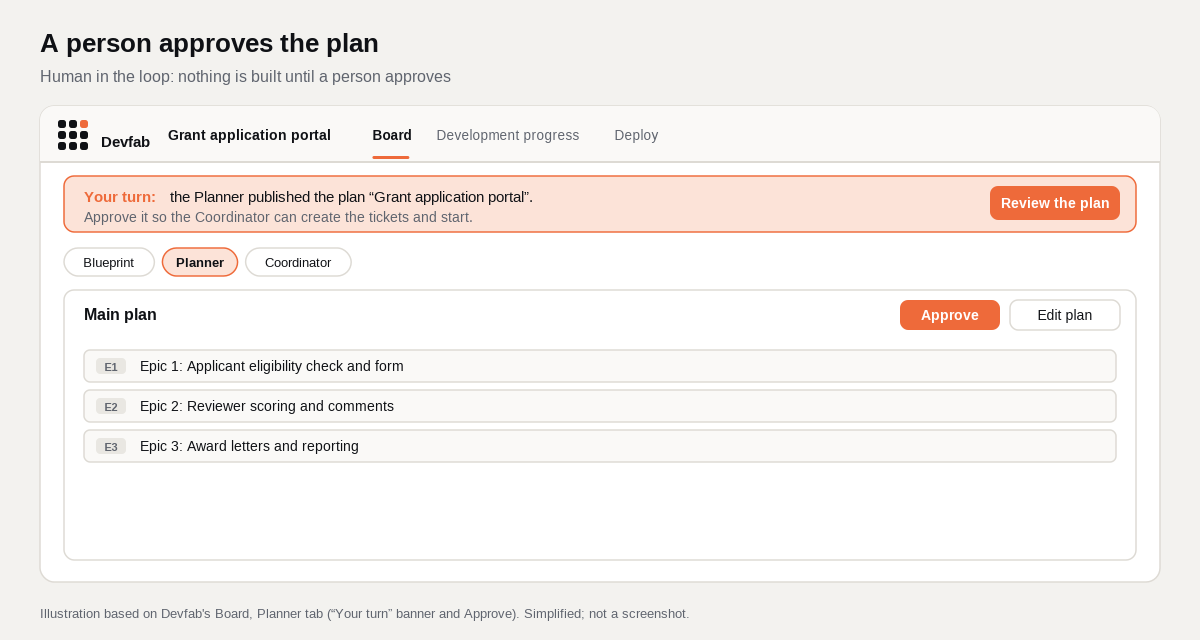
Coding agents automate the developer. Devfab automates the development lifecycle. goose and the tools above each make one developer faster. Devfab's Researcher maps the domain first, such as eligibility rules and reporting duties for a grant portal, then suggests a prototype. The Planner writes a plan, and a person approves it. The Coordinator creates tickets, dev agents build with ChainFlow so they see what a change touches, the QA agent runs UI, flow and logic tests, and Deploy ships to your own server. You can choose the model for each agent or keep Devfab's default.
Where goose is still the better choice
- You want it free and fully under your control. Apache 2.0, foundation-governed, with any of 15+ providers or local models.
- You want to build your own agent product. Custom distributions with preset providers, extensions and branding are supported (goose README).
- Your work isn't only code. goose covers research, writing, automation and data analysis too (same source).
- You want shareable automation. Recipes save workflows as portable YAML you can run in CI (goose docs).
- You already pay for a model subscription. goose can use existing Claude, ChatGPT or Gemini subscriptions via ACP (goose README).
How to choose
- Need a vendor, SSO and support: Claude Code.
- Need open source plus isolation and team seats: OpenHands.
- Want goose's freedom with a different interface: OpenCode.
- Want the agent in your editor, approving each step: Cline.
- Want the smallest tool for one developer: Aider.
- Need research, an approved plan, QA and deployment for client work: Devfab.
FAQ
Who maintains goose now?
The Agentic AI Foundation at the Linux Foundation. goose was created at Block and moved to the foundation in April 2026; the repository moved from block/goose to aaif-goose/goose and the docs to goose-docs.ai. It is still active, with releases v1.58 and v1.59 shipped in mid-November 2026.
What is the closest alternative to goose?
OpenCode. Both are free, open-source agents that run on your machine, work with many model providers including local models, and support MCP. OpenCode is MIT-licensed and offers a terminal UI, desktop and mobile apps. goose is Apache 2.0 and adds portable YAML recipes and an embeddable API.
Which goose alternative runs agents in a sandbox?
OpenHands. Its optional Docker conversation runtime gives each conversation its own isolated container, and its backends include local, Docker, remote VMs, Kubernetes and enterprise VPCs. A September 2026 review noted that goose has no default sandbox per run.
Is Devfab an open-source agent like goose?
No. Devfab is a Software Factory, not a single agent you run on your laptop. It runs research, a plan a person approves, build, QA and deploy as one line, and the code lives in your own GitHub account. If you want a free local agent you control fully, goose or OpenCode fits better.
Read next
- What is an AI software factory?
- Devfab vs goose
- goose vs Claude Code
- Best open-source AI coding agents
- OpenCode alternatives
Need the process around the agent, not another agent? Try Beta
Sources (checked November 2026): goose moves to AAIF (goose blog, Apr 7, 2026); goose docs; goose README; goose releases; PromptQuorum: goose review (Sep 12, 2026); Claude Code overview; Claude Code: enterprise deployment; Claude Code: manage costs; Claude pricing; OpenHands homepage; OpenHands pricing; Introducing Agent Canvas (Jun 16, 2026); OpenHands in September (Oct 7, 2026); OpenCode homepage; anomalyco/opencode on GitHub; OpenCode Zen docs; rywalker.com: OpenCode research note (Jun 2026); Cline docs; Cline Plan and Act; Cline pricing; TEXXR: OpenAI hires seven employees from Cline (Jan 29, 2026); Aider docs; Aider-AI/aider on GitHub; aider-chat on PyPI; CodeMySpec: Aider in 2026.
Frequently asked questions
Who maintains goose now?
The Agentic AI Foundation at the Linux Foundation. goose was created at Block and moved to the foundation in April 2026; the repository moved from block/goose to aaif-goose/goose and the docs to goose-docs.ai. It is still active, with releases v1.58 and v1.59 shipped in mid-November 2026.
What is the closest alternative to goose?
OpenCode. Both are free, open-source agents that run on your machine, work with many model providers including local models, and support MCP. OpenCode is MIT-licensed and offers a terminal UI, desktop and mobile apps. goose is Apache 2.0 and adds portable YAML recipes and an embeddable API.
Which goose alternative runs agents in a sandbox?
OpenHands. Its optional Docker conversation runtime gives each conversation its own isolated container, and its backends include local, Docker, remote VMs, Kubernetes and enterprise VPCs. A September 2026 review noted that goose has no default sandbox per run.
Is Devfab an open-source agent like goose?
No. Devfab is a Software Factory, not a single agent you run on your laptop. It runs research, a plan a person approves, build, QA and deploy as one line, and the code lives in your own GitHub account. If you want a free local agent you control fully, goose or OpenCode fits better.